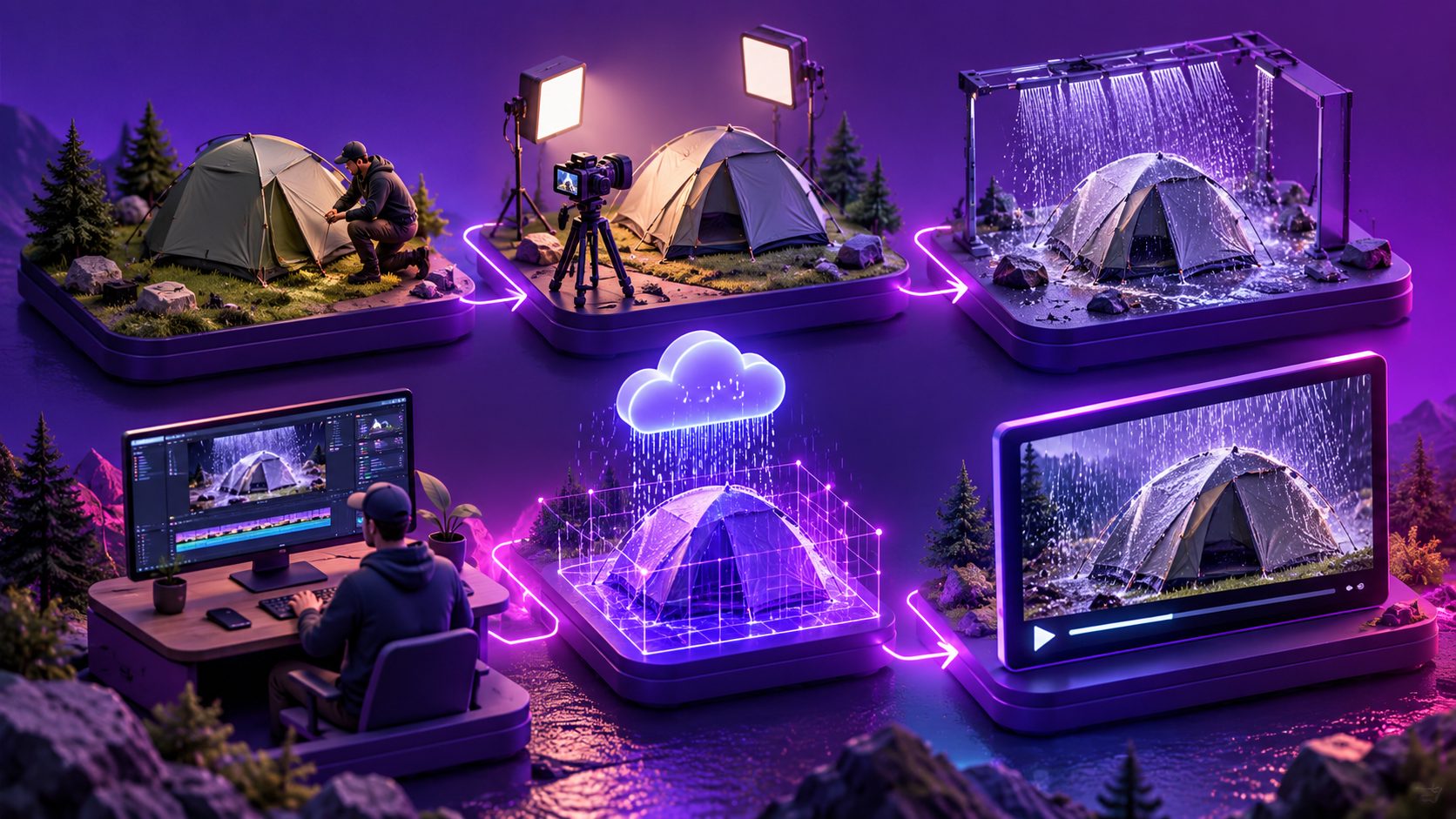
Camping Tarp Wind Resistance Test Video Ad: A Proof-First Guide


Summarize with
Summary
Build a camping tarp wind resistance test video ad with measured footage, pull-test context, and a 30-second storyboard. Plan a credible shoot.
By adsturbo.ai | Published 2026-10-26 | Updated 2026-10-26
A camping tarp wind resistance test video ad should connect a visible product response to a documented test condition—not simply show fabric flapping beside a fan. Film the setup, measured airflow, tie-out behavior, and post-test inspection, then edit those records into a concise product story.
This guide provides a proposed filming protocol and an original Condition–Response–Limit framework. It does not report completed physical tests or invent wind ratings.
What makes a tarp wind-test ad credible?
A credible tarp wind-test ad shows three things together: the conditions applied, the shelter’s response, and the limits of the conclusion. A dramatic shot alone cannot tell viewers which pitch, anchors, exposure duration, or wind direction produced the result.
Use this editorial framework to decide what belongs on screen:
| Evidence layer | What to capture | What it prevents |
|---|---|---|
| Condition | Product model, pitch dimensions, anchors, airflow measurement, duration | An unexplained performance number |
| Response | Fabric movement, pole deflection, tie-out behavior, anchor movement | Selective close-ups that conceal the system |
| Limit | Tested configuration, sample count, inspection findings | A demonstration becoming a universal promise |
For example, “remained standing during this recorded test” is narrower than “stormproof.” Neither phrase should appear unless the evidence supports it. The FTC requires advertisers to possess a reasonable basis for objective claims before publishing them; implied claims count too. (ftc.gov)
How should you plan wind-tunnel and pull-test footage?
Plan two separate demonstrations: one showing the assembled shelter under measured airflow, and another examining a defined attachment under tensile load. Do not present a tie-out pull result as a whole-shelter wind rating. Give each test its own method, footage, and conclusion.
Commission qualified test personnel to establish loads, fixtures, exclusion zones, and stopping criteria. Do not improvise destructive testing at an occupied campsite.
Use this proposed production sequence:
- Identify specimens. Assign IDs to three production units as a planning baseline—not a certification sample size.
- Document the pitch. Record ridge height, footprint, guyline arrangement, anchors, and initial condition.
- Agree on exposures. Have the operator define airflow levels, directions, durations, and repeat runs.
- Record measurements. Capture instrument placement, readings, and synchronized footage.
- Inspect afterward. Photograph seams, reinforcement patches, poles, and attachments.
Ferrino’s wind-tunnel account describes testing assembled tents, including evaluation of carbon poles. That illustrates the value of system-level footage, but its results cannot establish performance for a different tarp. (ferrino.com)
Which measurements belong in the evidence record?
Keep a record that lets an editor trace every performance statement to a specific specimen and recording. Separate measured values from observations, and preserve unsuccessful runs. A blank field should remain blank until the test operator supplies the result.
The following is a reporting template, not test data:
| Field | What to enter |
|---|---|
| Specimen and configuration | Unit ID, model, pitch, anchor system |
| Airflow | Measured speed, units, direction, instrument position |
| Exposure | Duration, steady or varying flow, run ID |
| Pull-test method | Fixture, attachment location, loading direction and rate |
| Result | Recorded load, observed movement, damage, stopping reason |
| Evidence reference | Original video filename and timecode |
For the ad, show only the most relevant measurements; place the fuller method on the product page. FTC guidance emphasizes that omissions can mislead when they leave consumers with a materially incorrect impression. A large speed number with an unreadable qualification is therefore a poor editorial choice. (ftc.gov)
What should a 30-second storyboard show?
A useful storyboard moves from a buyer’s question to visible evidence, then ends with a bounded conclusion and a clear next step. The example below allocates 30 seconds without inventing a result. Replace bracketed fields only after reviewing the completed test record.
| Time | Footage | Voiceover or on-screen copy |
|---|---|---|
| 0–3 seconds | Wide view of the actual test | “What happens when wind loads this tarp?” |
| 3–7 seconds | Pitch, anchors, specimen label | “Here is the configuration we tested.” |
| 7–14 seconds | Continuous wide shot plus measured airflow | “[Measured speed] for [duration], from [direction].” |
| 14–20 seconds | Separately labeled pull-test footage | “Tie-out test: [method and recorded result].” |
| 20–26 seconds | Post-test inspection | “[Observed outcome]. Tested configuration shown.” |
| 26–30 seconds | Product and setup details | “Explore the tarp and review the test method.” |
Keep the wide shot available whenever close-ups appear. The viewer should understand where the detail sits within the shelter.
For another evidence-led visual approach, adapt the macro-detail product authentication framework to show stitching and reinforcement without implying that appearance proves strength.
Where can AdsTurbo help without changing the evidence?
Use AI tools for assembly, captions, and localization—not to manufacture performance evidence. Preserve original test clips and readings as the factual foundation. Keep generated lifestyle scenes visibly separate from the test sequence so viewers do not mistake a visualization for a recorded event.
AdsTurbo supports Clip by Clip editing, video translation, and automated time-synchronized subtitles. Its Video Subtitle tool can export either a captioned video or a separate subtitle file. These capabilities can support an edit built around authentic test footage.
A practical workflow is:
- Select the documented test segments.
- Assemble the hook, setup, result, and inspection.
- Add readable measurement labels and qualifications.
- Translate narration and subtitles without strengthening the claim.
- Compare every version against the original evidence record.
Do not use generated motion or reconstruction as proof of fabric behavior. For mobile readability, apply the Instagram Reels safe-zone layout guide when positioning measurements and subtitles.
How should you test creative variations?
Test the presentation of the evidence, not competing versions of the truth. Keep the product configuration, result, qualifications, audience, and landing page consistent while changing one creative element. This makes the comparison easier to interpret without creating contradictory performance messages.
Start with three proposed hooks:
- Measurement-first: Open with the instrument and the matching wide shot.
- Detail-first: Open with a reinforced attachment, then show its recorded test.
- Question-first: Ask what was tested, then reveal the configuration.
Define the primary business metric before launch, such as purchases or qualified product-page visits. Treat attention metrics as diagnostic rather than proof that shoppers understood the claim.
Also review comments for interpretation errors. If viewers infer an all-weather guarantee, revise the ad rather than treating engagement as success. FTC substantiation policy covers reasonable implied claims, not only the exact words in the script. (ftc.gov)
Frequently asked questions
Can a fan demonstration be called a wind-tunnel test?
Label it a fan demonstration unless the facility and operator can substantiate the wind-tunnel description. Record what was actually done rather than borrowing a more authoritative label.
How many tarps must be tested?
There is no sample count established by this article. Three units are a proposed production-planning baseline only. A qualified testing provider should determine what evidence is appropriate for the intended claim.
Can a pull-test result become a wind-speed rating?
Not on its own. This framework treats attachment loading and assembled-shelter exposure as separate evidence. Do not publish a conversion unless a qualified specialist validates the method and its applicability.
What if no physical testing has been completed?
Make a setup or feature-demonstration video instead. Show construction and pitching details without inventing resistance figures or implying verified storm performance.
Build the creative around evidence you can show. Explore adsturbo.ai for the editing, subtitle, and localization workflow.