

By adsturbo.ai | Published 2026-10-09 | Updated 2026-10-09
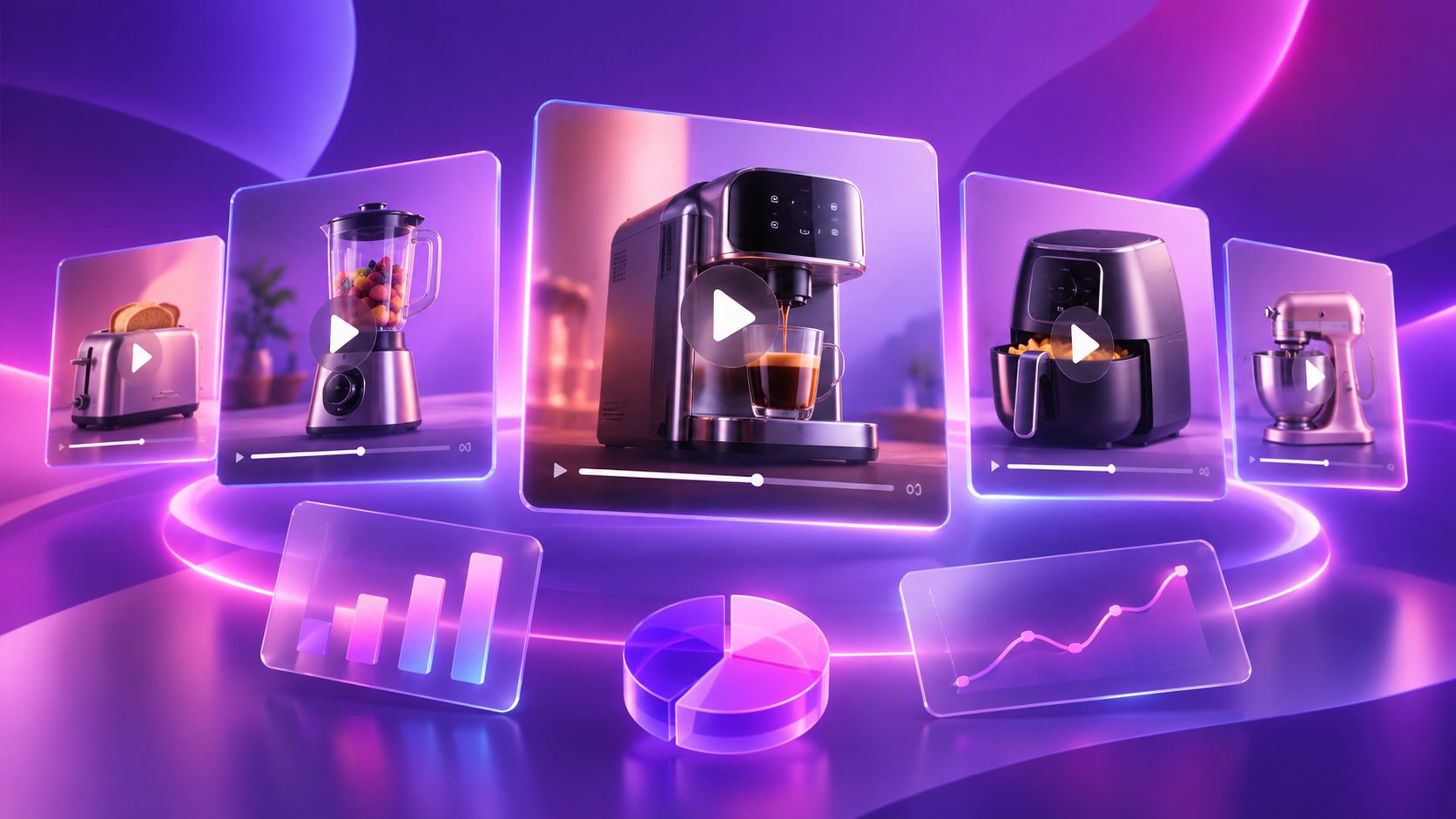
Kitchen appliance video ads multi SKU creative testing works best when every video answers one clear question: which product, promise, proof, or presentation gives shoppers the strongest reason to act? Instead of producing random variations, sellers can build a structured matrix around each SKU, then test controlled creative differences across TikTok, Meta, Amazon, and Shorts.
This guide presents a practical system for turning product photos, selling points, and reference videos into a repeatable testing pipeline.
What is multi-SKU creative testing for kitchen appliance ads?
Multi-SKU creative testing is a method of comparing video ads across several product models while keeping the test logic consistent. Each SKU receives a defined creative brief, proof sequence, audience angle, and platform format before production begins.
The key distinction is between testing products and testing creative variables:
- Product testing asks which appliance attracts demand.
- Angle testing asks which benefit motivates shoppers.
- Hook testing asks which opening earns attention.
- Proof testing asks which demonstration builds confidence.
- Format testing asks where the same message performs best.
For example, a seller with three countertop blenders should not create three unrelated videos. A better setup is to give each blender the same testing structure while allowing its strongest product-specific proof to lead.
A recent Amazon Ads case involving Cuisinart illustrates why production speed matters. In a controlled comparison, an AI-generated food processor video delivered an 18-point higher detail page view rate, a 14% lower cost per detail page view, and a 10-point higher branded search rate than a traditionally produced creative. The test used identical audience segments, bid strategies, and optimization conditions for approximately 30 days. (advertising.amazon.com)
Which creative variables should appliance sellers test first?
Start with variables that change the shopper’s interpretation of the product, not cosmetic edits such as font color or minor transitions. For kitchen appliances, the strongest first-round variables are usually problem, proof, result, and user context.
| Test layer | Version A | Version B |
|---|---|---|
| Hook | “Dinner takes too long?” | “One appliance, three prep steps” |
| Product proof | Close-up of controls | Demonstration of the finished result |
| Audience | Busy parents | Small-apartment cooks |
| Benefit | Faster preparation | Easier cleanup |
| Social proof | Review-style narration | Expert-style explanation |
| CTA | Shop the model | Compare available sizes |
A useful rule is to change one major variable per test cell. If the hook, actor, soundtrack, offer, product angle, and CTA all change at once, the result becomes difficult to interpret.
TikTok’s shopping guidance also emphasizes matching creative content to catalog and SKU information, while its testing materials recommend separating variables such as creative, audience, and bidding instead of changing everything simultaneously. (ads.tiktok.com)
How should you build a kitchen appliance creative matrix?
Build the matrix from the SKU outward. Each row should represent one product model, while each column represents a customer question or proof requirement.
Step 1: Create a SKU source pack
For every appliance, collect:
- Product name and exact model number.
- Approved product images.
- Primary use case.
- Three to five verified selling points.
- Product limitations or claims that require caution.
- Available discounts, bundles, or shipping information.
- Target customer segment.
- Preferred destination page.
A clean product photo is especially important for AI production. AdsTurbo Product Image accepts JPG and PNG product images, with clear photos on plain backgrounds producing the best results. The tool can analyze product shape, color, and category, then produce formats suitable for channels such as Amazon, Shopify, TikTok Shop, and Instagram.
Step 2: Assign one dominant job to each video
A short appliance ad should not explain every feature. Assign each video one job:
- Demonstrate speed.
- Show capacity.
- Prove texture or output quality.
- Reduce cleanup concerns.
- Compare compactness.
- Explain controls.
- Introduce a seasonal offer.
- Show the product in a realistic kitchen routine.
This creates a stronger learning loop than making one “everything video” for every SKU.
Step 3: Map proof to the product category
Different appliances require different visual evidence.
| Appliance type | Best proof sequence |
|---|---|
| Air fryer | Ingredients → cooking action → finished texture |
| Blender | Ingredients → blending movement → smooth result |
| Coffee maker | Setup → pour action → serving moment |
| Food processor | Attachment → preparation step → output consistency |
| Electric kettle | Water fill → heating cue → controlled pour |
| Stand mixer | Ingredient addition → mixing action → finished dough |
This proof-first approach is an original operating principle for the workflow: the creative angle should follow the product’s visible mechanism. If a product’s advantage cannot be shown clearly within a few seconds, use a comparison, close-up, or user-context angle instead of forcing a generic lifestyle scene.
What is the recommended batch production workflow?
A practical production sequence is:
- Rank SKUs by test priority. Start with products that have sufficient inventory, a clear offer, and a visible use case.
- Create two to four hypotheses per SKU. Use different customer problems or benefits, not superficial edits.
- Select one control concept. This can be the existing best-performing ad or the clearest product demonstration.
- Generate short-form variants. Keep the product, offer, and landing page consistent when testing hooks.
- Add platform versions. Prepare 9:16 for TikTok and Reels, 1:1 for feeds, and 16:9 where required.
- Review product fidelity. Check buttons, attachments, colors, proportions, packaging, and on-screen claims.
- Launch a controlled test. Keep audience, objective, and bidding approach stable where possible.
- Record the result. Save the hypothesis, asset ID, SKU, spend context, primary metric, and next action.
AdsTurbo supports product video generation from JPG or PNG product images, with optional selling points and promotional information. Its tools also include ad cloning, motion control, lip sync, character replacement, video translation, AI upscaling, background replacement, and subtitles. This allows one approved product pack to support multiple creative jobs without rebuilding the entire workflow manually.
For sellers working alone, a structured solo ecommerce video ads workflow can reduce production friction before the first test begins.
How many videos should each SKU receive?
A useful minimum test pack is six videos per priority SKU:
- Two hook variations.
- Two proof or benefit variations.
- One user-context variation.
- One offer or CTA variation.
For example, four priority SKUs create a 24-video first-round library. That does not mean all 24 should launch at once. Organize them into waves so the team can learn from the first group before spending more on later variations.
A practical naming system is:
SKU_Hook_Proof_Audience_Format_Version
Example:
BLENDER01_Speed_DrinkResult_BusyParent_9x16_V2
This makes reporting, iteration, and asset retrieval easier when multiple models look similar.
How should results be evaluated?
Evaluate performance in stages rather than relying on one metric.
Stage 1: Attention
Review thumb-stop rate, three-second views, hold rate, or the platform’s closest available attention metric. Weak performance usually points to the hook, first frame, or unclear product identity.
Stage 2: Consideration
Review outbound click-through rate, detail page views, landing-page engagement, and product-page interaction. A video may attract attention but fail to communicate what the appliance does.
Stage 3: Purchase intent
Review add-to-cart rate, checkout starts, purchases, cost per purchase, and return on ad spend. Compare these with product price, margin, and inventory position.
The most useful conclusion is not simply “Video B won.” Record why it won:
- The result appeared earlier.
- The product was recognizable in the first frame.
- The demonstration answered a common objection.
- The audience matched the use case.
- The CTA aligned with the landing page.
For broader campaign operations, a weekly TikTok ecommerce creative production workflow can help turn winning patterns into a recurring refresh cycle.
How can sellers scale winning appliance creatives?
Scale the winning creative logic, not just the winning file. If a “fast cleanup” angle works for one blender, adapt the same logic to related models while changing the product proof. If a compactness angle wins for a kettle, test it against smaller kitchens, dorm rooms, or office users.
AdsTurbo Ad Clone can analyze a reference video of up to 12 seconds, preserve its opening structure, pacing, shot logic, and CTA pattern, and generate variations for different products or markets. The seller should still verify that the new version makes truthful product-specific claims.
Use batch video ad resizing for ecommerce sale campaigns when a proven concept needs to be adapted across placements without changing its central message.
Common questions
Should every SKU have a completely different video?
No. The production system can stay consistent, but the proof must reflect each product’s real mechanism, output, and customer problem.
Is it better to test hooks or products first?
If inventory and product-market fit are uncertain, test products first. If one product already has demand, test hooks, benefits, and proof sequences before creating more SKU-level variation.
Can one product image support multiple video ads?
Yes. AdsTurbo Product Video supports JPG and PNG product images and can generate product review, product introduction, and product demonstration videos. Product accuracy still requires human review before launch.
What if the original footage is low quality?
Use AI upscaling to improve resolution, then inspect edges, text, product geometry, and motion. AdsTurbo Video Upscaling supports before-and-after preview and 4K export for suitable source videos.
How should multilingual appliance ads be produced?
Keep the visual proof consistent and localize the narration, subtitles, screen text, and CTA. AdsTurbo supports video translation, AI subtitles, lip sync, and multilingual creative workflows.