


作者:adsturbo.ai|发布日期:2026-09-15|更新日期:2026-09-15
An AI video ad maker comparison for ecommerce should focus on more than how quickly a tool produces a video. Sellers need to assess product accuracy, control over scenes and characters, platform-ready formats, localization, testing speed, and the operational workflow behind each generation.
The right platform is not necessarily the one with the most visual effects. It is the one that can turn reliable product assets into usable ad variations without weakening the product message.
What should an ecommerce seller compare in an AI video ad maker?
An ecommerce AI video ad maker should be compared across five practical gates: product fidelity, creative control, variation speed, localization, and production operations. A tool that performs well in only one area may still create friction at scale.
| Comparison factor | What to inspect | Why it matters |
|---|---|---|
| Product fidelity | Product shape, color, materials, packaging, and key details | Prevents creative from misrepresenting the item |
| Creative control | Scenes, actions, characters, script, CTA, and editing | Helps match the ad to the offer and audience |
| Variation speed | Multiple hooks, formats, voices, and versions | Supports structured creative testing |
| Localization | Translated audio, lip sync, subtitles, and text overlays | Makes regional adaptation more consistent |
| Workflow readiness | Batch processing, asynchronous jobs, webhooks, teams, and APIs | Determines whether production can scale |
This five-gate scorecard is a useful decision framework because ecommerce performance depends on the entire creative pipeline. A visually impressive first draft is less valuable if the product looks inaccurate, the CTA cannot be edited, or every regional version requires manual reconstruction.
How does product fidelity differ between AI video ad makers?
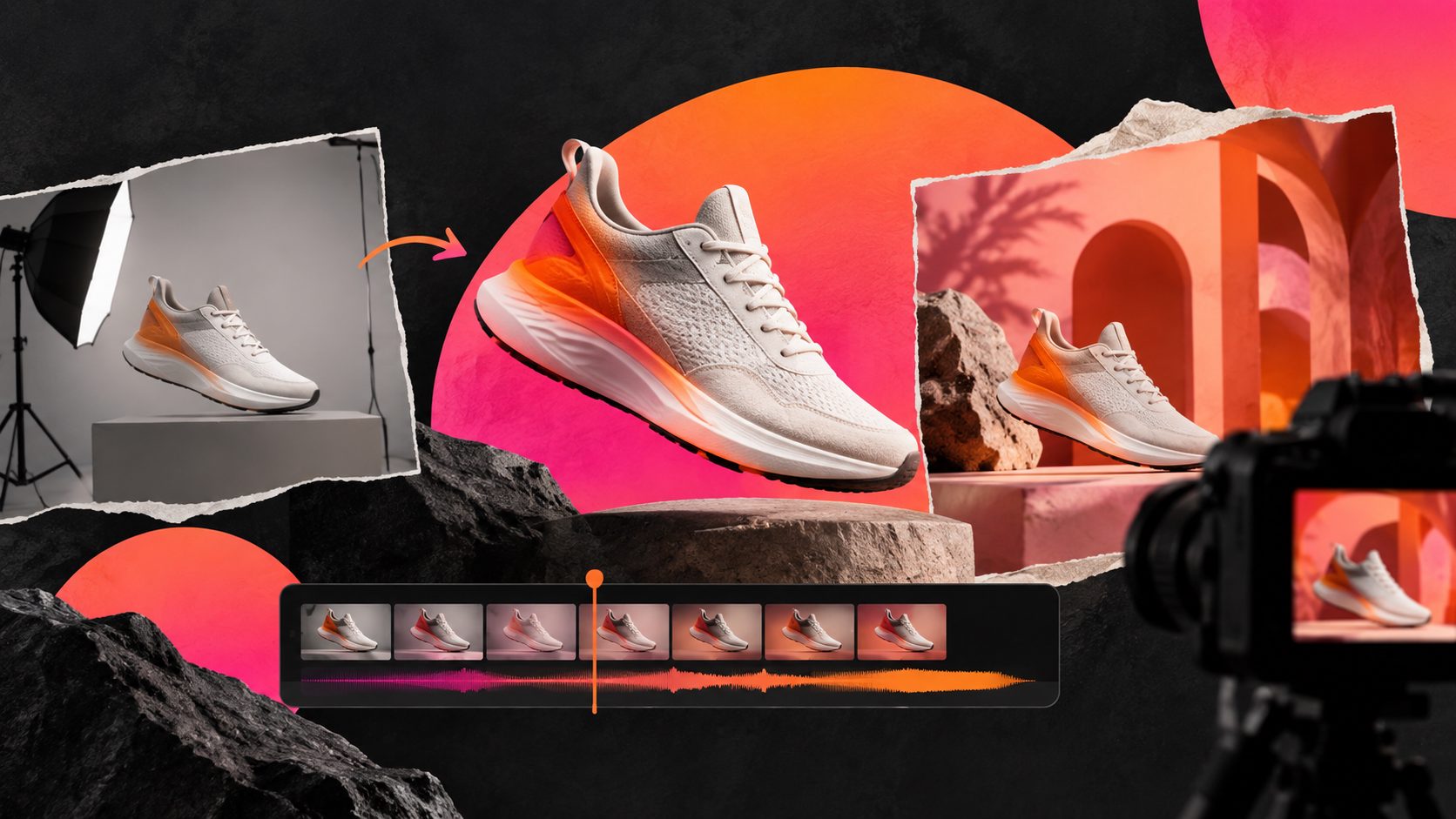
Product fidelity means the generated creative continues to represent the real product accurately. For ecommerce sellers, the strongest starting point is usually a clear product image, especially when the image shows the item on a plain-color background.
AdsTurbo Product Image accepts JPG or PNG product images and can automatically analyze a product’s shape, color, and category. It can generate six image types from one product photo: a main-image banner, lifestyle scene, close-up, material-detail image, usage-instruction image, and branded image. Outputs are available in nine aspect ratios for channels such as Amazon, Shopify, TikTok Shop, and Instagram.
That workflow is different from a general text-to-video tool. Instead of asking a model to invent the product from a description, the seller supplies a visual reference first. This does not eliminate the need for review, but it creates a more controlled asset foundation for product videos and ad variations.
For a practical example, sellers can combine product images with selling points and promotional information in AdsTurbo Product Video to generate UGC-style short ads, including product review, product introduction, and product demonstration formats. The AI product unboxing video workflow provides a related approach for turning product imagery into a more specific ecommerce video concept.
Which tools offer the best creative control?
Creative control describes how much of the final ad can be directed or revised. Basic makers often emphasize templates and automatic assembly. More advanced systems add controls for people, motion, dialogue, scenes, subtitles, and post-production.
AdsTurbo includes several control layers:
- Ad Clone can analyze a reference video and reconstruct its structure, pacing, shot logic, and CTA pattern for a new product.
- Motion Control transfers movement from a reference video to a target character image.
- Character Swap replaces a person in a source video or image while retaining the original action, lighting, and scene realism.
- Lip Sync uses a clear JPG or PNG portrait with MP3 or WAV audio.
- Background Replace, AI Eraser, subtitle generation, translation, and upscaling support post-production refinement.
These controls are especially relevant when a seller wants to preserve a proven creative structure while changing the product, presenter, language, or audience. AdsTurbo Ad Clone can analyze reference videos up to 12 seconds and generate ad variants in parallel. It also supports 9:16, 1:1, and 16:9 exports for TikTok, Meta, and Shorts.
The key comparison question is not “Can the tool generate a video?” It is “Can the seller change the variable that needs testing without changing everything else?”
How important are localization and platform formats?
Localization is more than translating on-screen text. A usable localized ad may require translated audio, aligned mouth movement, subtitles, regional copy, and a suitable aspect ratio.
AdsTurbo supports video translation, AI lip sync, and multilingual subtitle generation. Video Subtitle can automatically transcribe speech, create time-synchronized captions, and export either a video with embedded subtitles or a separate subtitle file. Subtitle layouts are adapted for social formats such as TikTok, Instagram Reels, and YouTube Shorts.
For promotional campaigns, Event Poster accepts JPG and PNG brand logos, product images, or visual assets. It can produce nine aspect ratios and generate poster copy in seven languages, including English, Chinese, Japanese, and Korean. Sellers can also add discount percentages, promo codes, campaign dates, and promotional terms directly to the poster.
For guidance on adapting one creative across placements, see this ecommerce video ad resizing guide. Format flexibility matters because a strong concept can lose clarity when the product, subtitles, or CTA are cropped incorrectly.
Which workflow is better for creative testing?
For testing, the best workflow separates the variables. A seller might keep the product and offer fixed while changing the hook, presenter, first three seconds, voice, CTA, or background. This makes performance differences easier to interpret than producing unrelated videos with no testing structure.
A practical comparison workflow is:
- Prepare a controlled product asset. Use a clear JPG or PNG product photo, preferably on a plain-color background.
- Choose one production route. Start with Product Video, Ad Clone, or a reference-based workflow.
- Define test variables. Change one or two elements at a time, such as hook and presenter.
- Create platform versions. Export the same concept for 9:16, 1:1, or 16:9 placements.
- Add accessibility and localization. Generate subtitles or translated versions where required.
- Review product accuracy. Check packaging, color, proportions, claims, captions, and CTA details before publishing.
This workflow is an original operational recommendation rather than a claim of benchmark performance. No independent head-to-head speed or conversion test is presented here; the comparison is based on capability fit and production requirements. Sellers should validate results with their own account data, audience, product category, and approval process.
For a deeper testing structure, the automated ecommerce ad creative A/B testing workflow explains how to organize creative variations around measurable experiments.
When does an API-ready platform become useful?
An API becomes valuable when creative production must connect with a catalog, internal approval system, campaign workflow, or automated testing process. The important questions are authentication, task handling, modularity, and completion events—not simply whether an API exists.
AdsTurbo API uses standard REST architecture with Bearer API Key authentication. Its six composable modules cover image generation, Persona, AI actors, Ad Clone, video generation, and task processing. The video generation API provides eight processing endpoints: shot analysis, lip sync, watermark removal, translation, upscaling, face swap, motion control, and subtitles.
All AdsTurbo generation tasks run asynchronously. Applications can receive completion events through status polling or Webhook callbacks, which is important when a pipeline creates many assets rather than one manual export.
Higher-level plans support team workflows, API access, and custom workflow support. That makes the platform more relevant to agencies, multi-SKU sellers, and brands managing localized creative at scale. Usage should still be evaluated against actual output duration and credit consumption. AdsTurbo charges different functions by output seconds or generated quantity, so a fair comparison should calculate the cost of a complete tested asset set rather than a single draft.
Frequently asked questions
What is the most important factor in an ecommerce AI video ad maker?
Product fidelity is usually the first gate. If the product’s appearance, packaging, or important features are inaccurate, stronger editing and better pacing cannot fully correct the creative.
Is a template tool enough for ecommerce ads?
A template tool may be enough for simple product introductions or repeatable promotions. Sellers who need reference-based reconstruction, character changes, motion transfer, translation, or structured testing should compare deeper editing controls.
Can one product image create multiple ecommerce assets?
Yes. AdsTurbo Product Image can generate six image types from one uploaded product photo and export them in nine aspect ratios. Clear JPG or PNG images on a plain-color background are recommended for the best results.
How should sellers compare AI video ad maker pricing?
Compare the cost of a complete test batch, including videos, translations, subtitles, upscaling, and alternate formats. Per-second credit rates can make a short single video look inexpensive while a multi-variant campaign has a different total cost.
Does an ecommerce video maker need an API?
Not every seller needs an API. It becomes useful when product catalogs, approval steps, batch generation, webhooks, or campaign systems need to connect with video production.