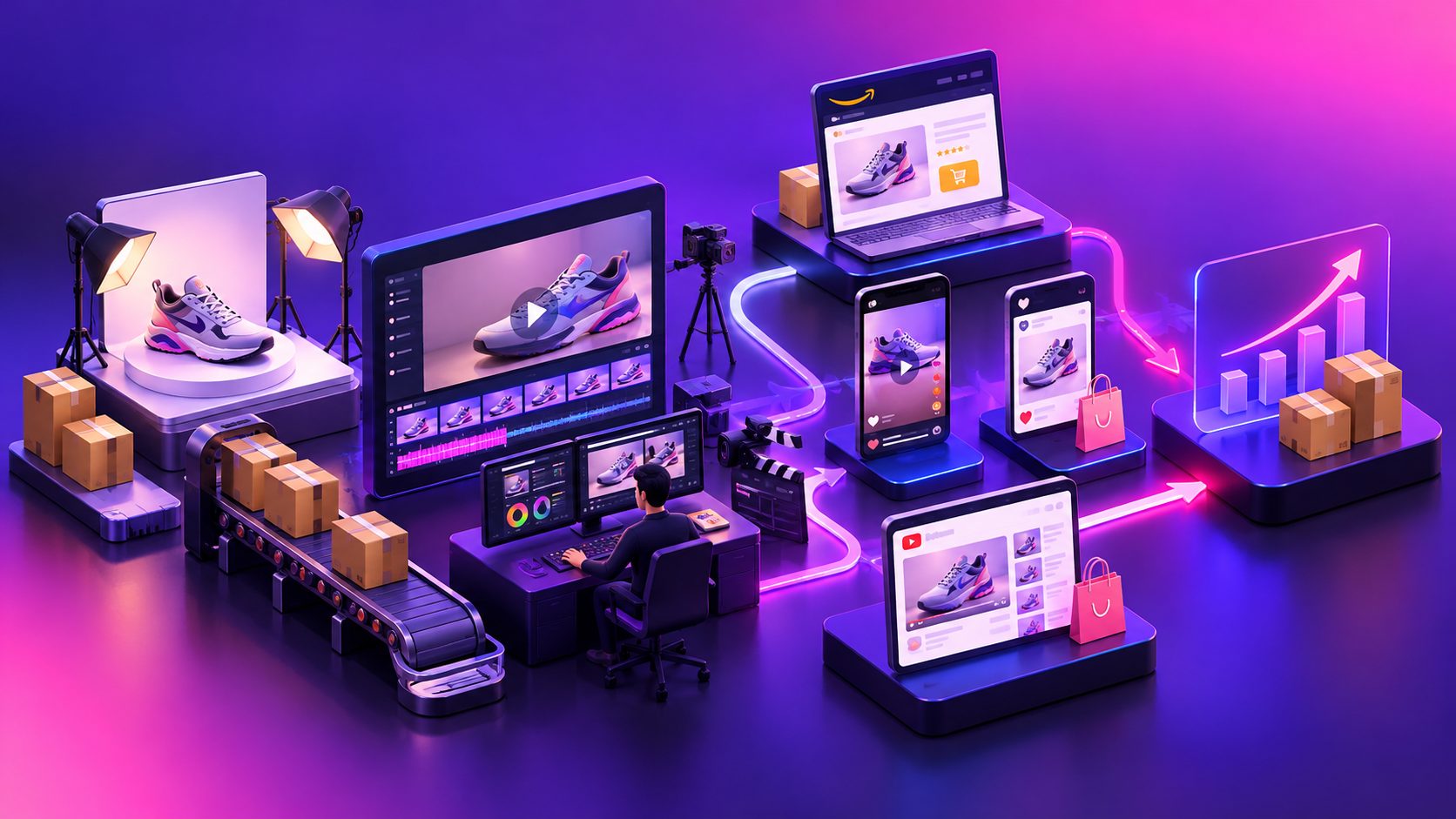
Alibaba Ready to Ship Video Ads: Turn Inventory, MOQ, and Lead Time Into B2B Demand


Summarize with
Summary
Learn how to create Alibaba ready to ship video ads that prove inventory, MOQ, lead time, and buyer fit for faster B2B decisions. Build yours with AdsTurbo.
By AdsTurbo | Published 2026-10-28 | Updated 2026-10-28
Alibaba ready to ship video ads should do more than display a product. For a B2B buyer, the creative needs to answer four practical questions quickly: What is available, how much must I order, when can it ship, and can this supplier support my market?
Alibaba.com defines Ready to Ship products as existing stock with limited customization, and its seller guidance says eligible products should be able to leave the production facility within 15 days of receiving an order. (activity.alibaba.com) That operational promise gives sellers a powerful advertising angle—but only when the video makes the promise specific and believable.
What should an Alibaba Ready to Ship video ad communicate?
An effective Ready to Ship video ad connects availability proof with a clear wholesale buying path. It does not treat a product as a generic lifestyle item; it presents the product as an orderable business opportunity.
A strong video usually communicates:
- Product appearance, dimensions, materials, or use case
- Available stock or a carefully qualified availability statement
- Minimum order quantity, or MOQ
- Dispatch or production handoff timing
- Packaging, variants, and customization limits
- The type of buyer or retail channel the product fits
- A direct next step, such as requesting a quote, ordering a sample, or starting an inquiry
Alibaba’s own buyer guidance distinguishes Ready to Ship listings from products that require an inquiry. A visible “Add to cart” or “Start order” option generally indicates that the product can be ordered directly, while “Send Inquiry” may indicate that the product needs further supplier discussion. (helpcenter.alibaba.com)
This distinction matters in video. “Fast shipping” is vague. “Standard colors, MOQ 50 units, dispatch target within 15 days” is commercially useful—provided the seller can substantiate it.
Ready to Ship versus made-to-order: what changes in the creative?
Ready-to-ship products and made-to-order products should not use the same advertising structure. The first sells speed and reduced purchasing friction; the second sells customization and production capability.
| Buyer concern | Ready-to-ship creative | Made-to-order creative |
|---|---|---|
| Main value proposition | Faster fulfillment and lower launch risk | Custom design and specification flexibility |
| Product proof | Stock presentation, packaging, standard variants | Samples, production process, customization examples |
| MOQ framing | Emphasize test-order accessibility when accurate | Explain how MOQ supports customization |
| Lead-time message | Dispatch window and shipping options | Sampling, production, QC, and delivery stages |
| CTA | Request stock confirmation or place a trial order | Request a quote or discuss specifications |
For Ready to Ship products, the first five seconds should often show the item and the commercial reason to care. For example: “Standard stock available for wholesale replenishment” is more relevant to a retailer than a slow cinematic product reveal.
Alibaba’s sourcing materials also emphasize that Ready to Ship products generally involve fewer customization options and shorter fulfillment timelines than customized goods. (alibaba.com)
A practical framework: the Stock-to-Proof Score
A useful way to evaluate a B2B product video is to score whether it converts inventory facts into buyer proof. This is an editorial framework for creative planning, not a marketplace ranking system.
Use five proof layers:
- Stock proof — Show the product in quantity, packaging, or a warehouse-ready context. Avoid implying inventory levels that are not confirmed.
- Specification proof — Display dimensions, materials, color options, included components, or product variants.
- MOQ proof — Put the minimum order quantity on screen and explain whether it applies per SKU, color, or total order.
- Time proof — Separate dispatch timing from total delivery time. A shipment leaving the facility is not the same as arriving in the buyer’s country.
- Commercial proof — Show the product in the buyer’s likely sales environment: retail shelving, a catalog, a showroom, a marketplace listing, or a distributor’s assortment.
The key insight is that inventory is not automatically a selling point. Inventory becomes persuasive only when the buyer understands how it reduces a business risk—such as missing a seasonal launch, delaying replenishment, or tying up cash in a long production cycle.
How to script a 15-second Ready to Ship product ad
A short B2B video can work when every scene has a job. The following structure is suitable for product listings, paid social, and sales follow-up messages.
0–3 seconds: State the commercial hook
Lead with the buyer’s operational need:
“Wholesale stock for faster replenishment.”
Avoid unsupported claims such as “ships tomorrow” unless the seller has verified that exact service level.
3–7 seconds: Demonstrate the product
Show the item from multiple angles, then highlight the feature that affects procurement: stackability, packaging, available colors, material, compatibility, or use case.
For products with technical or functional claims, demonstration is stronger than adjectives. A product testing approach can be adapted from this proof-first ecommerce video framework, which focuses on showing the claim rather than merely repeating it.
7–11 seconds: Put the buying terms on screen
Display the most important commercial facts:
- MOQ: 50 units
- Standard variants: black, white, blue
- Customization: limited or available on request
- Dispatch target: within the stated supplier timeline
Use “dispatch” and “delivery” carefully. A buyer may interpret “ships in 15 days” as arrival in 15 days, even though the statement only describes warehouse departure.
11–15 seconds: Give a specific CTA
End with one action:
- Request current stock confirmation
- Ask for a sample
- Get a wholesale quote
- Confirm packaging and shipping options
The CTA should match the listing’s actual buying path. If the product requires an inquiry, do not make the video sound like an instant checkout product.
How to adapt one product into multiple buyer-facing videos
A single Ready to Ship product can support several angles without changing the underlying inventory claim. This is especially useful for sellers testing different buyer segments in the United States and Europe.
| Video angle | Best buyer question answered |
|---|---|
| Replenishment angle | Can I restock without waiting for a new production run? |
| Trial-order angle | Can I test this product with a manageable MOQ? |
| Variant angle | Which colors, sizes, or packaging formats are available? |
| Retail-readiness angle | Can I place this product into my existing sales channel? |
| Demonstration angle | Does the product perform as described? |
AdsTurbo supports product video creation from a JPG or PNG product image, with optional selling points and promotional information. Its product video workflow can generate review, introduction, and demonstration-style videos. For stronger product fidelity, upload a clear product photo on a plain background; AdsTurbo’s Product Image tool is designed to analyze product shape, color, and category from JPG or PNG inputs.
For a more controlled production workflow, background replacement for ecommerce product ads can help separate a product from a distracting source image before placing it in a warehouse, retail, or usage context.
How to localize the same ad for Western B2B buyers
Localization is not only translation. A US or European buyer may respond better to a video that clarifies units, order terms, packaging, and business use rather than simply translating a Chinese-language product script.
Check these details before publishing:
- Convert measurements into units your target buyer understands.
- Explain whether MOQ applies per product, color, or order.
- Use “business days” when the supplier’s timing excludes weekends.
- Separate factory dispatch from estimated arrival.
- Translate on-screen text and subtitles, not only voiceover.
- Avoid absolute claims about customs clearance, duties, or final delivery.
AdsTurbo Video Subtitle can automatically transcribe speech, generate synchronized captions, and export either a subtitled video or a separate subtitle file. Its subtitle layouts are designed for formats such as TikTok, Instagram Reels, and YouTube Shorts. For multilingual campaigns, AdsTurbo also provides video translation and lip-sync capabilities.
Common mistakes that reduce trust
Ready to Ship advertising often fails because the message sounds faster than the operation behind it. The most common problems are:
- Showing a warehouse but never stating the MOQ
- Saying “in stock” without clarifying the stock date or variant
- Confusing dispatch time with door-to-door delivery
- Promising customization that changes the product from standard stock
- Using lifestyle footage that hides the actual product
- Adding too many CTAs
- Translating slogans while leaving procurement details unclear
A useful final check is simple: Could a buyer forward this video to a purchasing colleague and understand the order conditions without opening a second page? If not, the creative is probably optimized for attention rather than qualification.
Frequently asked questions
What are Alibaba Ready to Ship video ads?
Alibaba Ready to Ship video ads are short product videos that promote existing or standard-stock goods while explaining the details B2B buyers need, including product specifications, MOQ, variants, and dispatch timing.
Should an ad show the exact inventory quantity?
Only show an exact quantity when it has been verified and will remain accurate during the campaign. Otherwise, use qualified language such as “standard stock available” and direct buyers to confirm current inventory.
Is a low MOQ always the best selling point?
No. A low MOQ can attract trial orders, but some buyers care more about packaging, compliance documents, product consistency, or replenishment reliability. Match the message to the buyer segment.
Can one product video be reused for different markets?
Yes, if the product facts remain accurate. Create localized versions with appropriate language, units, subtitles, voiceover, and buyer-specific CTAs rather than changing unsupported claims.
How can sellers turn product images into video ads?
Start with a clear JPG or PNG product image, add verified selling points, and build scenes around product demonstration, commercial terms, and a specific CTA. AdsTurbo can also support product video generation, subtitles, translation, background replacement, and video upscaling within a broader ecommerce content workflow.
Final checklist
Before publishing an Alibaba Ready to Ship video ad, confirm that it includes:
- A visible product in the opening seconds
- A specific and supportable availability message
- MOQ and variant information
- Dispatch timing separated from delivery timing
- Product proof, not only lifestyle footage
- Localized subtitles and units
- One clear buyer action
- A workflow for updating the creative when inventory changes
For sellers turning existing stock into scalable B2B creative, AdsTurbo’s AI video advertising platform combines product video generation, subtitles, translation, ad cloning, character replacement, lip sync, and video upscaling. The result is a faster way to test multiple commercial angles without losing sight of the facts buyers need to make a wholesale decision.