

By adsturbo.ai | Published 2026-10-12 | Updated 2026-10-12
A colored contact lenses video ads generator can turn a static lens pattern, product photo, and a few selling points into short-form creative for TikTok, Instagram Reels, Shopify, or paid social testing. The strongest workflow does not simply animate the packaging. It shows the color, edge pattern, visual effect on the eye, and buying context in a controlled sequence.
For DTC lens brands, the practical challenge is visual proof: customers want to know whether a shade looks natural, noticeable, warm, cool, soft, or dramatic before ordering. A good production system should therefore create several visual angles without losing the original product pattern.
Safety note: Colored and decorative contact lenses are medical devices in the United States. The FDA states that consumers need a valid prescription and proper fitting, including for non-corrective decorative lenses. Advertising should not encourage unprescribed use or make unsupported eye-health claims. (fda.gov)
What is a colored contact lenses video ads generator?
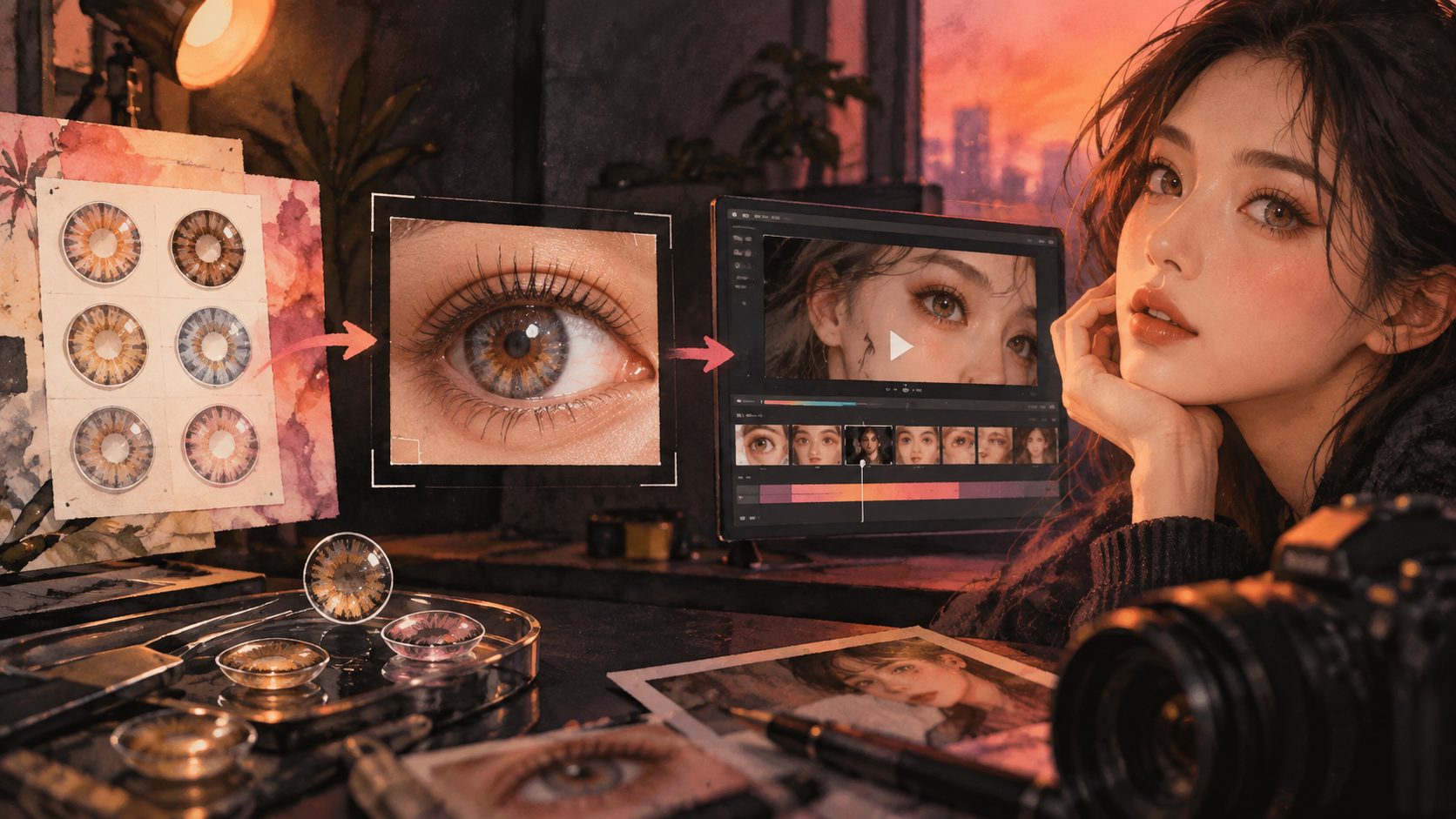
A colored contact lenses video ads generator is an AI-assisted production workflow that converts lens images, product information, reference footage, or a product page into short advertising videos.
For colored lenses, the useful output is not just a generic UGC clip. It should combine:
- A macro view of the lens pattern
- A controlled eye close-up or try-on scene
- The shade name and key product details
- A before-and-after or bare-eye comparison where appropriate
- A clear call to action
- Platform-ready crops such as 9:16, 1:1, and 16:9
Existing creative examples commonly use macro iris footage, shallow depth of field, package reveals, and creator-led try-ons. A short-form lens video analyzed by Alici.ai, for example, combines product-pack close-ups, gray and lavender shade labels, an eye inset, and a viewer vote. (alici.ai)
The opportunity is to connect those elements into a repeatable system rather than produce one visually attractive video at a time.
Why static pattern images are difficult to turn into convincing ads
A lens pattern image contains important visual information, but it is usually flat, small, and detached from the eye. An AI system may preserve the general color while changing the radial pattern, limbal ring, transparency, or perceived diameter.
That creates three common risks:
- Pattern drift: The generated lens no longer resembles the original design.
- Unclear scale: Viewers cannot tell how the lens may appear on an actual iris.
- Overpromising: A heavily enhanced eye close-up may imply a result that varies by natural eye color, lighting, camera settings, or fit.
The production goal should be visual translation, not visual invention. Treat the uploaded pattern as the product reference, then use motion, framing, and editing to make it easier to inspect.
A practical “Pattern-to-Proof” framework for lens ad videos
The following four-stage framework is an original production model for turning lens artwork into testable ad creative.
1. Pattern: show the product before the transformation
Open with the lens image, blister pack, or a clean product card. Use a slow push-in, light sweep, or controlled rotation instead of an aggressive effect.
This first shot answers: What exactly is being sold?
Recommended on-screen details include:
- Shade name
- Lens collection
- Diameter or other approved product specification
- Prescription availability, if applicable
- A short visual descriptor such as “soft brown blend” or “cool gray ring”
Avoid adding technical specifications unless they are confirmed on the product listing and permitted in the ad market.
2. Proof: move from flat artwork to eye-level context
The second stage should show the lens in a realistic eye close-up or a clearly labeled visual simulation. Keep the pupil, iris edge, lashes, and surrounding skin sufficiently visible so the viewer can judge the effect.
A useful sequence is:
- Bare-eye reference
- Lens pattern close-up
- Worn-look close-up
- Side-by-side comparison
- Shade selection CTA
The key is consistency. Use similar lighting, framing, and head position across the comparison shots. Otherwise, the creative may communicate lighting differences rather than lens differences.
3. Persona: build variations without reshooting every concept
Different audiences may respond to different visual contexts:
- Natural everyday makeup
- Soft glam
- Festival or editorial styling
- Warm-toned fashion
- Minimal male grooming
- Cosplay or costume styling
AdsTurbo supports AI actors, character replacement, face swap, lip sync, motion control, and video translation. These capabilities can help create audience or localization variants, but the lens pattern should remain the controlled product reference.
For a more detailed workflow, see the guide on AI skincare UGC video ads with a texture-first production process. The same principle applies here: let the product detail lead, and use the presenter as context rather than camouflage.
4. Prompt: finish with a low-friction next step
The final frame should tell the viewer what to do next:
- Compare shades
- View the full collection
- Check fit and prescription requirements
- See the color under different lighting
- Shop the approved product page
For US-facing campaigns, avoid wording that suggests viewers can buy decorative lenses casually without professional fitting. The FDA specifically warns that decorative lenses require an eye exam and prescription, and that poor fit or improper use can cause serious harm. (fda.gov)
How to make three useful ad variants from one lens image
One product image can support three different test angles without changing the underlying product.
| Variant | Opening hook | Main visual proof | Best use |
|---|---|---|---|
| Shade discovery | “Which eye color fits your look?” | Pattern-to-eye transition | Broad prospecting |
| Natural-effect proof | “See the edge before you choose” | Macro iris and limbal detail | Consideration traffic |
| Collection comparison | “Warm brown, gray, or lavender?” | Three synchronized shade cards | Multi-SKU testing |
This structure creates a cleaner experiment than changing everything at once. Keep the product image, offer, and CTA stable while testing the opening hook or visual order.
AdsTurbo’s Product Video workflow can use a JPG or PNG product image and optional selling points or promotion information to generate a short-form product video. Its broader toolset also includes product image generation, background replacement, subtitles, AI upscaling, and video translation.
For campaign teams producing multiple crops, the batch video ad resizing workflow for ecommerce sale campaigns provides a useful way to think about format adaptation without rebuilding the creative from zero.
How to write prompts that preserve the lens design
A reliable prompt should describe the camera behavior and edit, not ask the model to redesign the product.
Use a structure such as:
“Create a vertical 9:16 beauty product ad using the uploaded colored contact lens pattern as the exact visual reference. Begin with a clean macro shot of the lens, transition to a realistic eye close-up, preserve the original color distribution and edge pattern, use soft diffused lighting, add a simple shade label, and end with a collection CTA. Do not add medical, safety, or performance claims.”
Add constraints for:
- Eye color of the wearer
- Lighting temperature
- Makeup intensity
- Camera distance
- Background color
- Text language
- Maximum video length
- Required platform crop
If the first render changes the pattern, create a shorter product-detail shot and use editing to connect it to the eye scene. More motion is not always better; for this category, inspectability is a conversion asset.
Compliance checks before publishing
Before launching a colored lens video, verify:
- The seller and product meet applicable US contact lens requirements.
- The ad does not imply that a prescription is unnecessary.
- The creative does not promise improved vision, comfort, safety, or eye health without appropriate substantiation.
- The displayed shade is not presented as identical for every wearer.
- Any before-and-after comparison is clearly representative.
- Claims match the approved product page and packaging.
- Music, creator likeness, and reference footage have commercial rights.
The FTC says health-related advertising claims need appropriate substantiation, including for contact lenses and other regulated products. (ftc.gov)
AdsTurbo’s ecommerce TikTok ad production workflow can help teams organize repeatable hooks, formats, captions, and creative iterations. Its Video Subtitle tool can also generate synchronized captions and export either a subtitled video or a separate subtitle file.
Frequently asked questions
Can I create a lens video from only one product image?
Yes. A JPG or PNG pattern or product image can serve as the starting asset. For more credible creative, add the shade name, approved product details, and a clear description of the intended visual effect.
Should the video show the lens on an eye?
Usually, yes. A pattern-only video explains the product design, while an eye-level close-up helps viewers understand scale and appearance. Label simulations honestly and avoid implying that every wearer will see the same result.
What video format is best for TikTok and Reels?
Start with 9:16 vertical video. Create 1:1 and 16:9 versions when the same creative will be used across product pages, feeds, or display placements.
Can I localize colored lens ads for other markets?
Yes. AdsTurbo supports video translation, lip sync, subtitles, and multiple creative variations. Localize the language, offer, and compliance text while preserving the approved product representation.
How should I test different shades?
Keep the camera style and CTA consistent. Test one variable at a time, such as shade order, opening hook, comparison format, or creator context. This makes performance differences easier to interpret.
Final takeaway
A high-quality colored contact lens ad should make the product easier to inspect, not merely more dramatic. Start with the real pattern, connect it to a controlled macro eye view, create clearly labeled audience variations, and finish with a compliant shopping path.
AdsTurbo can support this workflow through product video generation, AI actors, character replacement, subtitles, translation, upscaling, and API-based task processing. For brands producing many SKUs, the most valuable advantage is a repeatable system that turns one approved product reference into a structured batch of testable creatives.