

By adsturbo.ai | Published 2026-10-11 | Updated 2026-10-11
An eyeshadow palette drop test video ecommerce shoppers can understand should do more than show a palette falling onto a table. It should make the powder, pan, hinge, and packaging visible before and after impact. A focused 15-second edit can turn a fragile-product concern into evidence that supports purchase confidence and reduces avoidable “arrived broken” complaints.
What should an eyeshadow palette drop test video prove?
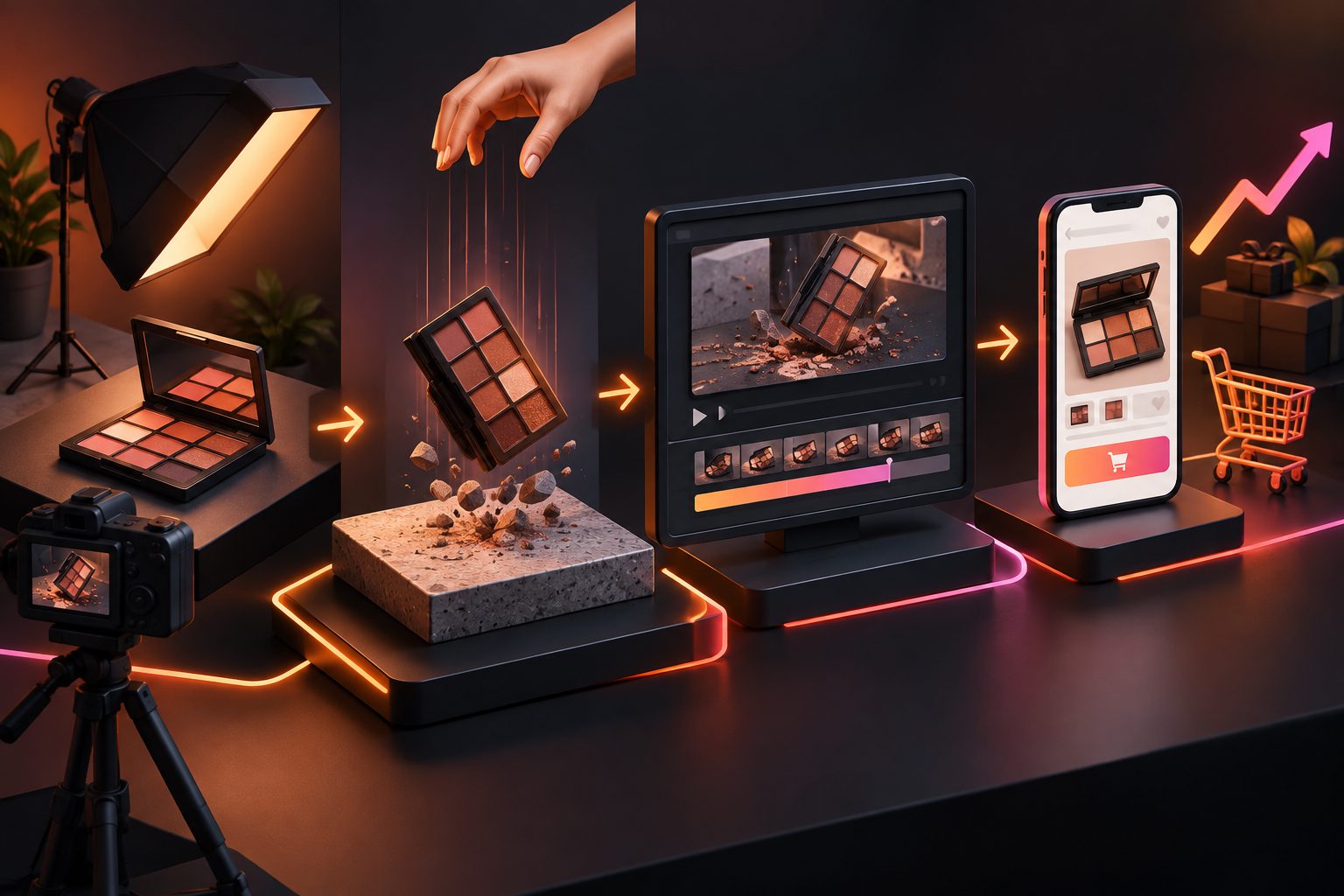
An eyeshadow palette drop test video should visually compare the product before impact, show a controlled drop, and reveal the exact condition afterward. The goal is not to claim laboratory certification. The goal is to make packaging performance and product integrity easier to judge.
Pressed cosmetics are vulnerable in several different ways:
- A pan can crack while the outer case looks intact.
- Loose powder can migrate into the hinge or mirror area.
- A corner impact can damage the case without immediately breaking the eyeshadow.
- Shimmer or soft-pressed shades may show fallout more clearly than firm matte shades.
Cosmetic powder behavior varies by formulation. Powder cohesion, compaction, and sensitivity to handling can differ substantially between products, which is why a visually convincing video should show the actual palette rather than rely on generic “durable packaging” language. (stablemicrosystems.com)
For ecommerce, the most useful promise is specific: “Here is what the palette looked like before the test, here is the impact, and here is the result.”
The 15-second storyboard that makes damage visible
A strong short-form video does not need ten random drops. It needs a sequence that helps viewers compare evidence quickly.
| Time | Shot | What shoppers should notice |
|---|---|---|
| 0–2 seconds | Closed palette hero shot | Brand, size, closure, and overall condition |
| 2–4 seconds | Macro open-palette shot | Powder surface, pan edges, mirror, and hinge |
| 4–6 seconds | Handheld weight or shake shot | Whether pans visibly shift inside the case |
| 6–8 seconds | Controlled drop | Drop height, landing surface, and orientation |
| 8–11 seconds | Immediate open-up | Loose powder, cracks, broken corners, or intact pans |
| 11–13 seconds | Macro comparison | Before-and-after close-up of the same shades |
| 13–15 seconds | CTA or proof card | “Tested before shipping” or a truthful product-specific claim |
This timing is an original Proof-First Palette Framework: establish the baseline, isolate the impact, expose the result, and end with a comparison. It is more persuasive than using slow motion alone because shoppers can connect the starting condition to the final condition.
Use one impact variable at a time
Do not combine a high drop, hard surface, spinning motion, and open lid in the same test. Viewers may find the footage dramatic, but they cannot understand what caused the result.
For a repeatable ecommerce demonstration, define:
- Drop height — for example, a clearly labeled tabletop height.
- Landing orientation — base, top, side, or corner.
- Surface — hardwood, tile, or another clearly identified surface.
- Product state — closed and latched, or open for a separate internal test.
- Inspection point — immediately after impact and again after handling.
If the video is intended to support packaging decisions rather than merely advertise the product, document each condition in a test log. Commercial drop-test guidance commonly emphasizes impact orientation, product fragility, package size, and the difference between package damage and product damage. (assets.aboutamazon.com)
How to film powder and cracks with a macro setup
The highest-value footage is usually not the drop itself. It is the close-up before and after.
Place the palette on a clean, matte surface. Use soft side lighting rather than direct overhead light. Side light makes cracks, powder dust, pan gaps, and raised edges easier to see without creating distracting glare on the mirror.
Capture these details:
- The full palette with every shade visible.
- The most fragile-looking shade, such as a soft shimmer or pressed glitter.
- The gap between each pan and the surrounding case.
- The hinge and clasp area.
- Powder residue around the mirror or inner lid.
- A finger or brush gently touching the surface after impact.
Avoid scraping the powder merely to create visible fallout. A misleading “damage” shot can create the exact distrust the video is supposed to remove.
For sellers without a filming setup, AdsTurbo can help turn a clear product image into a product-focused video workflow. Its Product Video process accepts JPG or PNG product images, and clear product photos on a plain background are best suited to image analysis. The resulting creative can be used as a pre-test explainer, while real drop footage should remain the source of truth for physical impact claims.
How to write the on-screen proof without overclaiming
The text overlay should describe what the viewer can see. It should not turn one marketing test into a universal shipping guarantee.
Use language such as:
- “Closed palette — controlled tabletop drop”
- “Corner impact shown in real time”
- “Inspecting pan edges and powder fallout”
- “No visible cracking after this test”
- “Test result applies to this filmed unit and setup”
Avoid unsupported statements such as:
- “Guaranteed unbreakable”
- “Will survive every shipment”
- “Zero refund risk”
- “Certified drop-proof”
A drop test video is persuasive because it reduces uncertainty, not because it eliminates every possible failure mode. If your fulfillment packaging changes, repeat the test with the new insert, carton, or protective sleeve.
A better comparison: product condition versus packaging condition
Many sellers show only whether the exterior box survived. That leaves an important question unanswered: did the pressed powder remain usable?
Use a two-column inspection card:
| Exterior condition | Interior condition |
|---|---|
| Case closed or separated | Cracked or intact pans |
| Hinge aligned or displaced | Powder fallout |
| Mirror intact or damaged | Shade surface changes |
| Corners clean or dented | Product still usable |
This distinction adds information that typical beauty product videos omit. Packaging can look acceptable while one or two shades are fractured. Conversely, a scuffed outer carton may still protect the palette completely.
For marketplace sellers, this evidence can also improve customer support. A buyer who reports damage can be asked for photos of the same areas shown in the video: hinge, pan edges, powder surface, and inner lid. The video does not replace a returns policy, but it creates a clearer inspection vocabulary.
How to turn one test into multiple ecommerce creatives
A single controlled test can produce several edits without repeating the physical drop:
- 15-second product-page video — complete before, impact, and after sequence.
- 9:16 short-form ad — macro hook followed by the result.
- 1:1 marketplace variant — centered palette and large proof captions.
- FAQ clip — “Can pressed eyeshadow survive shipping?”
- Customer-support clip — what to inspect when a palette arrives.
AdsTurbo supports tools for product video generation, video subtitles, background replacement, AI upscaling, and clip-by-clip editing. Its Video Subtitle tool can generate synchronized captions and export either a captioned video or a separate subtitle file. For a multi-market campaign, video translation and lip sync can help adapt the same proof structure to different languages, but the physical test footage should not be altered in a way that changes what happened.
For a broader weekly production system, the TikTok Ads creative production workflow for ecommerce sellers can help organize recurring variations. A solo ecommerce fast-video SOP is also useful when one person handles product photography, editing, and publishing.
The pre-publish checklist
Before uploading the video, confirm:
- The product is clearly identifiable in the first two seconds.
- The drop height and surface are visible or stated.
- The palette is shown before and after impact.
- Macro shots reveal powder condition and pan edges.
- Captions do not promise more than the test demonstrates.
- The video includes the correct platform ratio.
- The final frame contains a clear but truthful next step.
- Any AI-generated enhancement is used for clarity, not to fabricate damage or durability.
If several aspect ratios are needed for TikTok, Meta, and YouTube Shorts, the batch video ad resizing workflow can help create platform-ready versions while preserving the central proof sequence.
Frequently asked questions
Is a drop test video enough to prove an eyeshadow palette is shipping-safe?
No. It demonstrates performance under one defined setup. Shipping outcomes also depend on carton design, cushioning, movement, carrier handling, and the product formulation.
Should the palette be open or closed during the drop?
Use a closed, latched palette for a packaging-protection demonstration. A separate open-palette shot can show the condition of the powder, but it should not be presented as the same test condition.
What is the best length for a makeup drop-test ad?
Fifteen seconds is usually enough for one baseline, one controlled impact, and one clear inspection. Longer footage is better suited to a product page or customer-support explanation.
Can AI create the entire drop test?
AI can help generate product videos, captions, translations, edits, and creative variations. It should not be used to fabricate a physical impact result. Use real footage when making claims about whether a palette cracked or remained intact.
How can sellers reduce returns from broken powder?
Improve the physical packaging, test the most vulnerable orientations, and show honest evidence in product content. A video can set expectations, but it cannot compensate for insufficient cushioning or an unstable pan design.