By adsturbo.ai | Published 2026-10-19 | Updated 2026-10-19
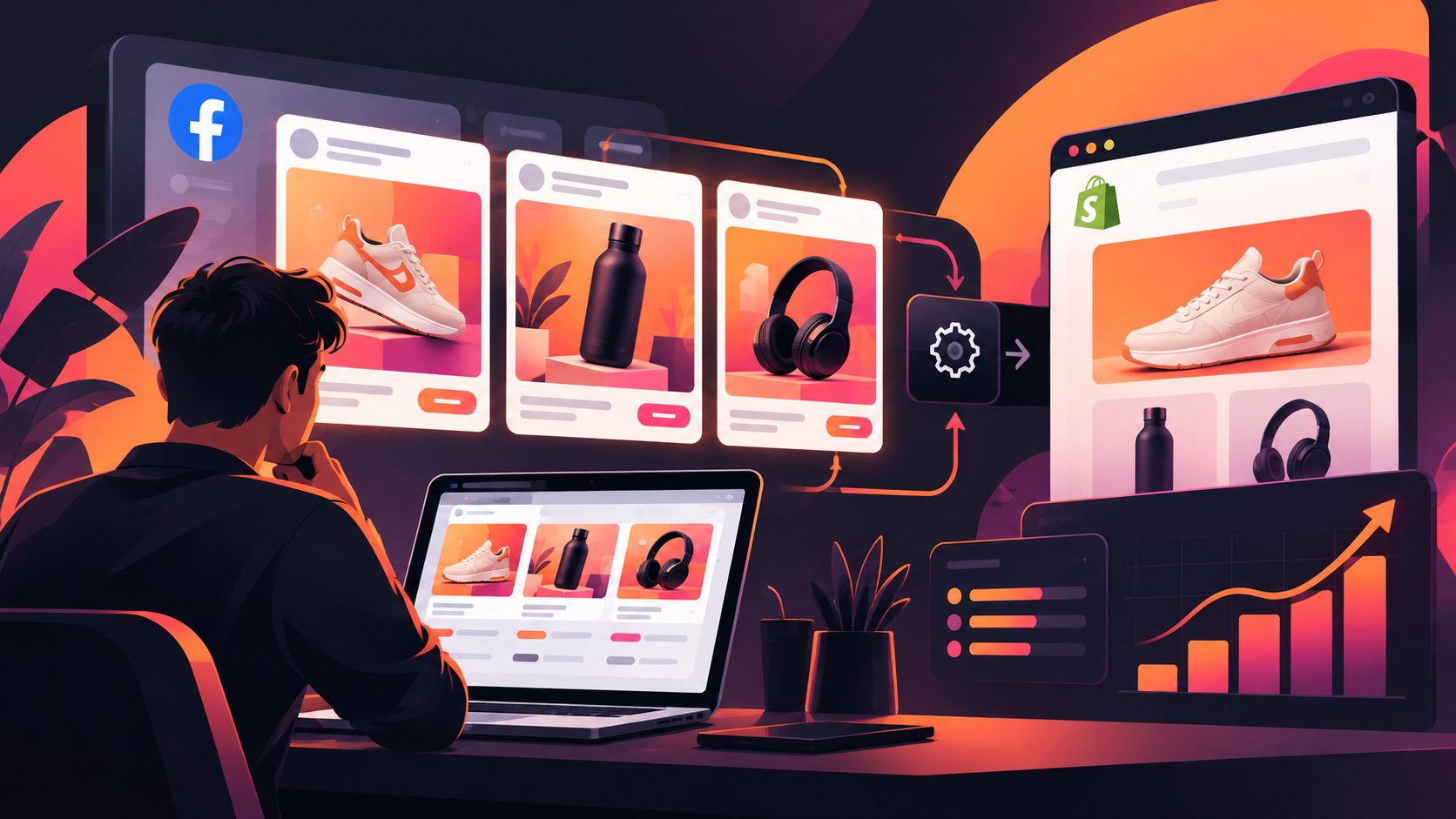
A facebook ecommerce ad creative generator helps Shopify and D2C sellers turn one product brief into multiple ad concepts, hooks, proof points, formats, and calls to action. The real advantage is not producing one polished video. It is creating a structured batch that can reveal which buying message deserves more budget.
For ecommerce teams, the most useful workflow combines three elements: a strong opening hook, a clear product benefit, and credible social proof. This guide shows how to build that system and use AdsTurbo to create testable Facebook and Instagram video variations.
What is a Facebook ecommerce ad creative generator?
A Facebook ecommerce ad creative generator is a tool or workflow that creates paid-social assets from product information, reference media, and marketing angles. It may produce video ads, static images, scripts, captions, subtitles, or multiple creative variations for testing.
The important distinction is between asset generation and creative testing:
- Asset generation creates videos or images.
- Creative testing compares different reasons to buy.
- Creative iteration uses performance signals to improve the next batch.
Search results for ecommerce creative testing consistently emphasize isolating meaningful variables instead of changing everything at once. Common variables include the offer, customer problem, hook, proof, format, and call to action. (darlingtongrowth.com)
For a Shopify seller, the generator should therefore support a repeatable input structure:
- Product and audience
- Customer problem
- Main benefit
- Proof or demonstration
- Offer and CTA
- Format and placement
This turns creative production into a learning loop rather than a collection of random videos.
Which creative elements should ecommerce sellers test first?
Test the buying reason before the visual polish. A useful order is: angle, hook, proof, format, and CTA.
| Testing layer | What changes | Example |
|---|---|---|
| Buying angle | Why the customer should care | Save time, improve fit, reduce mess |
| Hook | What stops the scroll | “Still dealing with this?” |
| Product proof | What makes the claim believable | Demo, comparison, customer quote |
| Format | How the story is presented | UGC, product demo, founder explanation |
| CTA | What action the viewer takes | Shop now, See the difference |
Many advertisers begin by comparing polished designs or thumbnail colors. That can create noise if the underlying message is weak. A modular testing approach is more informative because it preserves the winning parts while changing one major variable at a time. (hawkdigital.au)
The Hook–Benefit–Proof matrix
A practical framework for D2C brands is to build a matrix with three columns:
- Hook: The problem, question, or visual interruption.
- Benefit: The specific result the product offers.
- Proof: The demonstration, review, comparison, or evidence.
For example, a reusable water bottle campaign could create:
| Hook | Benefit | Proof |
|---|---|---|
| “Your bottle may be leaking for this reason.” | A more secure everyday carry | Close-up lid demonstration |
| “What fits inside a 32-ounce bottle?” | Fewer refills during the day | Capacity test |
| “I stopped buying disposable bottles.” | Lower routine friction | User-style explanation and usage shots |
This matrix is an original planning model for producing structured variations. Instead of asking AI for “five ads,” ask it for three hooks, three benefits, and two proof styles. The result is a controlled batch that can be named, compared, and reused.
How to generate Facebook ad variations from one product
Start with the product image, a short product description, and two or three confirmed selling points. Avoid giving the generator vague instructions such as “make it viral.” Specific inputs create more useful variations.
Step 1: Define the customer problem
Write the problem in the customer’s language. Use product reviews, support tickets, comments, and refund reasons where available.
Examples:
- “The waistband rolls down during movement.”
- “The charger is difficult to pack.”
- “The storage container takes too much space.”
- “The skincare routine feels too complicated.”
A problem-based hook usually gives the first frame a clear job: identify the viewer and create relevance.
Step 2: Select three benefit angles
Use different motivations rather than three versions of the same sentence:
- Functional benefit: What the product does better.
- Emotional benefit: How the customer feels after using it.
- Situational benefit: When or where it becomes useful.
For a fashion product, the angles might be comfort, confidence, and travel convenience. This creates broader learning than simply changing adjectives.
Step 3: Add proof before writing the CTA
Proof should answer, “Why should I believe this?” Suitable proof can include:
- Product-in-use demonstrations
- Before-and-after presentation where appropriate
- Material or feature close-ups
- Customer review excerpts
- Side-by-side comparisons
- Unboxing or setup sequences
AdsTurbo Product Video can use a JPG or PNG product image and optional selling points or promotional information to create UGC-style product videos. It can generate product review, product introduction, and product demonstration videos.
For brands that already have a strong reference ad, Ad Clone for competitor video structure analysis can help extract structure, pacing, and conversion points for a new concept. The goal should be to learn from the structure, not duplicate another brand’s identity or claims.
Step 4: Produce platform-aware versions
A single idea may need different edits for Reels, Feed, and other placements. Keep the core claim consistent, but adapt:
- Opening frame
- Caption size
- Subtitle placement
- Product scale
- Aspect ratio
- CTA timing
AdsTurbo Ad Clone supports exports in 9:16, 1:1, and 16:9 formats. AdsTurbo Video Subtitle can generate synchronized captions, download a video with embedded subtitles, or export a separate subtitle file.
For a broader workflow, auto-reframing ecommerce video for multiple platforms explains how to prepare one source video for different aspect ratios without rebuilding every edit manually.
How should Shopify sellers organize a creative test?
Use one control concept plus three to five structured variations. Keep the product page, audience, optimization event, offer, and major campaign settings as consistent as practical. Change one meaningful creative variable per test cell.
A simple naming system is:
Product_Angle_Hook_Proof_Format_Version
Example:
Bottle_LeakPrevention_Question_LidDemo_UGC_V1
Review results in layers:
- Attention: Does the opening earn a meaningful view?
- Engagement: Do viewers continue into the product explanation?
- Intent: Are people clicking or viewing the product page?
- Conversion: Does the creative contribute to purchases?
- Efficiency: Can the result support the target CPA or ROAS?
Do not promote a creative only because it has the highest click-through rate. A curiosity hook may earn clicks while failing to explain the product. The strongest creative is usually the one that connects attention to qualified shopping behavior.
A useful testing cadence is:
- Batch 1: Test three buying angles.
- Batch 2: Keep the strongest angle and test three hooks.
- Batch 3: Keep the winning hook and rotate proof styles.
- Batch 4: Adapt the winner into new formats, languages, or audience-specific versions.
AdsTurbo supports video translation, lip sync, character replacement, AI upscaling, motion control, subtitles, and background replacement. These controls can help reuse a proven concept across markets or creative formats without changing the central product message.
What makes an AI-generated Facebook ad usable?
A usable ad is specific, believable, and easy to evaluate. It should show the product early, communicate one main promise, and provide enough proof for the intended audience.
Before publishing, check:
- Is the product recognizable in the first few seconds?
- Does the hook identify a real problem or desire?
- Is the benefit specific rather than exaggerated?
- Does the proof match the claim?
- Are subtitles readable on mobile?
- Is the CTA clear?
- Does the landing page continue the same message?
- Are sensitive claims supported and compliant?
AI generation can increase creative volume, but judgment still belongs in the workflow. Remove unsupported claims, unnatural scenes, mismatched product details, and visual elements that distract from the offer.
For product photography, AdsTurbo Product Image accepts JPG and PNG uploads. Clear product photos on a solid-color background generally provide the best starting material. The tool can analyze product shape, color, and category, then create outputs such as banners, lifestyle images, close-ups, material details, instruction visuals, and brand images.
Frequently asked questions
Can one product image create multiple Facebook ad concepts?
Yes. A product image can serve as the starting point for product videos, product demonstrations, lifestyle visuals, and different hook-benefit-proof combinations. Stronger results usually come from adding precise selling points and audience context.
Should I test videos or static images first?
Test the format that best demonstrates the product. Use video for motion, setup, transformation, or usage proof. Use static images when the product benefit can be understood immediately through a clear visual and short message.
How many variations should a Shopify seller make?
Start with a manageable batch: one control and three to five structured variations. More assets are not automatically better if every variation changes multiple elements and makes the result difficult to interpret.
Can AdsTurbo support an automated production workflow?
AdsTurbo provides API access with six composable modules covering image generation, Persona, AI actors, Ad Clone, video generation, and task processing. All generation tasks run asynchronously, with completion available through status polling or Webhook callbacks. Higher-tier plans support team workflows, API access, and custom workflows.
Where can I start?
Begin with one product, three customer problems, three benefit angles, and two proof styles. Then use the resulting matrix to create a small, clearly named test batch through the AdsTurbo AI video ad platform.