

By adsturbo.ai | Published 2026-10-06 | Updated 2026-10-06
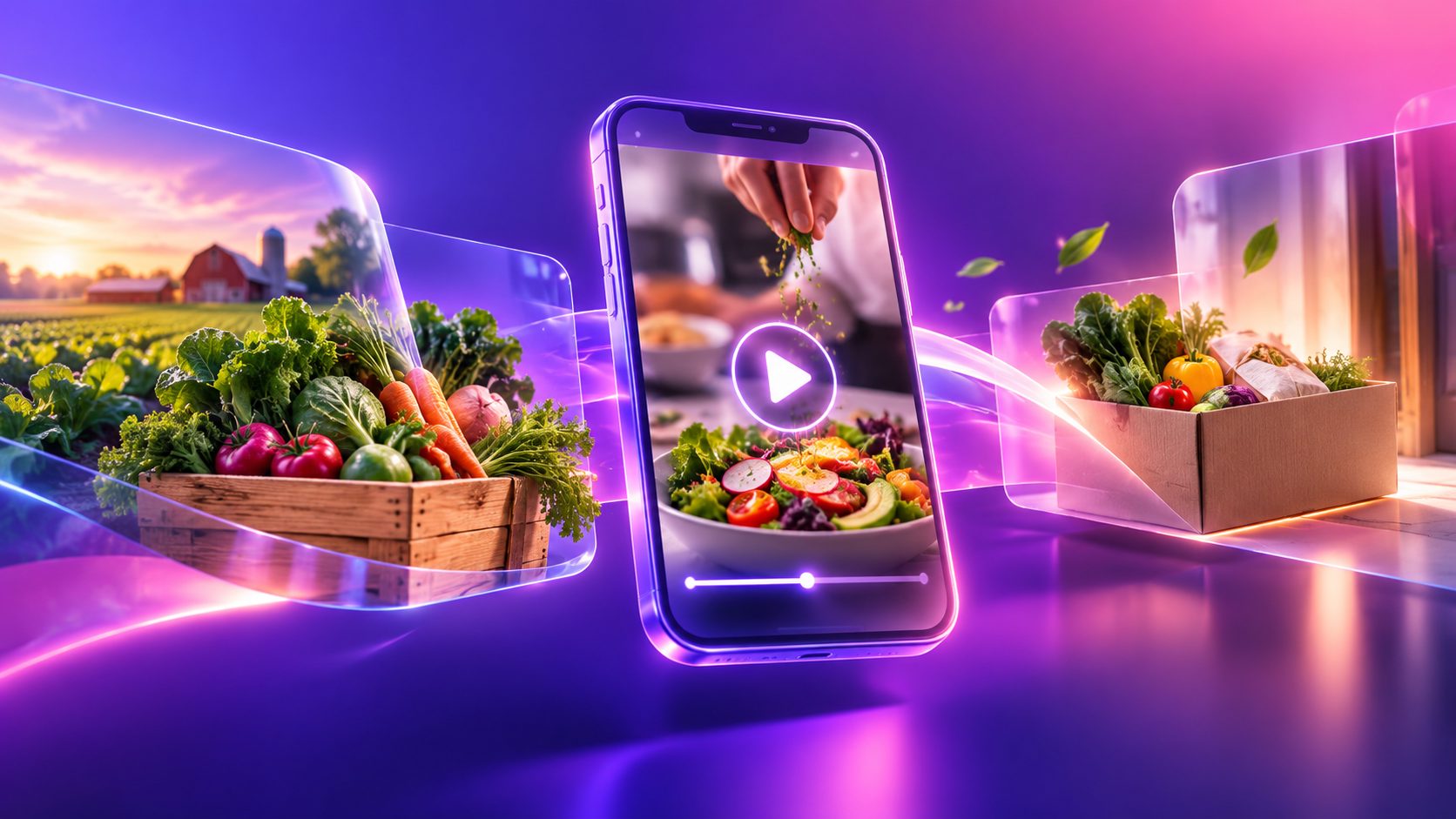
Effective farm to table ecommerce video ads do not simply show beautiful fields. In 15 seconds, they must prove where the food comes from, how freshness is protected after harvest, what arrives at the customer’s door, and why a first order is worth placing now.
The practical sequence is origin, harvest, protection, delivery, offer, action. This structure turns an atmospheric farm story into a direct-response ad without sacrificing authenticity.
What Must a Farm-Direct Video Ad Prove?
A farm-direct ad must answer three buyer questions: Is the source credible? Will the food arrive in good condition? What exactly am I buying? Each answer should appear visually instead of relying on broad claims such as “farm fresh” or “premium quality.”
Show recognizable evidence: hands harvesting the product, a dated packing label, insulated packaging, the opened delivery box, and the actual assortment. Keep the farmer’s story, but connect every story beat to purchase confidence.
A useful creative rule is to reserve no more than five seconds for general farm atmosphere. The remaining time should demonstrate fulfillment and the offer. A sunrise shot creates emotion; a packed box with visible contents reduces uncertainty.
What Is the Best 15-Second Storyboard?
The best 15-second farm-to-door storyboard presents one continuous journey from harvest to checkout. Each shot should introduce new proof, while the on-screen text remains readable without sound.
| Time | Visual | On-screen copy | Conversion job |
|---|---|---|---|
| 0–2 sec | Produce picked, eggs collected, or product cut at the source | “Harvested for your order” | Stop the scroll with origin |
| 2–4 sec | Farmer, field marker, farm name, or regional sign | “Grown in [verified location]” | Establish provenance |
| 4–7 sec | Sorting, packing, date label, cold packs, or insulation | “Packed to protect freshness” | Address delivery anxiety |
| 7–10 sec | Box arriving and being opened | “See what arrives” | Make the purchase tangible |
| 10–12 sec | Close-up of quantity and condition | “[Quantity] delivered to your door” | Clarify the offer |
| 12–15 sec | Product page, offer, and checkout action | “Start your first box” | Create one next step |
Do not fit a farm biography, sustainability manifesto, recipe, subscription explanation, and discount into the same spot. Build separate variants around those angles after the core proof ad is complete.
How Should Freshness Be Shown Without Vague Claims?
Freshness should be demonstrated through observable timestamps, handling steps, and product condition. Film the harvest or preparation date, packing sequence, sealed container, and unboxing result rather than placing an unsupported “fresher than stores” statement over generic footage.
Create a simple proof chain:
- Record the product at its origin.
- Capture the real sorting or preparation process.
- Show the packaging used for that shipment type.
- Display only delivery windows the business can consistently meet.
- End with the same product configuration sold on the landing page.
Objective advertising claims should have a reasonable basis before publication, according to the FTC advertising substantiation policy. Avoid unverified health, nutrition, environmental, or comparative freshness claims, even when they sound like familiar farm-marketing language. (ftc.gov)
How Can Cold-Chain Packaging Become Conversion Proof?
Cold-chain footage works when it makes an invisible logistics promise visible. Show the liner, cold source, sealed package, handling label, and expected opening experience in a tight three-shot sequence.
For perishable meat, seafood, dairy, or prepared food, use the packaging actually shipped. USDA guidance says perishable mail-order food should be sent cold or frozen with a cold source and appropriate packaging; it also advises recipients to check refrigerated deliveries promptly. The USDA mail-order food safety guidance provides the relevant handling details. (fsis.usda.gov)
Packaging claims must remain specific. “Insulated liner and cold packs” is demonstrable. “Guaranteed fresh in every climate” creates a broader promise that requires operational evidence.
Brands emphasizing recyclable or reduced-material shipping can adapt the visual logic from this eco-friendly packaging video ad framework.
How Should the First-Order Offer Appear?
A first-order offer should be understandable in one glance. Present the product, quantity, purchase model, incentive, and action without making viewers calculate the deal.
Use a compact offer card such as:
Seasonal Harvest Box
8–10 items · One-time order
First delivery incentive
Shop this week’s box
State whether the purchase is a one-time box, recurring subscription, deposit, or reservation. If selection changes seasonally, say so before checkout. Any discount, shipping threshold, delivery area, or expiration condition should be readable and consistent with the landing page.
Use one CTA—such as Shop the Box, Choose Your Delivery, or Start Your First Order—rather than combining “learn more,” “subscribe,” and “buy now.” For threshold-based offers, the free-shipping video ad test plan explains how to separate the shipping message from the product story.
What Is the 3P Proof Stack?
The 3P Proof Stack is an original creative scoring framework for evaluating a farm-direct ad before launch: Provenance, Protection, and Purchase. A complete 15-second concept should earn at least two visible proof points in every category.
| Category | Questions to score | Strong proof examples |
|---|---|---|
| Provenance | Can viewers identify who produced it and where? | Farmer, farm name, field, region, harvest activity |
| Protection | Can viewers see how condition is preserved? | Sorting, insulation, seal, cold source, packing date |
| Purchase | Can viewers understand what they receive and do next? | Box contents, quantity, price page, offer, single CTA |
Score each category from zero to two. A concept scoring 6/6 is ready for variation testing; a low Protection score signals delivery anxiety, while a low Purchase score indicates a beautiful brand film that may not drive orders.
This is a planning score, not a performance guarantee. Validate the final creative through controlled tests using the same audience, offer, landing page, and optimization event.
How Can Sellers Produce and Test Creative Variants?
Start with one proof-complete master, then change only one strategic variable per version. Useful tests include harvest versus unboxing hooks, farmer narration versus customer-style voice-over, discount versus seasonal scarcity, and one-time box versus subscription positioning.
AdsTurbo can support this workflow with clip-by-clip editing, Product Video, Video Subtitle, translation, AI upscaling, and background replacement. Its Product Video workflow accepts a JPG or PNG product image and can generate product review, introduction, or demonstration formats. Time-synchronized subtitles can also be exported separately or embedded in the video.
For structured testing, use an AI ad creative variation matrix instead of producing unrelated concepts. Sellers who lack creator footage can also adapt a no-filming AI UGC workflow, while keeping all farm, handling, and delivery representations accurate.
Frequently Asked Questions
Should a farmer appear in the first three seconds?
A farmer should appear early when personal provenance is the strongest differentiator. If the product itself is more visually striking, open with harvesting, cutting, pouring, or unboxing, then identify the producer in the next shot.
Can one 15-second ad explain the entire farm story?
No. Use the conversion ad to establish origin, handling, product, and offer. Publish the longer founder story, growing practices, recipes, and seasonal updates as separate retargeting or organic content.
Should the ad show a discount immediately?
Lead with the discount when the audience already understands the product category and price is the main barrier. For unfamiliar farms, show the product and proof first so the offer has context.
What aspect ratio should a farm-direct ad use?
Begin with 9:16 for vertical short-form placements, but preserve the central product, text, and CTA so the sequence can be adapted to 1:1 and 16:9. Avoid placing important labels against the extreme edges.
What should be tested first?
Test the opening proof. Compare a harvest shot, packing shot, and finished unboxing while keeping the offer, audience, CTA, and landing page unchanged. This isolates which buyer concern creates the strongest initial response.