


By adsturbo.ai | Published 2026-10-04 | Updated 2026-10-04
An AI ad creative variations generator should do more than produce different colors, captions, or presenters. Its real value is separating the variables that influence performance—especially the hook, voiceover argument, visual proof, and call to action—so ecommerce teams can learn why one advertisement beats another.
This guide presents a controlled 3×2×2 framework for generating 12 meaningful video ad variants without turning creative testing into guesswork.
What Is an AI Ad Creative Variations Generator?
An AI ad creative variations generator is a system that transforms one product, brief, or reference advertisement into multiple testable creatives. Effective systems vary strategic elements such as the opening premise, sales argument, visual demonstration, spokesperson, language, and CTA—not merely cosmetic details.
Most generators are good at increasing output volume. The harder problem is creating useful variation. Twelve ads with different backgrounds but the same message are effectively one concept presented twelve ways.
A test-ready batch should answer distinct questions:
- Which customer problem stops the scroll?
- Which product benefit sustains attention?
- Which proof format builds confidence?
- Which CTA matches the viewer’s level of intent?
- Does the concept survive a new actor, language, or placement?
This distinction separates creative production from creative experimentation. It also prevents teams from mistaking asset quantity for concept diversity.
Why Do Random Creative Variations Produce Weak Insights?
Random variations produce weak insights because several variables change simultaneously. If the hook, actor, script, offer, background, music, and CTA are all different, the winning ad reveals little about which change caused the result.
Google’s guidance for creative experiments recommends limiting how many elements are tested and keeping variations similar enough to learn from their differences. It also advises setting a testing threshold and documenting the outcome before repeating the process. (support.google.com)
Apply the same principle to short-form ecommerce video. First isolate one major variable, then combine the strongest components.
Creative fatigue should also be diagnosed rather than assumed. Falling click-through rates can reflect repetitive messaging, but performance can also decline because of audience saturation, weaker traffic, an expired promotion, higher competition, or landing-page friction. Use a creative-fatigue diagnostic workflow before replacing every asset.
How Do You Build a 3×2×2 Creative Testing Matrix?
Build the matrix by defining three genuinely different hooks, two voiceover arguments, and two CTAs. Multiplying those components creates 12 combinations while preserving a consistent product, offer, duration, and visual identity.
-
Choose three hook premises.
Use a problem interruption, an outcome-led promise, and a proof-first demonstration. These should represent different reasons to keep watching—not three rewrites of the same opening sentence. -
Write two voiceover arguments.
One can explain the product’s mechanism or distinguishing feature. The other can focus on the customer’s use case, routine, or desired outcome. -
Select two CTA commitment levels.
Pair a direct conversion CTA, such as “Shop the offer,” with a lower-friction CTA, such as “See how it works.” -
Lock the control variables.
Keep the product, price, promotion, audience, landing page, duration, and core visual treatment consistent. -
Name every asset systematically.
A label such asH2-V1-C2is easier to analyze than filenames such asfinal-video-new-7.
| Variable | Option 1 | Option 2 | Option 3 |
|---|---|---|---|
| Hook | Problem interruption | Outcome promise | Product proof |
| Voiceover | Mechanism-led | Use-case-led | — |
| CTA | Direct purchase | Learn or explore | — |
What Makes Two Variants Meaningfully Different?
Two variants are meaningfully different when a viewer receives a different reason to watch, believe, or act. Changing typography or cropping may improve delivery, but it does not create a new strategic hypothesis.
A practical original framework is the Creative Distance Score. Give one point for each element that changes:
- Hook premise
- Voiceover argument
- Visual proof
- Persona or presenter
- CTA commitment
Use a score of 1 when isolating a variable. Use a score of 2–3 when exploring new creative directions. A score of 4–5 usually creates an entirely new concept that should not be treated as a controlled variant.
For example, replacing “Tired of tangled cables?” with “This cable survived 10,000 bends” changes both the hook and proof strategy. That is a Creative Distance Score of 2. Changing only the caption font scores 0 and is better classified as a formatting adjustment.
How Should the 12 Variations Be Tested?
Do not launch all 12 variants with equal budgets and declare the lowest early CPA the winner. Deploy them in waves so each round answers one question and supplies inputs for the next round.
Wave 1: Test the hooks
Run the three hooks with the same voiceover, CTA, offer, and primary visual sequence. Evaluate whether viewers remain through the opening and continue into the product explanation.
Wave 2: Test the argument
Combine the strongest one or two hooks with both voiceover approaches. This identifies whether customers respond to technical differentiation or a relatable use case.
Wave 3: Test the CTA
Apply the two CTAs to the strongest hook-and-voiceover combinations. Judge them on downstream action rather than click-through rate alone.
Set minimum data requirements before selecting winners. The appropriate threshold depends on budget, conversion volume, platform, and purchase cycle; there is no universal impression count that makes every result reliable. Google similarly notes that experiment conclusions require sufficient performance data rather than an arbitrary early cutoff. (support.google.com)
How Can AI Turn a Winning Structure Into New Ads?
AI can analyze a reference ad, preserve its structural strengths, and rebuild the execution around a different product or audience. The safest approach is to reuse the framework—not copy protected branding, claims, footage, or creator likenesses.
AdsTurbo’s Ad Clone workflow can reconstruct the opening, pacing, shot logic, and CTA structure of a reference video. Teams can use a competitor ad script breakdown to identify those components before generating variants.
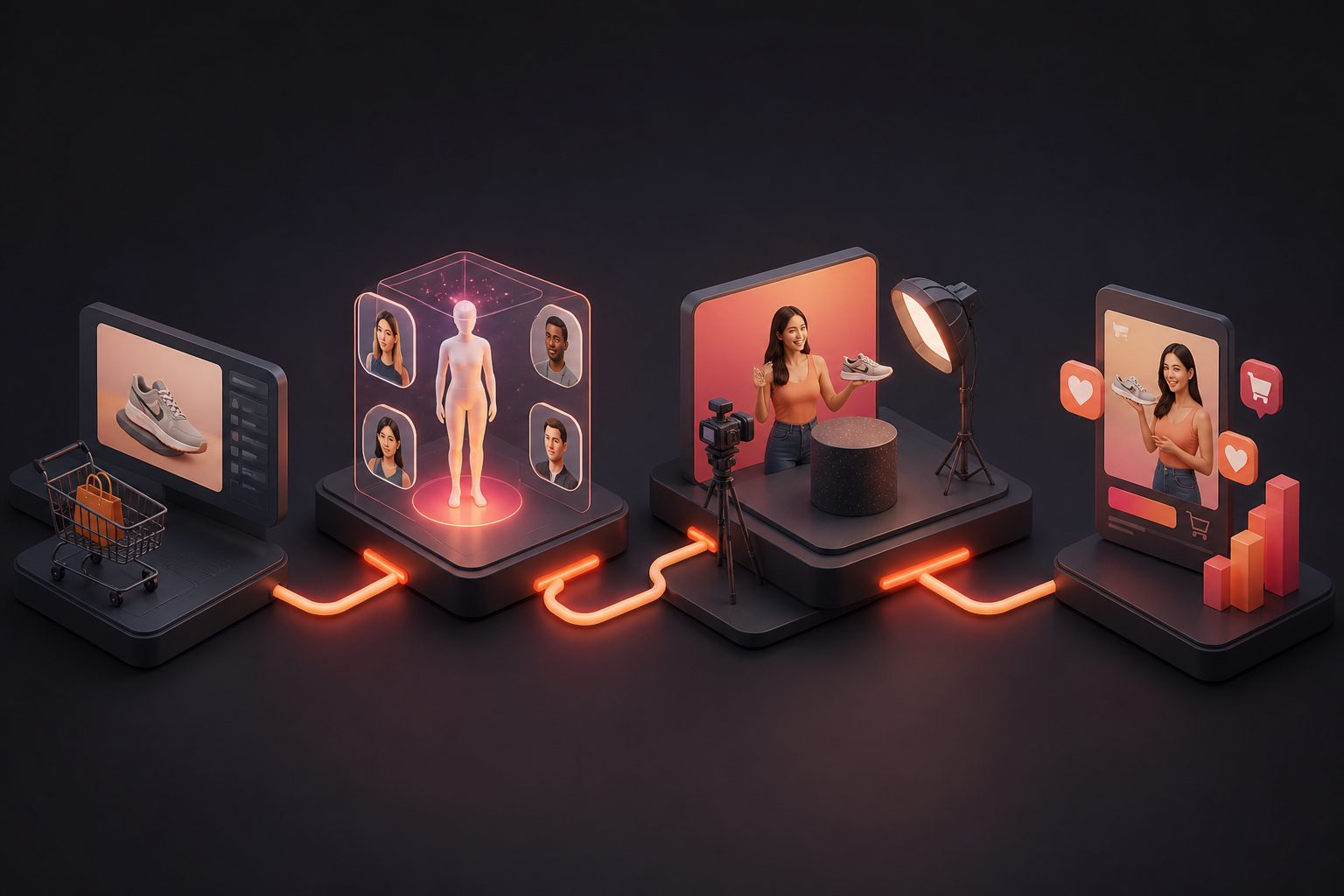
AdsTurbo also supports Clip by Clip editing, product videos, motion control, lip sync, character replacement, subtitles, translation, and video upscaling. This allows a strong concept to become multiple actors, languages, voiceovers, and formats without rebuilding the complete production each time.
For products without existing footage, a no-filming AI UGC workflow can begin with product imagery. AdsTurbo Product Video accepts JPG or PNG product images up to 10 MB and can generate review, introduction, and demonstration-style videos.
How Do You Prevent AI Variations From Looking Repetitive?
Prevent repetition by changing the advertising hypothesis before changing the surface treatment. A new actor reading the same script in the same setting is useful for persona testing, but it will not solve a weak message.
Maintain a creative ledger with these fields:
- Audience problem
- Hook premise
- Voiceover argument
- Proof type
- Objection addressed
- CTA
- Presenter
- Placement and aspect ratio
- Test date and outcome
When an asset underperforms, regenerate only the weakest component. Preserve a successful opening while replacing the proof scene, or retain a convincing demonstration while testing a new voiceover. This reduces unnecessary rendering and makes the next result interpretable.
For larger Meta campaigns, the same logic can expand into an 18-asset creative matrix covering multiple concepts, formats, and controlled iterations.
Frequently Asked Questions
How many ad variations should I generate?
Generate enough variants to cover distinct hypotheses, not an arbitrary quota. A 3×2×2 matrix creates 12 combinations, but smaller-budget advertisers should deploy them in waves instead of testing every combination simultaneously.
Can an AI ad generator solve creative fatigue?
It can accelerate refreshes, but volume alone does not solve fatigue. New ads must introduce different hooks, proof, use cases, personas, or offers. Cosmetic edits may extend an asset’s life without creating a genuinely new concept.
Which element should be tested first?
Test the hook first because viewers must continue watching before the voiceover or CTA can influence them. Keep later scenes stable during the initial hook test.
Should every winning ad be localized?
Localize only after confirming that the core concept works. Then adapt the voice, subtitles, on-screen text, presenter, examples, and CTA to the target market instead of performing a literal translation.
What should an AI ad creative variations generator preserve?
It should preserve accurate product appearance, approved claims, brand identity, offer details, and the control variables required by the experiment. Everything else should change only when tied to a clear hypothesis.