

Author: adsturbo.ai|Published: 2026-08-26|Updated: 2026-08-26
AI Ads Actors are synthetic or AI-assisted presenters used in video ads to demonstrate products, deliver scripts, localize messages, and create UGC-style creative variations without a traditional shoot. For ecommerce teams, their real value is not “replacing creators.” It is increasing the speed of structured creative testing while keeping product claims, platform disclosures, and brand consistency under control.
That distinction matters. A realistic avatar reading a generic script is rarely enough to improve paid performance. The useful workflow is more specific: choose a believable persona, match that persona to a buyer objection, place the product visually in the first seconds, then generate variations for hooks, languages, aspect ratios, and calls to action.
What are AI ad actors?
AI ad actors are digital presenters, avatars, or synthetic people used to appear in promotional videos. They may be fully generated, based on licensed avatar libraries, created from approved brand personas, or produced through face, voice, lip-sync, and motion-control workflows.
In ecommerce advertising, they usually appear in four formats:
- Talking-head UGC ads, where a presenter explains a product benefit.
- Product demo videos, where the actor points to, holds, or reacts to a product.
- Localized ads, where the same creative is translated and lip-synced into multiple languages.
- Variant testing ads, where the actor, hook, voice, scene, or CTA changes while the core offer stays the same.
AdsTurbo supports workflows that fit these use cases, including Ad Clone, Lip Sync, Product Video, Character Swap, Video Translation, Motion Control, Video Subtitle, Background Replace, and AI Upscaling. It also provides access to more than 300 AI actors and over 100 product ad templates.
Why ecommerce brands use them
Ecommerce teams use AI Ads Actors because paid social needs more creative learning than traditional production can usually supply. The bottleneck is no longer only media buying; it is producing enough credible video angles to test before creative fatigue sets in.
Digital video is taking a larger share of ad budgets. IAB’s 2025 Digital Video Ad Spend & Strategy Report reported that digital video was expected to capture nearly 60% of U.S. TV/video ad spend in 2025, while the full report noted that many buyers were already using or planning to use generative AI for digital video ad creation (IAB report).
For a small ecommerce team, the advantage is practical:
- More hooks: Test curiosity, problem-solution, discount, comparison, and testimonial-style openings.
- More personas: Try a skincare expert, busy parent, gamer, fitness buyer, or budget shopper without booking separate shoots.
- More markets: Translate, subtitle, and lip-sync the same concept for different regions.
- More formats: Export 9:16, 1:1, and 16:9 versions for TikTok, Meta, YouTube Shorts, listings, email, and landing pages.
- Faster iteration: Replace one weak scene instead of reshooting the whole ad.
The goal is not to make every video feel identical. The goal is to learn which promise, product moment, objection, and persona combination earns attention.
The AI actor selection framework most teams miss
The best AI actor is not the most realistic one; it is the one whose persona makes the product claim feel natural. A polished presenter can still fail if the actor, script, and buying situation do not match.
Use this original 4-part “PACT” framework before generating creative:
| Factor | Question to answer | Good sign | Risk sign |
|---|---|---|---|
| Persona | Who should viewers believe is speaking? | Matches the buyer’s context | Looks like a stock spokesperson |
| Angle | What objection or desire does the actor address? | One clear promise per video | Too many claims in 20 seconds |
| Context | Where should the product appear? | Product is visible early and often | Actor talks but product feels pasted in |
| Trust cue | Why should viewers keep watching? | Demo, comparison, proof, or relatable use case | Vague praise with no specifics |
For example, a beauty product should not default to a generic “influencer” actor. A better matrix might test: dermatologist-style explainer for ingredient trust, everyday user for routine fit, gift buyer for seasonal campaigns, and bargain hunter for bundle offers.
AdsTurbo’s product workflows can support this approach by combining product images, reference videos, selling points, and localized scripts. For teams starting from a product page rather than a full brief, the guide to turning a product page into ad creatives with URL to Video AI explains how a page can become structured creative input.
A practical workflow for producing AI actor ads
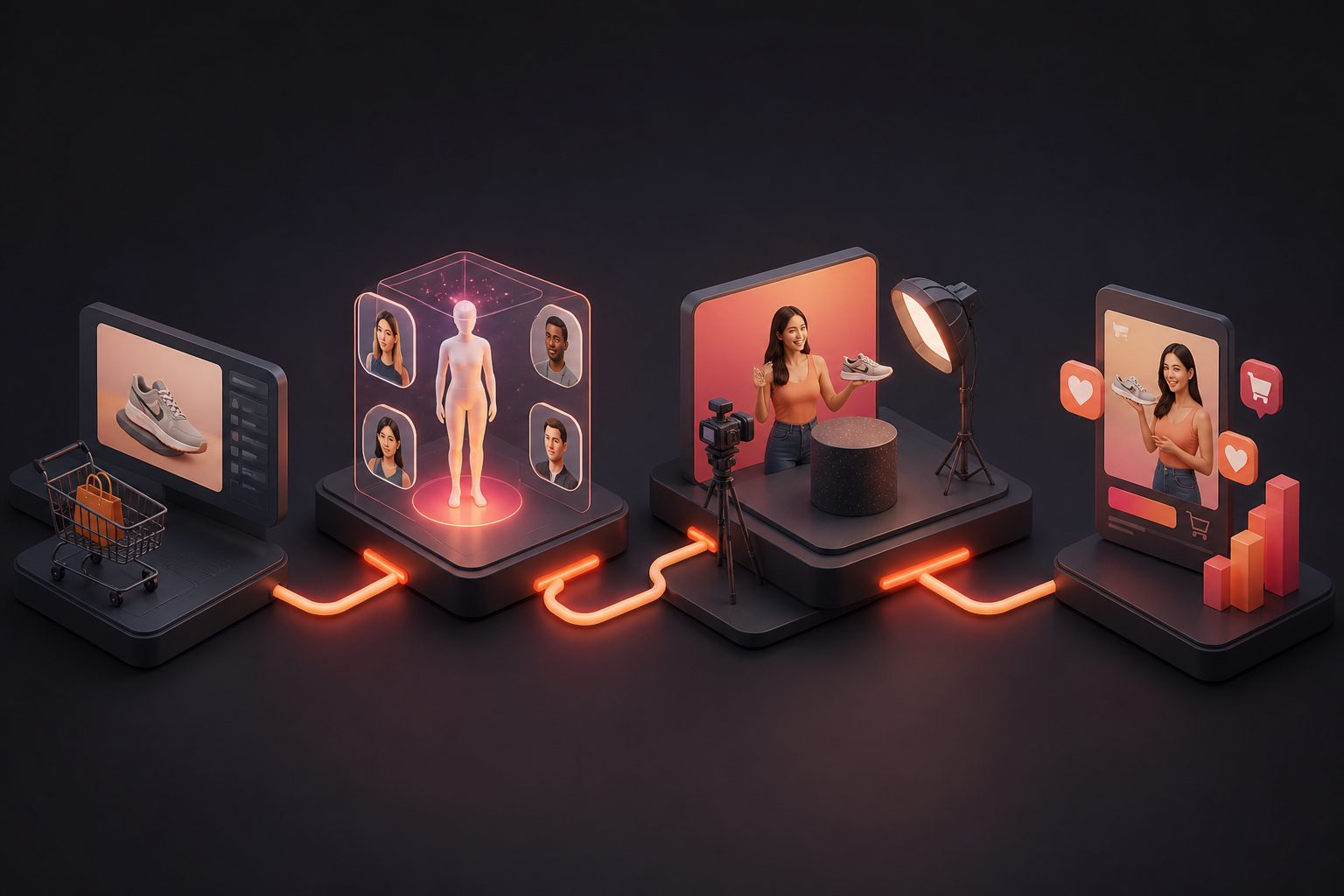
A reliable workflow starts with the offer, not the avatar. Select the product, define the buyer objection, write one short script, then generate controlled variations across actor, hook, language, and format.
A simple ecommerce workflow looks like this:
- Choose one product and one campaign job. Do not mix awareness, discount, demo, and retargeting in the same first script.
- Write a 20–35 second script. Put the product and problem in the first three seconds.
- Select an actor-persona match. Choose age, tone, styling, and energy based on the buyer segment.
- Add product visuals. Use clean JPG or PNG product images; clear photos on solid backgrounds tend to work best for product generation.
- Generate 3–6 variants. Change one major variable at a time: hook, actor, setting, CTA, or offer.
- Localize only winners. Translate and lip-sync videos after a concept shows promise in the source market.
- Upgrade and subtitle. Add social-ready captions, improve resolution when needed, and export channel-specific ratios.
AdsTurbo Product Video supports uploading a JPG or PNG product image up to 10MB and generating product review, introduction, or demonstration-style videos. The platform also supports asynchronous generation tasks, with completion available through status polling or Webhook callbacks for API workflows.
For ecommerce teams that want to generate ads directly from product assets, the guide to AI product video from URL for ecommerce teams is a useful companion workflow.
How AI actors compare with human creators
AI actors are better for rapid testing, localization, and controlled variation; human creators are stronger for lived experience, audience trust, and authentic community signals. The strongest creative systems often use both.
| Use case | AI actor is usually stronger | Human creator is usually stronger |
|---|---|---|
| Hook testing | Generate many openings quickly | Add personal improvisation |
| Localization | Translate, dub, subtitle, and lip-sync | Native cultural nuance and slang |
| Product education | Consistent script delivery | Expert credibility when real credentials matter |
| Social proof | Risky if it implies fake experience | Real testimonial value |
| Seasonal campaigns | Fast variant production | More distinctive creator style |
| Compliance control | Easier script review | Requires creator briefing and review |
The key risk is implied endorsement. If an AI presenter sounds like a real customer claiming personal results, viewers may interpret it as a testimonial. The FTC’s Endorsement Guides explain that endorsements can include messages consumers believe reflect someone else’s opinions or experiences, and disclosures must be clear and conspicuous when needed (FTC endorsement guidance).
A safer script says, “Here’s how the bottle works,” or “This is designed for…” rather than “I used this for 30 days and my skin changed,” unless that claim is backed by a real, substantiated testimonial.
Compliance: labels, likeness, and platform review
AI actor ads should be built with disclosure, consent, and claim substantiation from the start. The main risks are using a real person’s likeness without permission, presenting synthetic testimonials as real, or failing to label realistic AI-generated content where a platform requires it.
TikTok Ads Manager includes ad disclaimers for AI-generated, synthetic, or manipulated media, and its help center describes an AI-generated content disclaimer that adds a label to ads containing AI-generated content (TikTok Ads Manager disclaimer guidance). TikTok’s broader community guidelines also require clear labeling when AI realistically depicts people or scenes (TikTok Community Guidelines).
Meta has also expanded transparency around generative AI in ads and states that its approach will continue to evolve as technology and expectations change (Meta genAI transparency update).
In the United States, state-level rules are developing too. AP reported in June 2026 that New York enacted a law requiring ads featuring AI-generated people in place of actors to clearly label the use of a “synthetic performer” (AP report on New York synthetic performer labeling).
A practical compliance checklist:
- Use licensed AI actors or approved brand personas.
- Do not clone a real person’s face or voice without consent.
- Add AI-generated or synthetic performer disclosure when required.
- Avoid fake “I tried this” claims from a synthetic presenter.
- Keep product claims consistent with your landing page.
- Preserve source files, scripts, actor selections, and approvals.
- Review rules separately for TikTok, Meta, YouTube, Amazon, and local jurisdictions.
Creative patterns that work better than generic avatar videos
AI actor ads perform best when they are structured as product-led scenes, not just talking-head monologues. The actor should make the product easier to understand, compare, or trust.
Use these formats as starting points:
1. Problem-first hook
Open with the buyer’s pain point: “Still packing three chargers for one trip?” Then cut to the product in use. This works well for gadgets, travel accessories, storage products, and household problem-solvers.
2. Micro-demo
Show the product solving one task in 5–8 seconds. The actor narrates what is happening instead of overexplaining. This is stronger for visual products than a long testimonial-style script.
3. Objection handler
Give the actor one objection to answer: size, durability, fit, setup time, compatibility, shipping, ingredients, or use case. This format is useful for retargeting.
4. Localized presenter
Keep the product footage mostly constant, but change the language, subtitles, voice, and actor to fit each market. AdsTurbo supports video translation, lip sync, subtitles, and multilingual localization workflows.
5. Winning-ad reconstruction
Start from a reference video, extract the hook, pacing, shot logic, and CTA structure, then rebuild it around your product instead of copying the original asset. AdsTurbo’s Ad Clone workflow is designed to analyze reference material and generate new brand-specific ad variants.
For related character-based workflows, the guide to replacing a character in video with AI for ecommerce ads explains how character replacement can support audience testing and localization.
How to measure AI actor ad quality before spending media budget
Before launching, score every AI actor ad on clarity, trust, product presence, platform fit, and variation discipline. This avoids wasting budget on videos that look impressive but do not teach you anything.
Use a 1–5 score for each item:
| Criterion | What to check | Minimum launch standard |
|---|---|---|
| Hook clarity | Can a viewer understand the point in 3 seconds? | 4/5 |
| Product visibility | Is the product shown early and repeatedly? | 4/5 |
| Actor fit | Does the persona match the buyer and claim? | 3/5 |
| Lip-sync realism | Does speech look natural at normal speed? | 4/5 |
| Claim safety | Are all claims accurate and supportable? | 5/5 |
| Format fit | Are captions, crop, and CTA right for the channel? | 4/5 |
| Test design | Is only one major variable changed? | 4/5 |
A useful first test is 12 videos: three hooks, two actor personas, and two CTAs. Keep the product, offer, and landing page constant. If a hook wins across both actors, the message is probably stronger than the face. If one actor wins across hooks, persona-market fit may be the lever.
AdsTurbo Video Subtitle can automatically transcribe speech and generate time-synced subtitles, with styling suited to TikTok, Instagram Reels, and YouTube Shorts. Users can download videos with embedded subtitles or export separate subtitle files.
Where AdsTurbo fits in an AI actor production stack
AdsTurbo is designed for ecommerce sellers that need AI video ad generation, product creative variation, and multilingual localization in one workflow. It combines actor-led video creation with product image, editing, translation, and API capabilities.
Relevant AdsTurbo capabilities include:
- More than 300 AI actors and over 100 product ad templates.
- Ad Clone for reconstructing reference-video structure, pacing, hooks, shot logic, and CTA patterns.
- Product Video for turning JPG or PNG product images into UGC-style short video ads.
- Lip Sync, Character Swap, Motion Control, Video Translation, AI Upscaling, AI Eraser, Background Replace, and Video Subtitle.
- Product Image generation, white-background image processing, event poster creation, and background replacement.
- API modules for image generation, Persona, AI actors, Ad Clone, video generation, and task processing.
- Standard REST API authentication with Bearer API Key.
- Asynchronous task execution with status polling or Webhook callbacks.
- Advanced plans with team workflows and custom workflow support, plus API access on every plan.
For teams building a full ecommerce creative pipeline, adsturbo.ai can connect actor-led videos with product visuals, subtitles, translation, upscaling, and batch creative operations.
Common mistakes to avoid
Most AI actor ad failures come from weak creative direction, not from the AI actor itself. The tools can generate output quickly, but they cannot decide your positioning, proof, compliance posture, or testing logic for you.
Avoid these mistakes:
- Choosing the most attractive actor instead of the most relevant persona.
- Using one long generic script for every product.
- Making the actor talk before the product appears.
- Creating fake personal testimonials.
- Translating a video without adapting idioms, offer framing, or captions.
- Changing hook, actor, CTA, price, and landing page in the same test.
- Forgetting AI disclosure settings on platforms that require them.
- Exporting one aspect ratio and cropping it poorly across every channel.
The best AI actor ads feel like a clear product explanation from the right person in the right context. The worst ones feel like a synthetic spokesperson reading a catalog page.
Frequently asked questions
Are AI Ads Actors legal to use in ecommerce ads?
Yes, AI actors can be legal to use, but legality depends on consent, disclosure, claims, and jurisdiction. Use licensed synthetic presenters, avoid unauthorized face or voice cloning, follow platform AI labeling rules, and substantiate every product claim.
Do AI actor ads need an AI-generated label?
Often, yes, especially when the ad realistically depicts a synthetic person or manipulated media. Requirements vary by platform and location, so check TikTok, Meta, YouTube, Amazon, and applicable state or national rules before launch.
Are AI actors better than UGC creators?
They are better for speed, scale, and controlled testing; they are not automatically better for trust. Real creators remain valuable when personal experience, community credibility, or authentic testimonial content is central to the campaign.
What products work best with AI ad actors?
Visually demonstrable products work best. Beauty tools, gadgets, accessories, home goods, fitness items, apps, and problem-solving products usually benefit more than products that require deep expert validation or sensitive personal claims.
How many AI actor videos should a brand test first?
A practical first test is 8–12 videos. Combine two or three hooks, two actor personas, and two CTAs while keeping the product, offer, and landing page constant. This creates learning without turning the test into noise.
Final takeaway
AI Ads Actors are most useful when treated as a creative testing system, not a shortcut to instant performance. Ecommerce brands should use them to generate structured variants, localize winning concepts, refresh fatigued creatives, and keep production moving without losing control of claims or compliance.
The winning workflow is simple: start with the buyer objection, choose a persona that makes the message credible, show the product early, disclose synthetic media where required, and measure each variation against a clear hypothesis.