TikTok ads unoriginal content duplicate detection: How to Rebuild Winning Ads


Summarize with
Summary
Learn how TikTok ads unoriginal content duplicate detection works in practice, what makes an ad look repetitive, and how to rebuild winning concepts into original creatives. Use this workflow to reduc
By adsturbo.ai | Published 2026-10-23 | Updated 2026-10-23
TikTok ads unoriginal content duplicate detection is not a published pass/fail formula that advertisers can calculate with certainty. TikTok publicly describes unoriginal content as reproduced material without new or creative changes, while its advertising rules also address intellectual property, misleading edits, AI disclosure, and commercial transparency. (tiktok.com)
For ecommerce sellers, the practical lesson is simple: borrow the performance idea, not the identifiable execution. A new product, logo, crop, filter, or soundtrack may not be enough if the structure, footage, voice, captions, and on-screen action still look copied.
What does TikTok consider unoriginal content?
Unoriginal content is media reproduced or imported without meaningful new creative contribution. TikTok gives examples such as visible watermarks, superimposed logos, low-quality clips, and content that has not been meaningfully changed. Its Community Guidelines distinguish between content that violates intellectual property rights and content that may remain on the platform but is ineligible for recommendation. (tiktok.com)
For paid ecommerce ads, the risk usually falls into four overlapping categories:
| Risk area | What it can look like | Safer direction |
|---|---|---|
| Reused footage | The same creator, shots, gestures, and timing | Shoot or generate new scenes |
| Repeated structure | Identical hook, reveal, proof sequence, and CTA | Keep the problem, redesign the narrative |
| Visible source signals | Watermarks, logos, platform UI, or repost artifacts | Use clean, licensed source assets |
| Weak transformation | Minor crop, speed change, filter, or subtitle swap | Add new product logic, commentary, and visual evidence |
TikTok Shop guidance is especially direct: simply adding artistic effects, logos, or watermarks does not necessarily make copied content original. It also warns against manipulating edits or filters merely to disguise repetitive content. (seller-us.tiktok.com)
Is there a public duplicate-detection score?
No public TikTok document provides a numeric “duplicate score,” fixed similarity threshold, or guaranteed checklist for passing review. Claims about exact perceptual-hash thresholds or secret detection percentages should therefore be treated as speculation.
A more reliable interpretation is to assess creative identity across several layers:
- Source layer: Is the footage yours or properly licensed?
- Visual layer: Are the shots, subject, setting, and motion materially different?
- Narrative layer: Does the ad make a new argument or simply repeat the original?
- Audio layer: Is the voiceover, sound design, and spoken wording original?
- Commercial layer: Are the product claims, disclosure, and landing-page experience accurate?
This layered model is an editorial risk framework, not a statement of TikTok’s internal algorithm. It helps teams avoid overfocusing on superficial edits.
Why changing the product is not enough
A common ecommerce mistake is to take a successful competitor ad and replace the product while preserving almost everything else. The result may still resemble the source because viewers recognize the sequence, not just the item.
For example, these two concepts are materially different:
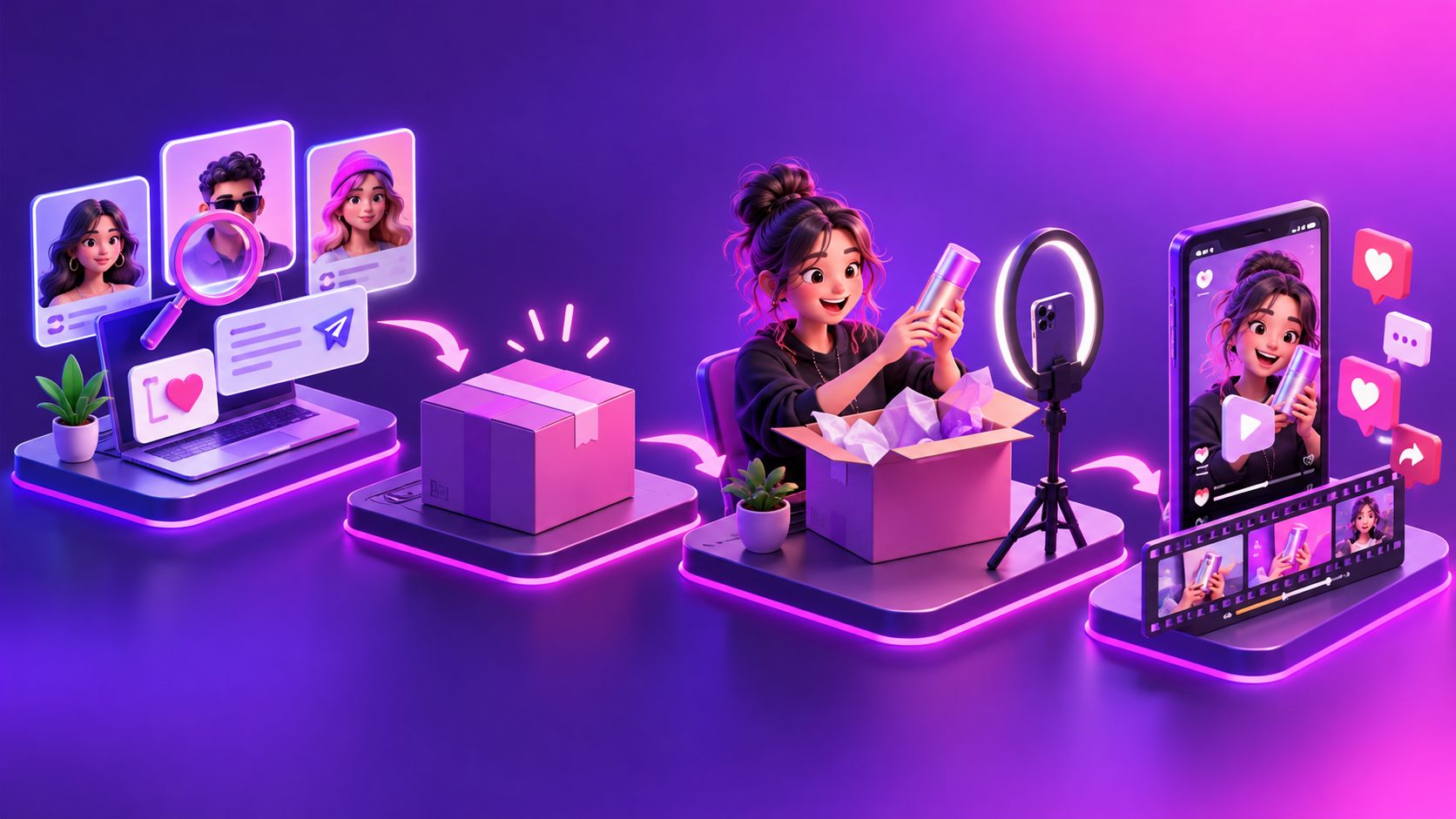
- “Creator opens package, reacts with surprise, demonstrates three features, ends with a discount.”
- “Customer starts with a failed alternative, shows a close-up of one product detail, tests it in context, then explains who should buy it.”
Both may use a product demonstration, but the second changes the buyer problem, proof mechanism, pacing, and CTA logic.
TikTok’s promotional guidance also warns against recreating a video that directly mirrors another creator’s actions. (seller-us.tiktok.com) The safest approach is to extract the principle—such as fast proof, a before-and-after explanation, or a comparison hook—then rebuild the execution from your own product facts.
How to turn a winning ad into an original creative
Use this five-step reconstruction workflow before producing variants.
1. Extract the ad’s conversion logic
Write down the reference ad without copying its exact script:
- Audience problem
- First three-second promise
- Proof type
- Objection addressed
- Product benefit
- Offer or CTA
- Emotional tone
This is the strategic layer. It is usually safer to reuse because ideas, facts, and general concepts are different from copying a specific expression. TikTok’s guidelines explain that copyright protects original expression rather than underlying ideas and facts. (tiktok.com)
2. Replace the narrative engine
Choose a new reason for the viewer to continue watching. Suitable ecommerce structures include:
- A product test with a measurable condition
- A mistake-and-correction story
- A side-by-side comparison
- A customer question answered on camera
- A use-case demonstration for a specific audience
- A visual unboxing focused on one decision point
Do not merely rewrite the same lines. Change the order of discovery so the viewer receives information differently.
3. Rebuild the visual grammar
Create a fresh shot list with different:
- Camera distance
- Subject movement
- Setting
- Product interaction
- Transition logic
- Text placement
- Demonstration order
A useful internal test is to mute both videos. If a reviewer can still describe them as “the same sequence,” the remake needs more than a new soundtrack.
4. Add product-specific evidence
Originality improves when the ad contains evidence that could not be copied from a generic competitor template. Examples include:
- A close-up of your product’s actual material
- A genuine setup or usage step
- A fit, size, compatibility, or care detail
- A customer objection answered with product-specific footage
- A comparison based on your own documented attributes
Avoid unsupported superiority claims. TikTok’s advertising policy restricts misleading, exaggerated, and absolute product claims. (ads.tiktok.com)
5. Produce controlled variations
A variation should change one strategic variable at a time, not create ten cosmetic copies. A practical test matrix is:
| Variable | Version A | Version B |
|---|---|---|
| Hook | Problem statement | Demonstration first |
| Proof | Close-up detail | Real-use scenario |
| Speaker | Founder-style voice | Customer-style narration |
| CTA | Shop the product | See how it works |
| Length | 15 seconds | 25 seconds |
This creates interpretable results. If every version changes the hook, actor, pacing, and offer simultaneously, performance data cannot tell you what mattered.
How AI can help without creating repetitive ads
AI is useful for scaling a new creative system, not for disguising duplicated footage. AdsTurbo supports ad cloning workflows that can analyze a reference video’s structure and help generate new advertising variants. The responsible use is to preserve the high-level hook, pacing intention, or CTA pattern while replacing the script, scenes, product proof, voice, and audience angle.
For ecommerce teams, the workflow can also include:
- Product-image-to-video generation for new product demonstrations
- Character replacement for testing different audience-facing personas
- Lip sync and video translation for localized versions
- Subtitle generation with downloadable embedded or separate subtitle files
- Background replacement and AI upscaling for cleaner source material
AdsTurbo’s AI UGC video workflow for ecommerce products can support product-image-based creative production, while its automatic captions workflow helps teams prepare readable versions for short-form placements.
AI edits should also be disclosed when required. TikTok’s advertising policy says significantly AI-modified media may need an AIGC label or clear disclosure, particularly when a real person is made to appear to do or say something they did not. (ads.tiktok.com)
What should you check before submitting a TikTok ad?
Run this final review:
- Rights: Confirm that footage, music, likenesses, logos, and product claims are authorized.
- Originality: Remove copied footage, platform watermarks, repost artifacts, and mirrored sequences.
- Transformation: Confirm that the narrative, visual proof, and spoken explanation are genuinely new.
- Disclosure: Apply commercial-content and AI disclosures where required. TikTok requires disclosure when content promotes a brand, product, or service. (ads.us.tiktok.com)
- Accuracy: Check that the landing page supports the ad’s claims and offer.
- Quality: Review captions, audio clarity, framing, product visibility, and mobile readability.
- Evidence log: Save source files, licenses, scripts, and the creative brief in case an appeal or internal review is needed.
For technical quality issues such as soft footage, a separate TikTok ads low-quality video fix guide can help your team improve resolution and export decisions without confusing quality enhancement with originality.
Frequently asked questions
Can I use a competitor’s TikTok ad as a template?
You can study its marketing structure, but copying its footage, wording, choreography, editing pattern, or distinctive presentation creates avoidable risk. Use the reference to identify a buyer insight, then produce a new execution with your own assets and evidence.
Does changing the soundtrack make an ad original?
Not by itself. Audio is only one layer. If the visual sequence, script, gestures, and CTA remain substantially the same, a new soundtrack may still leave the ad looking repetitive.
Can I reuse my own TikTok ad?
TikTok Shop guidance advises against reposting the same content because repeated uploads may not add new value. Instead, create a new version with a different customer question, proof sequence, opening, or product use case. (seller-us.tiktok.com)
Can AI-generated ads pass review?
There is no universal guarantee. AI-generated or significantly AI-modified content must still satisfy originality, intellectual-property, accuracy, disclosure, and quality requirements. Treat AI as a production aid, not a way to conceal copied material.
What is the safest way to scale winning creative?
Scale the insight into a modular system: multiple hooks, proof types, speakers, lengths, and CTAs. Keep documentation for the source assets and build each version around a distinct customer reason to watch.