


作者:adsturbo.ai|发布日期:September 9, 2026|更新日期:September 9, 2026
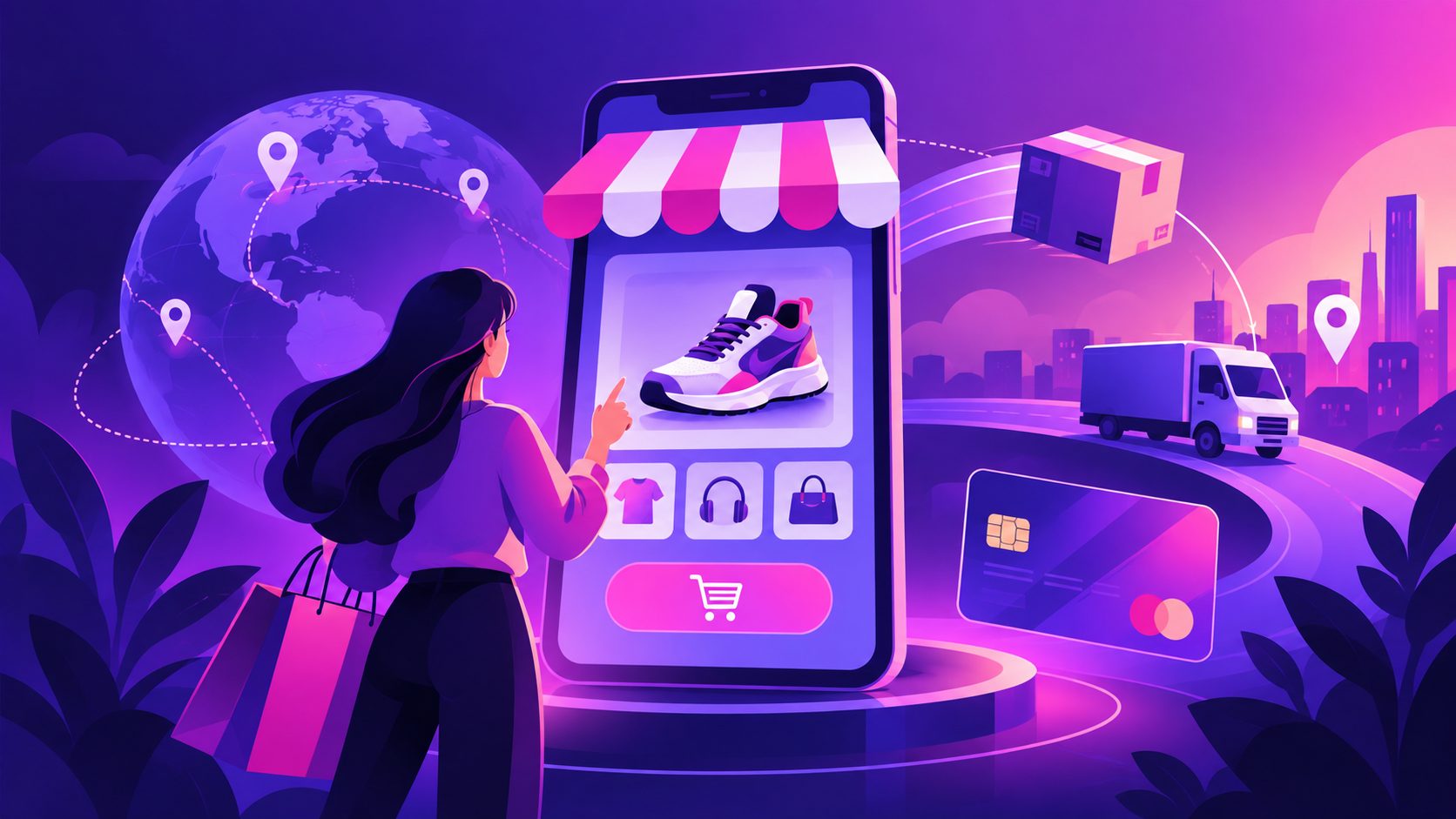
What is e-commerce? E-commerce is the buying or selling of goods and services through the internet or another computer network. It includes online stores, marketplaces, mobile commerce, social commerce, digital subscriptions, and business purchasing systems.
The important point is that e-commerce is defined by how an order is placed, not necessarily by how payment, delivery, or fulfillment happens. The OECD definition of e-commerce focuses on orders made through computer networks, while the U.S. Census Bureau definition also allows payment to happen offline.
What does e-commerce include?
E-commerce covers more than a customer clicking “Buy Now.” It is a connected system that includes product discovery, merchandising, advertising, ordering, payment, fulfillment, customer service, and retention.
Common examples include:
- Buying clothing from a brand’s website
- Purchasing household products on Amazon or another marketplace
- Ordering food through a mobile app
- Subscribing to software or digital content
- A retailer ordering inventory from a wholesaler
- A customer selling a used item through a peer-to-peer platform
- A company responding to an online procurement request from a government agency
This broad definition explains why e-commerce can look very different across industries. A physical product seller may need inventory and shipping, while a software company may deliver access immediately after payment.
In the United States, the scale of online retail is substantial. The U.S. Census Bureau estimated $340.2 billion in retail e-commerce sales for the second quarter of 2026, representing 17.1% of total retail sales for that quarter. These figures measure retail sales, not every form of digital commerce.
What are the main e-commerce business models?
E-commerce business models describe who sells to whom and how value changes hands. The most common models are B2C, B2B, C2C, C2B, and B2G.
| Model | Meaning | Typical example |
|---|---|---|
| B2C | Business to consumer | A brand selling skincare directly to shoppers |
| B2B | Business to business | A manufacturer selling inventory to a retailer |
| C2C | Consumer to consumer | An individual selling used furniture online |
| C2B | Consumer to business | A creator licensing content to a company |
| B2G | Business to government | A supplier responding to online public procurement |
B2C and direct-to-consumer commerce
B2C is the model most people associate with online shopping. A business sells products or services to individual customers through its own store, a marketplace, a social platform, or a combination of channels.
Direct-to-consumer, or DTC, is a specific B2C approach in which the brand sells directly rather than relying entirely on wholesalers or traditional retail distribution. DTC sellers typically control more of the customer experience, including product pages, email capture, advertising creative, and post-purchase communication.
Marketplaces versus owned stores
A marketplace provides built-in traffic, payment processing, and often fulfillment infrastructure. The trade-off is less control over customer data, presentation, fees, and platform rules.
An owned store gives a seller more control over branding, merchandising, customer relationships, and first-party data. However, the seller must usually create more of its own demand through search, social media, email, partnerships, or paid advertising.
Many successful sellers use both. A marketplace can provide reach, while an owned store supports brand building and repeat purchases.
How does e-commerce work?
E-commerce works through a sequence of commercial and operational steps, from attracting attention to delivering the promised value.
- Product discovery: A customer finds an item through search, social media, an ad, an influencer, email, or a marketplace.
- Evaluation: The customer reviews images, video, price, features, reviews, shipping details, and return terms.
- Order placement: The buyer selects a product, enters delivery information, and submits an order.
- Payment authorization: A payment processor, bank, wallet, or marketplace confirms the transaction.
- Order processing: The seller or fulfillment partner checks inventory and prepares the order.
- Delivery or access: A physical product is shipped, or a digital product or service is made available.
- Support and retention: The business handles questions, returns, refunds, reviews, replenishment, or future offers.
A key operational detail is often overlooked: the payment does not have to happen online for an order to qualify as e-commerce under the U.S. Census Bureau’s measurement approach. The ordering method is the defining factor.
What is the difference between e-commerce and e-business?
E-commerce focuses on online buying and selling. E-business is broader and includes the digital systems that support a company’s operations, such as internal communication, inventory management, human resources, procurement, analytics, and customer relationship management.
For example, an online checkout is e-commerce. A warehouse management system connected to that checkout is part of e-business. The two concepts overlap, but they are not identical.
This distinction matters for sellers because a storefront alone does not create a reliable online business. Product data, logistics, advertising, customer support, and measurement all influence whether the transaction can scale.
Why do product videos matter in e-commerce?
Product pages answer rational questions, but video can demonstrate motion, use, scale, texture, and context faster than static images. For sellers competing in social feeds and marketplace listings, short-form video is also a practical way to test different hooks, audiences, offers, and calls to action.
A useful seller-side framework is the four-layer commerce creative loop:
- Clarity: Can the viewer identify the product and its use quickly?
- Relevance: Does the scenario match a specific customer or problem?
- Proof: Does the creative show a feature, result, demonstration, or credible use case?
- Action: Is the next step clear, such as visiting a product page or claiming an offer?
This framework adds an important distinction: an attractive video is not automatically a useful commerce asset. The creative must connect product understanding to a measurable next action.
For sellers working from limited assets, AdsTurbo can turn JPG or PNG product images into product-focused video concepts, including product review, introduction, and demonstration formats. Its AI product video generator is designed around creating testable ecommerce ad assets rather than treating video as a one-off production project.
How can e-commerce sellers scale creative testing?
Creative testing becomes more manageable when sellers separate the variables instead of changing everything at once. A practical test matrix can vary:
- Hook: problem, benefit, comparison, curiosity, or offer
- Presenter: different AI actors, personas, or character styles
- Proof type: demonstration, close-up, testimonial-style explanation, or feature callout
- Offer: discount, bundle, free shipping, or limited-time promotion
- Format: 9:16 for short-form video, 1:1 for feeds, or 16:9 for wider placements
- Market: different languages, voiceovers, subtitles, and cultural references
AdsTurbo offers tools for ad cloning, motion control, lip sync, character replacement, video translation, upscaling, subtitles, and product video generation. Its Ad Clone workflow can analyze a reference video of up to 12 seconds and generate advertising variations based on its structure. The video ad variation workflow provides a relevant approach for organizing A/B creative tests.
For localization, sellers can pair translated audio with synchronized mouth movement and platform-ready subtitles. AdsTurbo’s multilingual dubbing workflow is relevant when the same product needs different language versions for regional campaigns.
All AdsTurbo generation tasks run asynchronously. Completion can be received through status polling or Webhook callbacks, which is useful when a seller is generating multiple assets or connecting production to an internal workflow. Higher-level plans also support team workflows, API access, and custom workflows.
What are the benefits and challenges of e-commerce?
The main benefits include broader market access, 24/7 availability, measurable customer journeys, flexible product presentation, and the ability to sell through multiple channels.
The main challenges include:
- Customer acquisition costs
- Platform dependence
- Shipping delays and returns
- Payment fraud and chargebacks
- Data privacy obligations
- Product quality expectations
- Creative fatigue
- Differences in local tax, language, and consumer behavior
Trust is especially important because customers cannot physically inspect a product before purchase. Clear product information, accurate delivery promises, transparent return policies, secure payment handling, and credible reviews all reduce uncertainty. The Federal Trade Commission’s online shopping guidance recommends checking sellers, comparing total costs, reviewing delivery and refund terms, and keeping purchase records.
Frequently Asked Questions
What is e-commerce in simple terms?
E-commerce is the online exchange of goods or services. A customer, business, or government entity places an order through an internet-connected system, and the seller provides the product, service, or access.
Is e-commerce only for physical products?
No. E-commerce includes physical goods, digital products, subscriptions, software, bookings, professional services, and other transactions where ordering happens electronically.
What is the most common e-commerce model?
B2C, or business-to-consumer commerce, is the model most familiar to shoppers. It includes brands selling directly through websites, apps, marketplaces, and social commerce channels.
Do e-commerce payments have to happen online?
No. Under the U.S. Census Bureau’s definition, a transaction may still count as e-commerce when the order is placed online but payment is completed through another method.
How do videos support e-commerce marketing?
Videos can show how a product looks, works, or fits into a customer’s life. Sellers can also use multiple creative variations to test hooks, presenters, offers, languages, and formats before scaling ad spend.


