

By AdsTurbo Team | Published 2026-10-20 | Updated 2026-10-20
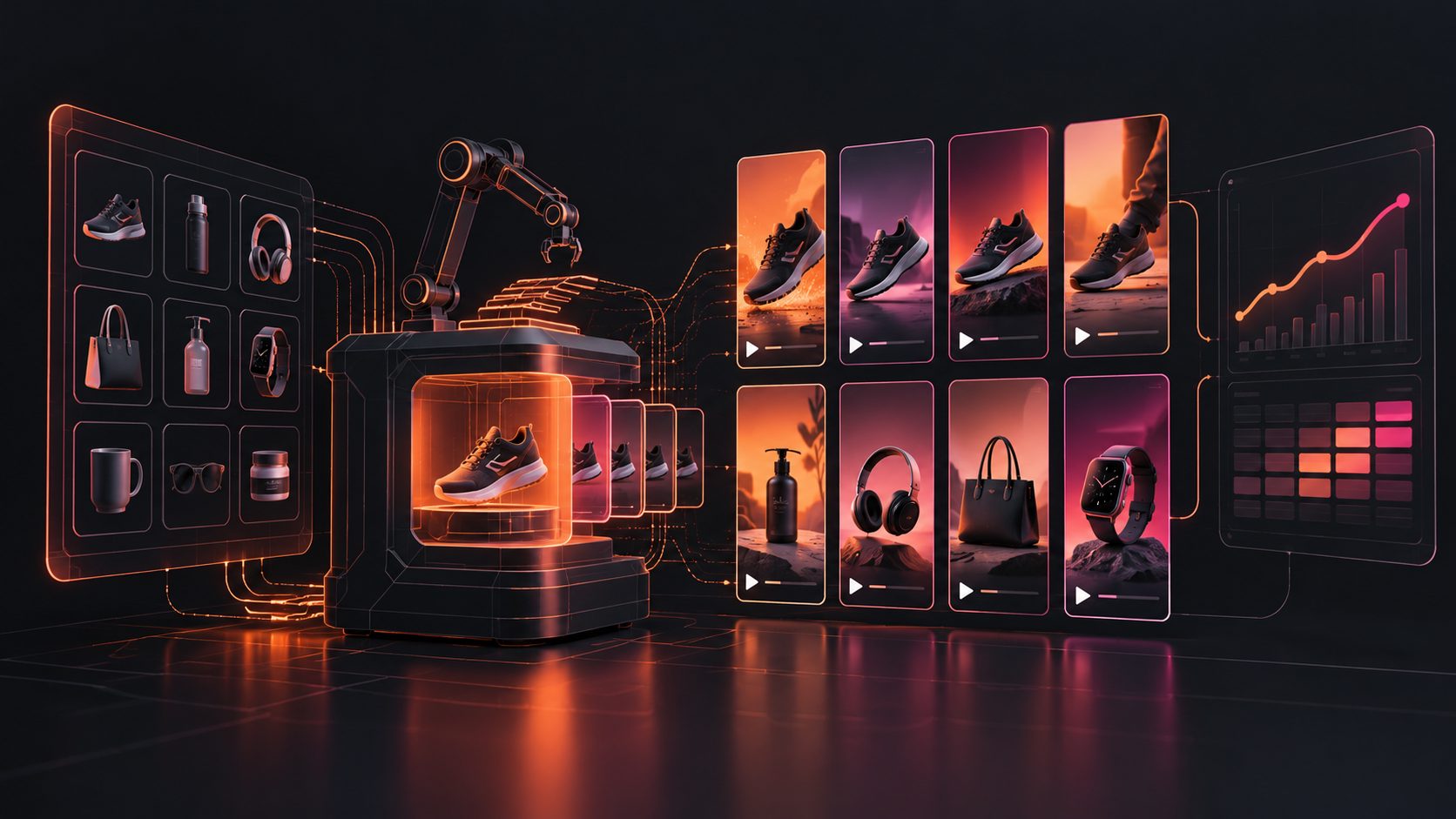
A bulk TikTok product video generator helps ecommerce sellers turn product images, selling points, and reference creatives into multiple short-form video variations. The useful goal is not producing a large folder of similar clips. It is building a controlled testing system for hooks, product benefits, presenters, offers, and calls to action.
For Shopify and TikTok Shop sellers, this approach can reduce the bottleneck between identifying a promising SKU and publishing enough creative variations to learn what works.
What is a bulk TikTok product video generator?
A bulk TikTok product video generator is a workflow that creates multiple product-focused videos from organized ecommerce inputs such as product images, descriptions, benefits, promotions, and creative references.
The strongest workflows separate inputs, creative variables, and review:
- Inputs: product photos, product name, selling points, price or promotion, and target audience.
- Creative variables: opening hook, visual angle, presenter style, voice, captions, pacing, and CTA.
- Review: product accuracy, claims, subtitles, formatting, brand consistency, and platform compliance.
TikTok’s own Seller Center AI Video Maker follows a similar review-oriented model: sellers select a product and assets, generate a video, review or revise the result, and complete posting settings before publishing. (seller-us.tiktok.com)
The difference between simple automation and useful bulk production is controlled variation. If every output changes at once, performance data becomes difficult to interpret.
Why batch production matters for Shopify and TikTok Shop sellers
Batch production is valuable because one product rarely has only one plausible sales angle. A skincare product might be positioned around convenience, visible texture, routine simplicity, or a seasonal promotion. A kitchen tool might be shown through a problem-first demonstration, a comparison, or a quick recipe.
A seller who produces only one video is testing one creative idea. A seller who produces a structured batch can compare several hypotheses without reshooting every product.
The leading bulk-video workflows commonly emphasize catalog coverage, reusable creative variables, product libraries, and review before publishing. (neobund.com) That is the right operational direction, but many workflows stop at “generate more videos.” The missing layer is a testing design that explains what each variation is intended to prove.
The 4-variable testing matrix
A practical matrix for ecommerce video testing uses four dimensions:
| Variable | Example options | What it helps evaluate |
|---|---|---|
| Hook | Problem, curiosity, result, comparison | Which opening earns attention |
| Product angle | Feature, use case, demonstration, proof | Which benefit creates interest |
| Persona | Founder, creator, expert, everyday user | Which messenger feels credible |
| Offer | Discount, bundle, urgency, free shipping | Which commercial framing drives action |
For example, one SKU can produce:
- 3 hook types
- 2 product angles
- 2 presenter styles
- 2 CTAs
That creates a 24-cell creative map, but you do not need to publish all 24 immediately. Start with 6–8 clearly different variations, then expand around the strongest signal.
This is more informative than generating 20 videos where only the background music changes.
How to turn a winning TikTok into a product-specific batch
A reference video can provide useful structural guidance without copying its product claims or identity. The goal is to study the mechanics:
- Opening pattern: Does the video begin with a question, visual surprise, problem, or result?
- Scene sequence: What happens in the first few shots?
- Proof moment: When does the viewer see the product working?
- Pacing: How quickly do cuts, captions, and visual changes occur?
- CTA structure: Is the viewer asked to shop, compare, save, comment, or act before a deadline?
AdsTurbo’s Ad Clone workflow is designed to analyze a reference video and reconstruct its structure, pacing, shot logic, and CTA pattern for new advertising variations. Its Ad Clone API can analyze reference videos up to 12 seconds and generate ad variations in parallel.
A useful rule is to preserve the creative skeleton, not the surface details. Keep the rhythm and communication logic, but replace the product, claims, visuals, voice, and audience context.
For a practical product-image workflow, see the guide to turning a TikTok Shop product image into a video ad.
A repeatable bulk workflow for product video testing
1. Prepare a clean product input
Start with a clear JPG or PNG product image. AdsTurbo Product Video supports product images up to 10 MB and can use optional selling points or promotional information.
A clean image on a simple background is usually easier to analyze than a cluttered lifestyle image. For product-image generation, AdsTurbo recommends clear product photos on a solid-color background for the best result.
Prepare these fields before generation:
- Product name
- Primary customer problem
- Three defensible benefits
- One proof point
- Promotion or offer
- Target customer
- Prohibited or restricted claims
2. Write hooks by customer tension
Avoid generating hooks that all say “You need this product.” Instead, group them by customer tension:
- Frustration: “Still dealing with this every morning?”
- Discovery: “I did not expect this feature to matter.”
- Demonstration: “Watch what happens when…”
- Comparison: “The difference is visible in one step.”
- Use case: “For small kitchens, this changes the setup.”
Each hook should lead naturally into a product demonstration. A strong opening that never proves the claim will create curiosity without purchase intent.
3. Create controlled variations
Use a naming system that makes the batch readable:
SKU_Hook_Angle_Persona_Offer_Version
Example:
MUG01_Problem_Demo_Creator_Bundle_V2
This simple structure helps a team identify which variable changed. It also makes later performance reviews more useful than filenames such as final_video_17.mp4.
AdsTurbo supports product videos, Ad Clone, video subtitles, translation, character replacement, lip sync, motion control, background replacement, and AI upscaling. These tools can support different stages of the batch workflow, from initial creation to localization and finishing.
For a broader process, use this AI UGC video ads workflow for ecommerce testing.
4. Review before publishing
Bulk generation does not remove the need for human review. Check every variation for:
- Correct product shape, color, size, and packaging
- Accurate on-screen text
- Subtitles that match the spoken audio
- Claims that can be supported
- Clear product visibility
- Correct TikTok Shop product linkage
- Appropriate disclosures and promotional terms
- Safe cropping in a vertical 9:16 frame
TikTok’s seller guidance specifically recommends reviewing generated videos and refining or regenerating them before posting. (seller-us.tiktok.com)
How to decide which videos deserve more production
Do not scale a variation simply because it receives views. Use a staged decision model:
- Attention check: Does the opening retain viewers long enough to reach the product explanation?
- Message check: Do viewers understand the product and its benefit?
- Action check: Does the video generate product clicks, add-to-carts, or purchases?
- Replication check: Can the winning idea be adapted to another SKU or audience?
A useful interpretation framework is:
- High views, low clicks: the hook may be entertaining but commercially weak.
- Low views, strong conversion rate: the offer or product angle may be valuable but needs a better opening.
- Strong clicks, low purchases: investigate product-page clarity, price, shipping, trust, or offer strength.
- Strong performance across several hooks: expand the product angle and localize it into more formats.
This prevents the common mistake of optimizing only for top-of-funnel metrics.
Common questions
Can one product image create multiple TikTok videos?
Yes. A single product image can serve as the source for multiple creative directions, including product demonstrations, UGC-style explanations, benefit-led videos, and promotional variations. Better results come from changing the message and structure, not only the visual background.
Is bulk video generation the same as reposting one video many times?
No. Reposting creates distribution volume, while structured batch production creates testable differences. Each version should have a clear purpose, such as testing a new hook, audience, product benefit, or offer.
Should Shopify sellers and TikTok Shop sellers use the same video?
They can reuse the core creative, but the final version should match the destination. Check the product link, caption, CTA, safe zones, disclosures, and customer expectations for each channel.
How can sellers localize a winning video?
Translate the spoken content and subtitles, then review timing and lip movement. AdsTurbo provides video translation, lip sync, and subtitle tools for adapting product videos across languages. Its Video Subtitle tool can export either a video with embedded captions or a separate subtitle file.
What is the best first batch size?
Start with 6–8 distinct variations for one priority SKU. Use different hooks and product angles first. Once a meaningful signal appears, produce more versions around the strongest combination instead of expanding every variable equally.
Build a repeatable creative system
A bulk TikTok product video generator becomes valuable when it is connected to a learning loop:
Product inputs → creative matrix → batch generation → quality review → publishing → performance analysis → next batch.
For sellers with larger catalogs, AdsTurbo supports asynchronous generation with status polling or Webhook completion events. Advanced plans also support team workflows, API access, and custom workflows. That makes it possible to connect video production with catalog operations rather than treating every asset as a one-off task.
Start with one product, define the variables you want to test, and create a batch that produces interpretable evidence. The objective is not more videos by itself. It is faster learning about which message, proof point, and audience angle can move a product forward.