


By adsturbo.ai | Published 2026-10-03 | Updated 2026-10-03
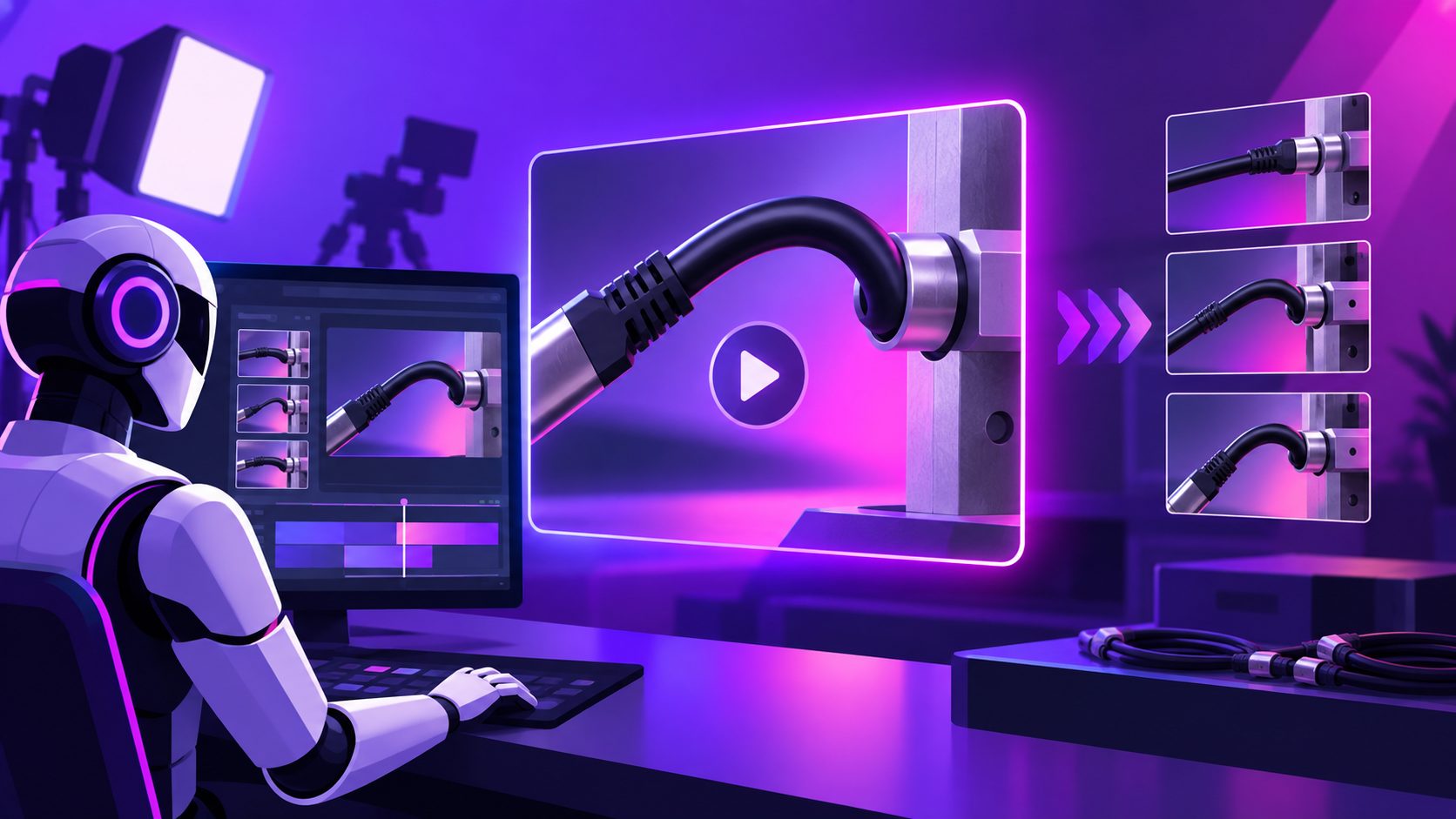
A cable bending test video ad generator AI helps ecommerce sellers turn genuine durability-test footage into a short, structured advertisement. The strongest version does not fabricate an extreme test. It compresses real evidence—product identity, test conditions, repeated bending, electrical continuity, and the final result—into a credible 15-second story.
For USB-C cables, charging cords, adapters, and other 3C accessories, this proof-first approach can communicate durability faster than a list of materials or specifications. The challenge is preserving enough context that viewers understand what was actually tested.
What Is a Cable Bending Test Video Ad Generator AI?
A cable bending test video ad generator AI is a production workflow that combines authentic test footage with AI-assisted scripting, editing, captions, localization, and format adaptation. It converts a long or repetitive laboratory recording into a concise product-proof ad without replacing the underlying evidence.
A useful system should help sellers:
- Identify the strongest visible proof in the source video.
- Build a hook around the cable’s common failure point.
- Preserve test-machine, counter, and continuity details.
- Add readable claims and qualifications.
- Export versions for TikTok, Meta, YouTube Shorts, or marketplace placements.
AI should organize and clarify the test—not invent bends, sparks, counters, certifications, or post-test performance that the original footage does not show.
What Evidence Should Be Captured Before Editing?
Record the test method before writing the advertising claim. A cycle count alone is difficult to evaluate because bend angle, radius, applied load, speed, fixture position, sample count, and failure criteria can materially change the result.
For example, Consumer Reports’ charging-cable durability test used a motorized rig to bend 11 cable models to 90 degrees while checking whether they continued powering a device. The USB-IF also publishes mechanical and electrical compliance criteria for USB Type-C cable assemblies.
Capture these elements in the raw footage:
| Evidence element | What the camera should show | Safer claim style |
|---|---|---|
| Product identity | Connector, jacket, strain relief, SKU label | “Tested with model X” |
| Test geometry | Fixture and visible bending motion | “Bent repeatedly at the connector joint” |
| Cycle evidence | Machine counter or documented endpoint | “Completed 10,000 cycles under this method” |
| Functional check | Charging, continuity, or data test | “Continued charging after the test” |
| Sample scope | Number of tested units | “Result shown for the tested sample” |
Avoid turning one successful sample into a broad statement such as “never breaks.”
How Do You Structure the 15-Second Video?
Use five shots: failure concern, test setup, repeated stress, functional verification, and product payoff. This sequence answers the viewer’s main question—“Will this cable survive daily bending?”—without making the ad feel like a technical lecture.
-
0–2 seconds: Show the weak point.
Open with a macro shot of the connector joint. Use a hook such as: “This is where charging cables usually fail.” -
2–5 seconds: Establish the method.
Reveal the identified cable inside the bending rig. Show the clamp, bend direction, and cycle counter where available. -
5–9 seconds: Compress repetition.
Speed up authentic test footage while keeping the motion consistent. Overlay only the verified cycle count. -
9–12 seconds: Verify the outcome.
Show the tested cable powering a device or passing the documented continuity check. -
12–15 seconds: Present the product and CTA.
End with a clean product shot, the qualified durability statement, and a simple action such as “See specifications” or “Shop the tested design.”
How Can AI Turn Real Test Footage Into Ad Variants?
A cable bending test video ad generator AI works best when the source package includes the original video, a clear product image, the approved test statement, and the desired platform. Keep those assets together so every variant traces back to the same evidence.
A practical AdsTurbo workflow can include:
- Extract the source video’s hook, pacing, shot logic, and CTA structure with an ad script breakdown workflow.
- Rebuild the edit clip by clip, preserving the real bending sequence and verification shot.
- Add time-synchronized subtitles for sound-off viewing.
- Use AI upscaling when compression makes the connector, counter, or strain relief difficult to inspect; follow a controlled ecommerce video upscaling workflow.
- Translate voice and captions for regional campaigns using a multilingual product video workflow.
AdsTurbo supports clip-by-clip editing, subtitles, video translation, AI upscaling, product video creation, and background replacement. Generate aspect-ratio and language variants only after the master evidence sequence is approved.
How Do You Measure Whether the Ad Looks Credible?
Use a Proof Density Score instead of judging the video by visual polish alone. This original five-part framework awards zero, one, or two points for each evidence category, producing a maximum score of 10.
- Identity: Is the tested product unmistakably the advertised SKU?
- Method: Can viewers see how and where the cable was bent?
- Continuity: Does the sequence avoid unexplained cuts or product swaps?
- Outcome: Is post-test function visibly or instrumentally checked?
- Qualification: Does the wording state the cycle count and test scope accurately?
A score of 8–10 indicates a strong evidence chain. A score of 5–7 suggests that the claim may be plausible but lacks context. Below 5, the creative behaves more like a durability-themed demonstration than documented product proof.
This score does not predict conversion lift. It is an editorial control for finding missing evidence before media spend begins.
Which Editing Mistakes Reduce Trust?
The biggest mistake is making the generated ad look more conclusive than the source test. Dramatic effects may increase attention while simultaneously weakening the credibility of the product claim.
Avoid:
- Generating a fake mechanical counter.
- Hiding the fixture with excessive close-ups.
- Cutting from one cable into a different post-test sample.
- Adding sparks, snapping sounds, or deformation that did not occur.
- Saying “lab certified” without a relevant certification.
- Presenting accelerated footage as real-time footage.
- Claiming a lifetime equivalent without documenting the usage assumption.
The FTC states that advertising claims must be truthful, non-deceptive, and evidence-based. Its advertising substantiation guidance also explains that advertisers should possess a reasonable basis for objective claims before publishing them.
Frequently Asked Questions
Can AI generate the entire bending test from one product photo?
AI can create a durability-themed visualization, but that visualization should not be presented as evidence of a real test. Record the physical test separately and use AI for scripting, captions, pacing, cleanup, localization, and variant production.
What claim should appear on screen?
Use the narrowest claim supported by your documentation. “Completed 10,000 bends under our stated test method” is more precise than “unbreakable,” especially when only a limited number of samples were tested.
Should the ad show the complete test?
No. A 15-second ad can accelerate repetitive sections, but it should retain the product identity, test setup, cycle evidence, and functional result. Place fuller methodology on the product page when necessary.
Can the same video be localized for multiple markets?
Yes. The cable bending test video ad generator AI workflow can preserve the evidence sequence while changing subtitles, voice, CTA, and offer language. Keep numerical claims and qualifications consistent unless each market has different verified documentation.
Which creative element should be tested first?
Test the opening two seconds first: connector close-up, bent-cable problem shot, machine-in-motion shot, or cycle-count hook. Keep the underlying proof sequence unchanged so the experiment measures the hook rather than a different durability claim.
Turn Durability Testing Into Buyer-Readable Proof
The best cable ad is not the one with the most violent bending animation. It is the one that lets a shopper quickly connect a familiar failure point with a documented result.
Use a cable bending test video ad generator AI to compress authentic evidence, create platform-ready variants, and localize the message. Keep the test method visible, qualify the claim, and make every generated scene traceable to something your team can prove.