Foundation Wear Test Video Ad: A Trust-Building DTC Framework

Summarize with
Summary
Learn how to create a credible foundation wear test video ad with controlled comparisons, anti-oxidation checks, shot timing, and scalable AI production. Build your test plan.
By adsturbo.ai | Published 2026-10-22 | Updated 2026-10-22
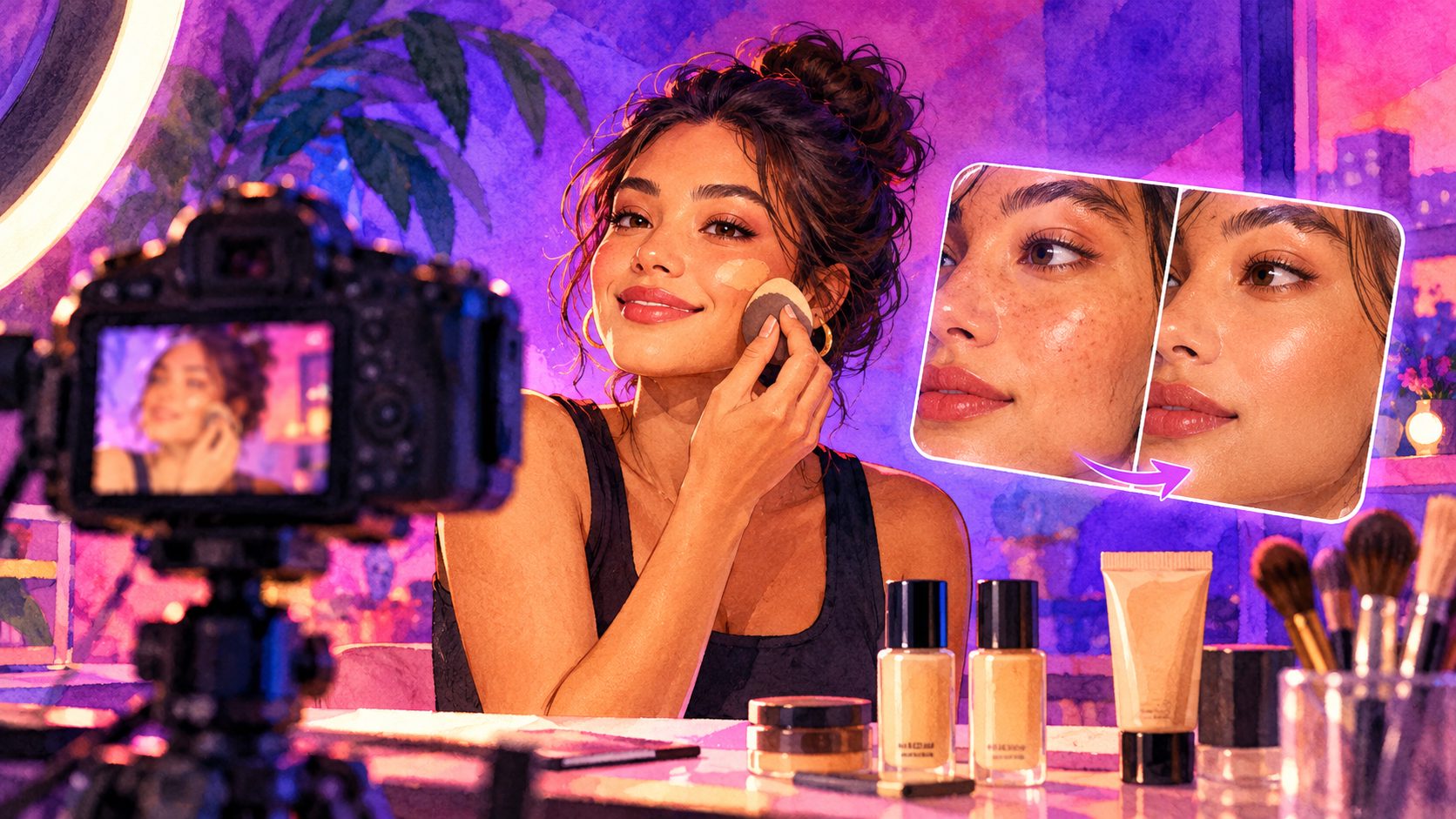
A foundation wear test video ad shows how makeup performs after application, time, movement, oil, heat, and everyday friction. The strongest versions do more than show a polished before-and-after: they make the test conditions visible, compare predictable failure points, and give viewers enough evidence to judge the result.
For beauty DTC brands, this format can turn vague claims such as “long-lasting” or “all-day coverage” into a clear, watchable experiment.
What makes a foundation wear test video ad credible?
A credible foundation wear test video ad connects a specific product promise to a repeatable test. If the claim is oil control, show the T-zone at several time points. If the claim is low oxidation, compare the freshly applied shade with the same shade after a defined waiting period. If the claim is transfer resistance, show contact with a tissue or mask rather than simply stating the result.
Search results for foundation wear tests commonly emphasize application, before-and-after coverage, and real-world longevity. Editorial tests also often disclose conditions such as skin type, primer use, weather, and wear duration. (mamabella.uk)
The missed opportunity is that many short ads compress the test into a single “morning versus night” transition. That makes the result visually attractive, but it does not explain what changed, why it changed, or whether the comparison was controlled.
The four proof layers
Use four layers to make the video easier to believe:
- Application proof: texture, coverage, blending, and finish.
- Time proof: clearly labeled checkpoints such as 0, 4, 8, and 12 hours.
- Stress proof: oil, sweat, humidity, mask friction, or nose-and-glasses wear.
- Comparison proof: a consistent split-face, swatch, or side-by-side control.
This structure is more useful than simply adding a dramatic close-up at the end.
How should you design the test before filming?
Start with one primary claim and no more than two supporting claims. A wear test becomes difficult to interpret when it tries to prove coverage, hydration, transfer resistance, oxidation, pore blurring, and waterproofing in the same 15 seconds.
A practical test sheet can look like this:
| Test element | Recommended setup | What to show |
|---|---|---|
| Skin preparation | Same cleanser and moisturizer on both sides | Preparation time and products |
| Application | Equal amount, same tool, same number of passes | Pump count or measured dots |
| Lighting | Fixed camera position and neutral light | Identical framing at each checkpoint |
| Time | 0, 4, 8, and 12 hours when relevant | On-screen timestamps |
| Stress point | T-zone, around the nose, chin, or mask area | Close-up texture and separation |
| Comparison | Split face or product-versus-control swatch | The control condition |
For a short-form ad, you may not show every checkpoint in full. You can still capture them during production and edit the strongest evidence into the final cut.
Original testing framework: score each checkpoint on four visible variables—coverage retention, oil breakthrough, shade shift, and texture breakdown. A simple 0–3 scale creates an internal creative brief and helps your team produce consistent variants without inventing unsupported performance claims.
What is the best 15-second structure?
A concise foundation wear test video ad should reveal the question immediately, show the method quickly, and reserve the final seconds for the most persuasive comparison.
0–2 seconds: Open with the failure point
Use a close-up of the area viewers care about:
- “Will it separate around the nose?”
- “Does the shade turn darker?”
- “What happens after an 8-hour day?”
- “Foundation wear test: left side versus right side.”
Avoid starting with a slow product beauty shot. The viewer should understand the test before deciding whether to keep watching.
2–5 seconds: Establish the baseline
Show the bottle, shade, application amount, and one side of the face. A split-face setup is especially efficient because it reduces variation in skin type, lighting, and facial movement.
If the ad uses a creator, keep the delivery conversational. A natural selfie-style review can feel more credible than a highly polished commercial when the core promise is everyday wear. Paid-social creative analyses frequently use direct application, close-up coverage, and a final product-and-CTA frame for this reason. (motionapp.com)
5–11 seconds: Compress the wear timeline
Use fast but readable transitions:
- 0 hours: fresh application
- 4 hours: first oil or creasing check
- 8 hours: coverage and oxidation check
- Final frame: close-up of the main stress area
Do not use a time-lapse transition without labels. “Morning” and “night” are less informative than exact elapsed time.
11–15 seconds: State the observed result
The final line should describe what the footage demonstrates, not make a broader promise than the test supports. For example:
- “Coverage stayed more even through the T-zone.”
- “The right side showed less visible separation at the nose.”
- “Compare the finish after eight hours.”
Then show the product, shade name, and a simple CTA.
How can you test oxidation and oil breakthrough separately?
Oxidation and oil breakthrough are different problems, so they need different visual evidence. Oxidation is a shade or tone shift over time. Oil breakthrough is increased shine, separation, or movement caused by skin oils.
For an oxidation test, apply a controlled swatch to the jaw or inner arm and film it at application, after 30 minutes, and at the final checkpoint. Keep the lighting, camera exposure, and white balance fixed. Avoid automatic exposure changes, which can make a stable shade appear to shift.
For oil breakthrough, focus on the forehead, sides of the nose, and chin. Show the skin before blotting, then show the tissue or blotting paper if that is part of the test. A close-up of texture is more useful than a heavily filtered “glow” shot.
Do not combine the two conclusions. A foundation may retain its shade while becoming shinier, or remain matte while visibly oxidizing. Separating the measurements gives the viewer a clearer reason to trust the ad.
How do you make a wear-test ad without misleading editing?
The most important production rule is to preserve the comparison. Use the same camera angle, focal length, distance, and lighting at every checkpoint. Record the model’s skin without beauty filters, smoothing effects, or changing exposure.
A credible edit should also disclose relevant conditions in small but readable text:
- Skin type
- Primer or no primer
- Foundation amount
- Wear duration
- Indoor or outdoor exposure
- Whether powder, setting spray, or touch-ups were used
This matters because online viewers regularly question wear tests that apply several products, use heavy concealer, or show a result after only a few minutes. Community discussions repeatedly identify those variables as reasons a foundation test becomes difficult to interpret.
For paid campaigns, create two versions:
- Proof version: more timestamps, method details, and close-ups.
- Hook version: faster opening, one core claim, and a stronger product reveal.
Both should use the same underlying test footage.
How can ecommerce teams scale multiple variants?
Once the core footage is captured, vary one factor at a time:
- Different skin concerns: redness, shine, texture, or uneven tone
- Different environments: office, commute, warm outdoor setting
- Different creators or AI actors
- Different openings: question, close-up, side-by-side, or final-result reveal
- Different aspect ratios for TikTok, Instagram Reels, and YouTube Shorts
AdsTurbo supports product video creation from JPG or PNG product images, along with ad cloning, video subtitles, translation, AI upscaling, character replacement, lip sync, and background replacement. Its Ad Clone workflow can analyze a reference video of up to 12 seconds and generate advertising variations while preserving the source structure, pacing, shot logic, and CTA pattern.
For production teams, automatic captions for ecommerce video ads can make checkpoint labels and spoken claims easier to follow. If a winning concept needs regional testing, ecommerce video translation AI supports localization of audio and subtitles. For adapting a horizontal product demo into a vertical placement, the Amazon-to-TikTok aspect ratio guide provides a practical editing reference.
All AdsTurbo generation tasks run asynchronously, with completion events available through status polling or Webhook callbacks. That makes it possible to place creative generation into a repeatable workflow instead of treating each variation as a manual one-off.
Common questions
How long should a foundation wear test be?
Use 15 seconds for a direct-response ad and a longer cut for proof-heavy landing pages. The key is not maximum duration but visible checkpoints that explain what was tested.
Should a foundation wear test use primer?
Either approach can work, but the ad should state the condition. A no-primer test isolates the foundation more clearly, while a normal-routine test reflects how customers may actually use it.
Is a before-and-after image enough?
Usually not. A before-and-after frame shows coverage but does not establish wear time, oxidation, oil control, or transfer resistance. Add at least one timed checkpoint or stress test.
Can AI generate the whole ad from a product photo?
A product photo can support product-video and creative-variation workflows, but a genuine wear claim still needs credible evidence. Use real test footage for performance proof, then use AI tools for editing, localization, captions, formatting, and controlled variations.
What should the CTA say?
Match the CTA to the test outcome: “Find your shade,” “See the full wear test,” or “Shop the foundation.” Avoid promising results that the footage does not demonstrate.