

作者:adsturbo.ai|发布日期:September 15, 2026|更新日期:September 15, 2026
Learning how to create clothing product videos for ecommerce ads starts with one principle: show shoppers what photos cannot prove. A strong apparel video demonstrates fit, movement, fabric, styling, and sizing in a few seconds—then gives viewers a clear reason to shop.
The workflow below combines product accuracy, short-form storytelling, platform-ready editing, and a practical testing system for ecommerce sellers.
What should a clothing product video prove?
A clothing product video should answer the shopper’s most important buying question before introducing the offer. For apparel, that usually means showing how the garment sits on a body, moves during use, looks in context, and compares with the customer’s expected size.
Use this Fit-Proof Matrix to plan each video:
| Shopper concern | Visual proof to include | Useful text overlay |
|---|---|---|
| Fit and silhouette | Front, side, and walking shots | “Relaxed fit” or “Hits at the waist” |
| Fabric and construction | Close-up of texture, seams, stretch, or closure | “Lightweight knit” or “Soft stretch fabric” |
| Styling | One complete outfit or two quick outfit changes | “Dress it up or down” |
| Size and proportions | Model height, worn size, and size range | “Model is 5'8”, wearing M” |
| Use case | Workday, travel, workout, occasion, or everyday scene | “Made for all-day wear” |
This matrix is an original planning framework: every claim in the script should be connected to visible proof. If a benefit cannot be demonstrated on screen, rewrite it as a more precise product fact or remove it.
How should you structure the script?
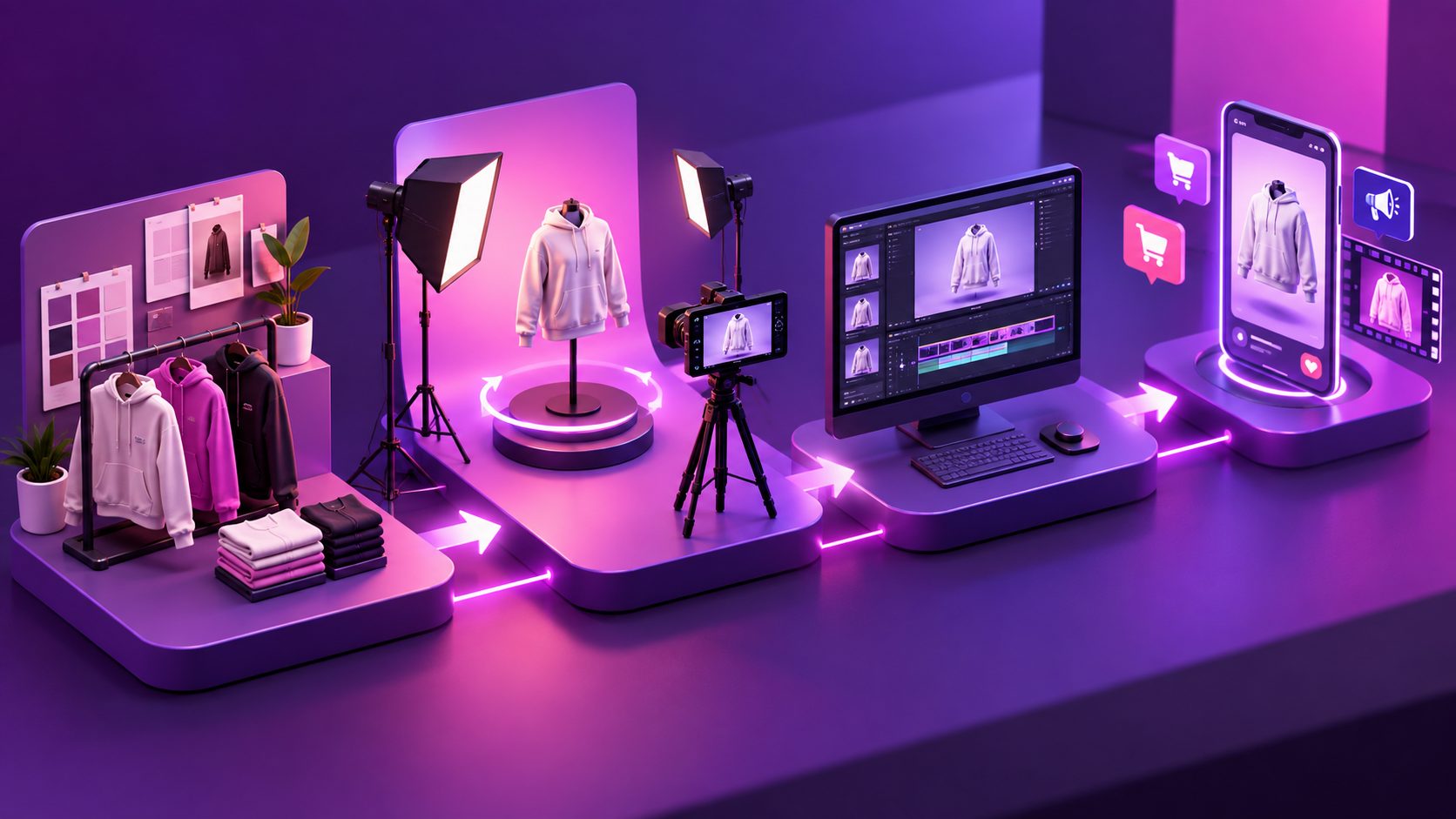
The most reliable structure is hook → product proof → styling context → size cue → offer → call to action. It works for UGC-style ads, product-page videos, and short paid-social variations because each section performs a specific job.
A 15-second example:
- 0–2 seconds: Hook
“A polished outfit that still feels comfortable after a full day?” - 2–6 seconds: Fit proof
Show the model turning, sitting, or walking. Add one concise fit statement. - 6–9 seconds: Detail proof
Cut to the fabric, pockets, neckline, buttons, or waistband. - 9–12 seconds: Styling and size
Show the complete look and display the model’s height and worn size. - 12–15 seconds: Offer and CTA
Present the promotion, product name, and “Shop now.”
Avoid opening with a logo animation or a slow establishing shot. Google’s official video guidance recommends capturing attention within the first 2–3 seconds, while TikTok’s fashion guidance emphasizes showing the product in use. The opening should therefore contain either visible movement, a styling transformation, or a clear customer problem.
For more hook ideas, see the Instagram Reels ad script templates for ecommerce.
Which shots matter most for apparel?
The best clothing ads are not necessarily cinematic. They are diagnostic: each shot helps the viewer judge whether the item is worth buying.
Capture or generate these shots:
- Full-body front view: establishes length, silhouette, and overall proportion.
- Side or three-quarter turn: reveals drape, volume, and how the garment moves.
- Movement shot: walking, sitting, reaching, or layering demonstrates comfort and flexibility.
- Fabric close-up: shows texture, knit, sheen, quilting, ribbing, or structure.
- Functional detail: highlight pockets, zippers, adjustable straps, cuffs, lining, or closures.
- Styled outfit: show how the product works with shoes, accessories, or another layer.
- Size reference: include model height, worn size, and a brief fit note where accurate.
For AI-assisted production, keep the approved product image as the visual source of truth. AdsTurbo Product Video accepts JPG or PNG product images up to 10MB and can create UGC-style product review, introduction, and demonstration videos. A clear product photo on a plain-color background generally gives the best starting point.
When the source image is soft or compressed, use AI upscaling for ecommerce video assets carefully. Upscaling can improve legibility, but it should not be used to invent garment details that are not present in the original product.
How do you create multiple ad variations without reshooting?
Build one master story, then vary one creative variable at a time. This makes performance easier to interpret and prevents a “batch” from becoming a collection of unrelated videos.
A practical six-asset test pack includes:
- Fit angle: “See how it moves when you walk.”
- Comfort angle: focus on softness, stretch, weight, or construction.
- Styling angle: demonstrate one item in two or three looks.
- Problem-solution angle: address wrinkles, layering, coverage, or wardrobe gaps.
- Social-proof angle: turn a verified customer review into a spoken or captioned script.
- Offer angle: lead with the discount, bundle, seasonal event, or limited promotion.
Keep the product shots similar while changing the hook, voice, pacing, or CTA. This creates cleaner tests than changing the model, background, script, offer, and product angle simultaneously.
AdsTurbo supports advertising workflows such as Ad Clone, Product Video, Motion Control, Lip Sync, Character Swap, Video Translation, and subtitles. Its Ad Clone workflow can analyze a reference video up to 12 seconds, extract its structure, and help rebuild variations around a different product. Use that capability to study pacing and CTA logic—not to copy another brand’s identity, claims, or protected creative assets.
Which formats should you export?
Create channel-specific versions instead of placing one crop everywhere. Google recommends supplying horizontal 16:9, square 1:1, and vertical 9:16 assets for eligible campaigns. Its global 2024 data also reports stronger Shorts conversion performance when vertical assets are added to Demand Gen campaigns, although results vary by account and audience.
For most clothing campaigns, prepare:
| Placement | Recommended creative approach |
|---|---|
| TikTok and Instagram Reels | 9:16, creator-style delivery, fast product demonstration |
| YouTube Shorts | 9:16, readable captions, strong first-frame movement |
| Meta Feed | 1:1 or 4:5 where supported, product visible without sound |
| YouTube in-stream | 16:9, broader explanation and stronger brand context |
| Product page | Clearer fit and detail demonstration, less aggressive selling |
Keep important text away from the top and bottom interface areas. AdsTurbo Event Poster can also create promotional visuals in nine aspect ratios, with product, discount, promo code, dates, and terms included for campaign support.
How should you add captions and localization?
Design the video to work with sound off. Captions should reinforce the visual proof rather than repeat every spoken word. Use short lines such as “Non-sheer fabric,” “Two-way stretch,” or “Model wears size S,” but only when those statements are accurate.
AdsTurbo Video Subtitle can automatically transcribe speech, generate synchronized captions, and export either a video with embedded subtitles or a separate subtitle file. Subtitle styling can be adapted for TikTok, Instagram Reels, and YouTube Shorts formats.
For cross-border campaigns, translate the voiceover and captions separately from the visual edit. Keep measurements, size labels, currency, shipping promises, and promotional terms aligned with the destination market. AdsTurbo supports multilingual video translation and localized product imagery, including English, Chinese, Japanese, and Korean text options for supported image workflows.
How do you review the video before publishing?
Use a five-point pre-launch check:
- Product accuracy: color, pattern, logo, seams, buttons, and proportions match the real SKU.
- Fit honesty: the model or generated character does not imply an unsupported fit or body outcome.
- Claim accuracy: comfort, material, sustainability, and performance claims are documented.
- Mobile readability: the product and first caption are understandable on a small screen.
- Destination match: the advertised variant, price, size range, and landing page are consistent.
A beautiful video with an inaccurate sleeve length or altered neckline can create more returns than sales. For apparel, product fidelity is a conversion requirement, not just a brand-quality preference.
How do you measure clothing ad performance?
Measure the creative in stages rather than relying only on purchases. Track thumb-stop or hold rate, early retention, landing-page views, add-to-cart rate, purchase conversion rate, and return or complaint signals.
A useful decision rule is:
- Weak early retention: revise the hook or opening shot.
- Strong viewing but weak clicks: clarify the product benefit or CTA.
- Strong clicks but weak add-to-cart: improve fit, size, price, or product-page information.
- Strong add-to-cart but weak purchases: inspect checkout friction, shipping, trust, or offer clarity.
This turns video production into a feedback loop. The next script should be based on the failed or successful proof point—not simply on making the next video look different.
Frequently asked questions
How long should a clothing product ad be?
Start with a focused 10–20 second version for short-form placements. Build a longer cut only when the product needs more explanation, such as layered styling, technical construction, or a detailed size demonstration.
Can I make a clothing video from product photos?
Yes. Product photos can support AI-generated motion, UGC-style concepts, product introductions, and short demonstrations. Review the result carefully for changes to garment shape, color, texture, or fit before publishing.
Should clothing ads use AI actors or real creators?
Use AI actors for concept testing, localization, and rapid variation production. Use real creator footage when authentic try-on behavior, personal fit commentary, or verified customer experience is central to the claim.
What is the most important clothing video shot?
The most important shot is the one that answers the product’s main buying objection. For a dress, it may be a full-body turn; for activewear, movement; for knitwear, a fabric close-up and stretch demonstration.
How many variations should I launch?
Begin with a controlled six-asset test pack built around different hooks and proof angles. Expand the winning concept into new sizes, languages, models, backgrounds, and CTAs only after the core message earns meaningful engagement.