Motion Control Athletic Shoes: A Biomechanics Video Ad Guide

Summarize with
Summary
Learn how to demonstrate motion control athletic shoes with clear biomechanics visuals, proof-led scripts, and scalable AI video ad workflows. Build better tests.
By adsturbo.ai | Published 2026-11-06 | Updated 2026-11-06
For sellers of motion control athletic shoes, the hardest marketing problem is not showing the sneaker. It is showing what the shoe is designed to do during movement without making unsupported medical promises. A strong ad should make stability, foot guidance, heel structure, and fit easier to understand through clear motion—not vague claims such as “fix your gait.”
What are motion control athletic shoes?
Motion control athletic shoes are highly structured athletic shoes designed to limit excessive inward foot motion, commonly associated with overpronation. They may use firmer medial materials, reinforced heel counters, wider platforms, or other guidance features to create a more controlled feel.
The American Academy of Orthopaedic Surgeons distinguishes motion-control footwear from lighter stability footwear: motion-control models are generally intended for runners who need more control, while stability shoes provide lighter to moderate support. A professional gait assessment is more reliable than judging foot type from appearance alone. (orthoinfo.org)
For ecommerce advertising, this definition creates an important boundary:
- Demonstrate structure and movement guidance.
- Explain who the design may be intended for.
- Avoid claiming that a shoe prevents injuries or treats a medical condition.
- Encourage shoppers with persistent pain or complex foot issues to consult a qualified professional.
This approach is both more credible and easier for viewers to understand.
Motion control vs. stability shoes: what should the ad explain?
Motion control and stability shoes overlap, but they should not be presented as identical. Stability shoes typically offer moderate guidance for mild to moderate pronation, while motion-control shoes are positioned toward stronger support needs. However, labels vary across brands, so the construction and intended use should be shown clearly.
| Feature | Stability shoe | Motion-control shoe |
|---|---|---|
| Typical support level | Light to moderate | Higher structural control |
| Common design elements | Guide rails, firmer foam, supportive geometry | Rigid platform, reinforced heel, denser medial structure |
| Best marketing angle | Guided comfort and everyday stability | Controlled movement and structured support |
| Visual proof | Foot path and heel alignment | Heel control, platform stability, side-to-side resistance |
| Main caution | Do not imply universal correction | Do not claim medical treatment or injury prevention |
Research reviews suggest that motion-control features can influence rearfoot eversion and other lower-limb movement variables, but there is no universal threshold defining “excessive” pronation. (pmc.ncbi.nlm.nih.gov)
That uncertainty is useful for marketers: show the shoe’s design and movement behavior rather than promising the same result for every runner.
How should a biomechanics video ad be structured?
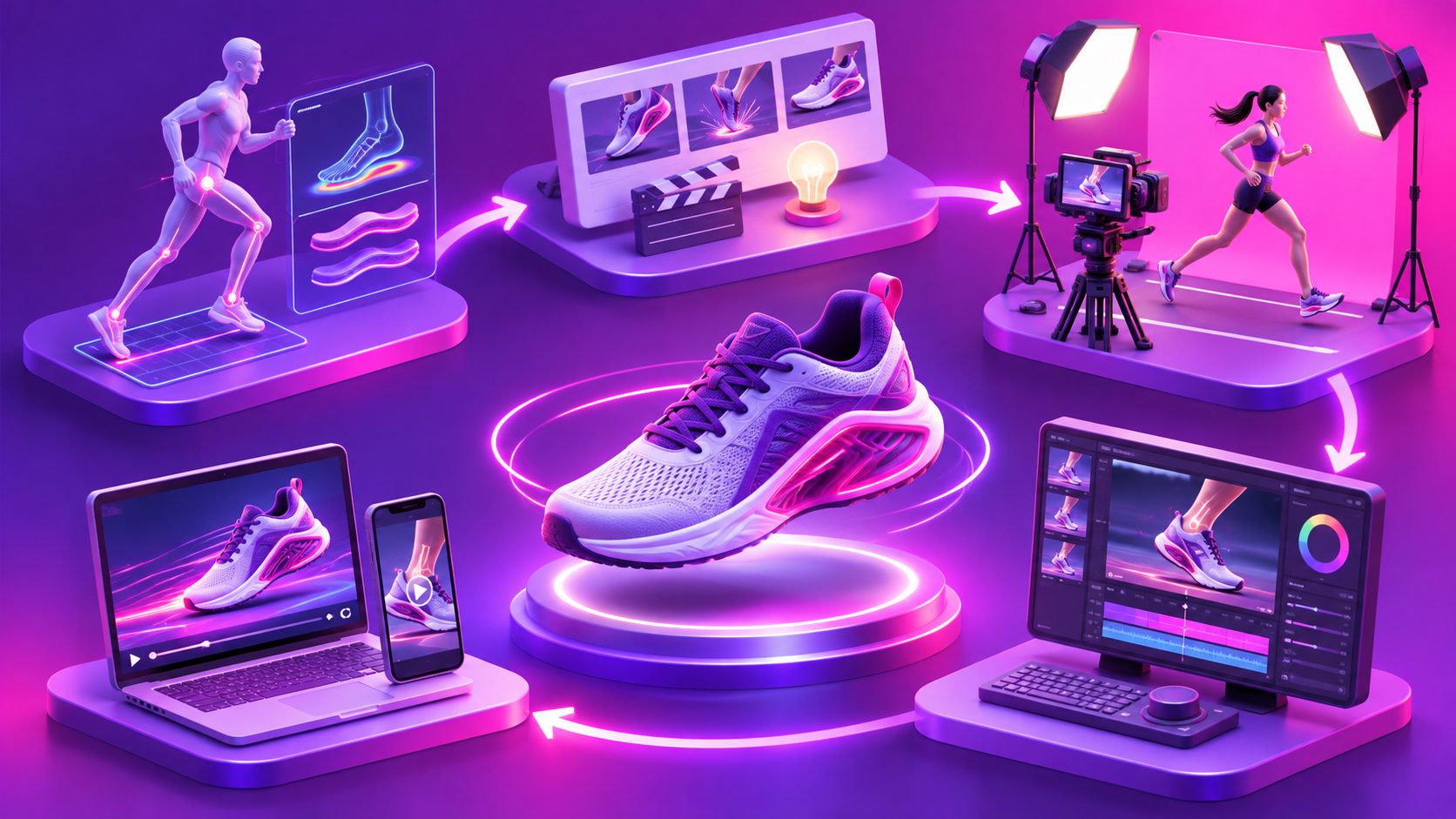
A high-performing product video should translate technical features into visible moments. The following five-part structure is an original, proof-first framework for athletic footwear sellers.
1. Start with the movement problem
Use a close-up of a runner landing, viewed from behind. The first two seconds should establish the motion viewers need to inspect: heel entry, inward roll, or side-to-side instability.
Possible on-screen line:
“Designed for a more controlled stride.”
Keep the language descriptive. Do not state that the shoe “corrects” every runner’s gait.
2. Reveal the construction
Cut to the outsole, heel counter, medial sidewall, or midsole. Use simple overlays to identify the feature being discussed.
For example:
- “Structured heel counter”
- “Supportive medial geometry”
- “Stable platform”
- “Firm guidance zone”
This is more persuasive than listing materials without showing their position on the shoe.
3. Use matched-angle comparisons
Show the same runner, speed, camera angle, and surface in two clips: one with a standard trainer and one with the featured model. Keep the comparison fair.
Do not alter playback speed in only one clip. Do not use different athletes unless the purpose is to show fit variation. A split-screen comparison should clarify the shoe’s geometry, not manufacture a dramatic result.
4. Connect structure to the shopper
Move from technical detail to practical use:
- Daily walking
- Treadmill training
- Easy road miles
- Long periods on the feet
- Runners seeking a more structured feel
The exact use cases should match the product’s own testing and labeling. Avoid presenting a marketing video as a substitute for gait analysis.
5. End with a fit-focused CTA
A safer CTA is:
“Compare the support features and find your fit.”
For ecommerce, send viewers to the product page, size guide, or a comparison section. The goal is to help them evaluate—not pressure them into a medical conclusion.
What should sellers test before scaling the campaign?
The most useful test is not simply “which hook gets more clicks.” It is whether viewers understand the product’s support concept quickly enough to continue watching.
A practical creative test matrix can use four variables:
- Hook: inward roll, long-run fatigue, stable platform, or product construction.
- Proof style: slow-motion footage, split screen, 3D callouts, or hand-held product demonstration.
- Audience framing: runners, walkers, flat-footed shoppers, or workers standing for long periods.
- CTA: compare features, view sizing, inspect the outsole, or shop the model.
Create one controlled variation at a time. If both the hook and visual proof change, performance data becomes difficult to interpret.
A useful internal scoring method is the three-second clarity check:
- Can the viewer identify the product category?
- Can the viewer see the movement or support feature?
- Can the viewer understand the intended benefit without sound?
If the answer is “no” to two of the three questions, revise the opening before producing more versions.
How can AI speed up motion-control shoe creative production?
AI is most useful when it helps sellers produce controlled variations from the same approved product evidence. AdsTurbo can combine a product image, selling points, and a reference video to generate short-form product advertising for launch testing and creative iteration.
For a footwear workflow:
- Upload a clear JPG or PNG product image.
- Provide verified selling points such as heel structure, outsole geometry, or intended activity.
- Select a product video or UGC-style format.
- Create multiple hooks and aspect ratios for TikTok, Meta, and Shorts.
- Add subtitles and translate approved versions for regional campaigns.
- Review every claim against the product specification before publishing.
AdsTurbo also supports Ad Clone workflows that analyze a reference ad’s structure, pacing, shot logic, and CTA format. Its Ad Clone API can analyze reference videos up to 12 seconds and generate variations in parallel, which is useful when a seller wants to preserve a proven opening while replacing the product and message.
For post-production, AdsTurbo provides motion control, lip sync, character replacement, video translation, upscaling, subtitles, and other editing endpoints. Video subtitle exports can include either burned-in captions or separate subtitle files.
For a broader ecommerce creative system, see the guide to an ecommerce ad creative variation generator and the workflow for a bulk AI video ad generator for ecommerce.
What claims should motion-control shoe ads avoid?
Avoid absolute or clinical statements unless they are supported by appropriate evidence and approved for the relevant market. High-risk wording includes:
- “Prevents running injuries”
- “Cures flat feet”
- “Fixes overpronation permanently”
- “Guarantees pain-free running”
- “Works for every foot type”
Use narrower alternatives:
- “Built for a more structured feel”
- “Designed to help guide foot movement”
- “Features a reinforced heel and supportive platform”
- “Made for runners seeking additional stability”
This language protects consumer trust while giving the product a clear reason to exist.
Frequently asked questions
Are motion-control shoes the same as stability shoes?
No. Motion-control shoes generally provide stronger structural guidance, while stability shoes usually target lighter or moderate support needs. Brand terminology varies, so shoppers should inspect the construction and intended use.
Can an AI video prove that a shoe prevents injury?
No. A video can demonstrate visible features and movement in a controlled setup, but it cannot establish that a shoe prevents injuries for every wearer. Injury risk is influenced by training load, anatomy, surface, fit, and other factors.
What footage should a seller capture?
Capture rear, side, and three-quarter running angles, plus close-ups of the heel counter, outsole, medial side, flex point, and upper. Keep lighting, speed, camera height, and surface consistent across comparison clips.
Should product ads use slow motion?
Slow motion can help viewers inspect landing and heel movement, but it should be labeled clearly and used consistently. Pair it with normal-speed footage so the product does not appear to perform differently because of editing.
How can sellers localize the same shoe ad?
Use translated voiceover, synchronized lip movement where appropriate, and platform-specific subtitles. AdsTurbo supports video translation, lip sync, subtitle generation, and multiple output formats for localized creative production.
For footwear brands expanding their visual merchandising, a pure white background image workflow can also help create consistent product-page assets alongside video ads.
Conclusion
The strongest motion-control footwear ads do not rely on technical jargon or exaggerated health claims. They show a clear movement question, connect visible construction to a controlled use case, and give shoppers enough information to compare fit and support responsibly.
For ecommerce teams, the scalable advantage comes from turning one verified product demonstration into multiple hooks, angles, languages, subtitles, and platform formats—while keeping the underlying evidence consistent.