Pre Owned Luxury Condition Video: Show Wear Clearly

Summarize with
Summary
Learn how to create a pre owned luxury condition video with macro flaw shots, condition-proof sequencing, and honest captions that help reduce avoidable returns. Build the workflow with AdsTurbo.
By adsturbo.ai | Published 2026-10-24 | Updated 2026-10-24
A pre owned luxury condition video should help shoppers understand the item they will actually receive—not make a used product look artificially new. The most useful videos combine full-item views, macro shots of wear, functional demonstrations, and precise captions. This approach gives buyers better evidence before checkout and helps sellers reduce avoidable disputes caused by unclear condition descriptions.
For handbags, watches, jewelry, shoes, and accessories, transparency is a selling asset. OfferUp’s seller guidance also recommends showing scratches, stains, worn edges, and missing parts clearly, using slow movement and the same lighting as the listing photos. (help.offerup.com)
What is a pre owned luxury condition video?
A pre owned luxury condition video is a short product video that documents the identity, visible wear, function, and included accessories of a previously owned luxury item. It is different from a conventional beauty video because its primary purpose is condition clarity, not only visual appeal.
A strong video answers five buyer questions:
- What exactly is the item?
- What does it look like from every important angle?
- Where are the flaws or signs of use?
- Do the moving parts work as expected?
- What does the video not prove, especially regarding authenticity?
The video can support an authentication review by showing markings, construction, and hardware. It should not be presented as a replacement for professional authentication. Luxury resale specialists such as FASHIONPHILE describe authentication and condition inspection as separate review processes, including examination of damage, repairs, materials, and brand-specific markers. (fashionphile.com)
Why condition-first video can reduce buyer uncertainty
Still images are essential, but they can flatten texture, hide small scratches, or make hardware appear more uniform than it is. Controlled motion changes the way light reflects across leather, metal, stitching, glazing, and edge paint.
The highest-value footage is often not the most glamorous. A slow close-up of a rubbed corner may answer more buyer questions than a polished lifestyle shot.
| Product area | What the buyer should be able to evaluate |
|---|---|
| Corners and edges | Scuffing, peeling, cracking, color loss, or deformation |
| Handles and straps | Darkening, stretching, creasing, and edge wear |
| Hardware | Scratches, tarnishing, plating loss, and finish consistency |
| Closure and zipper | Alignment, stiffness, wobble, and operation |
| Interior and lining | Stains, pen marks, odors disclosed in text, and shape |
| Base and feet | Contact wear, scratches, and structural changes |
| Markings | Visible serial, date, logo, or production details where applicable |
| Accessories | Dust bag, box, strap, receipt, and missing inclusions |
A practical rule is to show every flaw that could materially change a buyer’s decision. A condition video should never use shadows, fast camera movement, filters, or aggressive retouching to make damage harder to see.
The Condition Proof Ladder: a better structure for resale videos
Most ranking pages cover inspection shots and condition grades. A more useful production method is to organize the video as a Condition Proof Ladder. Each level answers a different risk question and creates a logical viewing sequence.
1. Identity
Open with the verified product category, brand, model, size, color, and included accessories. If a detail has not been confirmed, leave it out rather than guessing.
2. Orientation
Show the front, back, sides, base, and interior. Keep the camera path slow and repeatable. Buyers need to understand the item’s proportions before evaluating details.
3. Wear
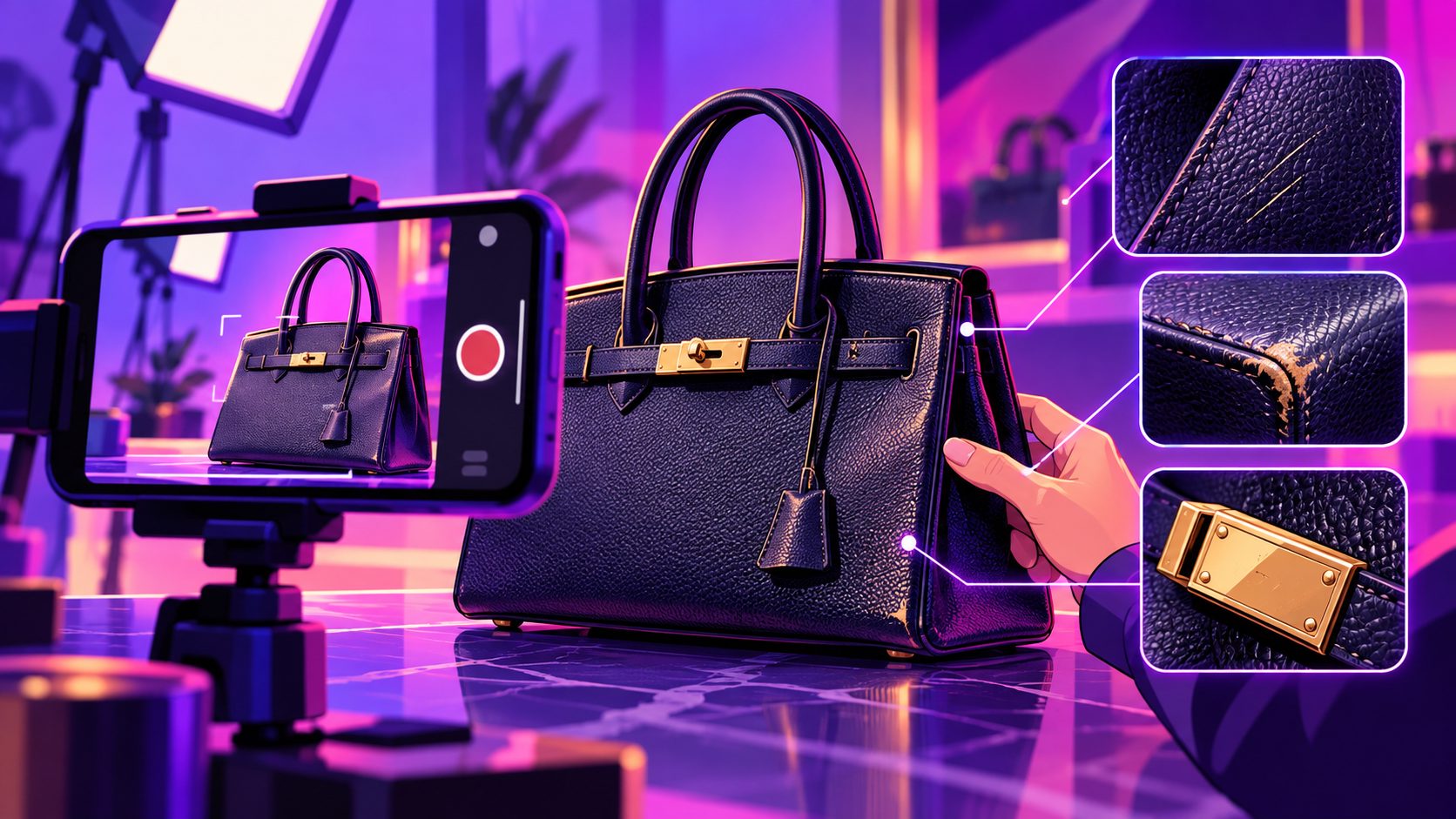
Move into macro shots of the corners, handles, straps, lining, hardware, edge paint, and high-contact areas. Pair each shot with specific wording such as:
- “Light surface scratches on the clasp”
- “Visible corner rub on the lower front edge”
- “Minor discoloration near the handle base”
- “Interior marks visible on the lining”
Avoid vague phrases such as “some wear” when the location and type of wear can be described precisely.
4. Function
Demonstrate a zipper, clasp, snap, lock, strap adjustment, watch crown, or other relevant mechanism when safe and appropriate. A short movement clip is stronger evidence than a caption that simply says “works.”
5. Evidence boundary
Close with a statement that separates condition documentation from authentication. The video shows visible condition and handling; it does not independently certify authenticity, provenance, valuation, or marketplace eligibility.
How to film the condition details
Use a repeatable inspection shot list
Create one checklist for each product category. A handbag checklist may include:
- Full exterior from six directions
- Interior, pockets, lining, and base
- Corners, piping, handles, straps, and edge paint
- Logo, closure, zipper pulls, chain, feet, and hardware
- Serial, date, or production markings where applicable
- Accessories and items included with the sale
- Every visible flaw, filmed both in context and close-up
Photograph or film flaws in the same lighting used for the hero shots. This makes the condition evidence easier to compare with the rest of the listing. Reseller photography guidance commonly recommends clear close-ups of scratches, stains, holes, missing parts, discoloration, and functional issues rather than hiding them behind creative angles. (editthispic.com)
Use light to reveal, not exaggerate
For glossy hardware, use soft, even lighting and slowly change the viewing angle. A fixed reflection can hide scratches; a fast reflection can make minor wear look severe. The goal is a faithful view of the surface.
For leather and fabric, avoid lighting that creates deep shadows inside corners. If a defect only appears at a particular angle, show both the normal view and the revealing angle.
Match captions to the exact shot
Captions should identify the location, severity, and type of issue. For example:
“Small surface marks on the front clasp; clasp opens and closes normally.”
This is more useful than “excellent condition” because generalized grades are interpreted differently by different buyers. eBay, for example, separates “Pre-owned - Excellent” and “Pre-owned - Good,” but sellers still need to provide item-specific information and images. (ebay.com)
A practical 20-second video script
For a short-form listing or social ad, use this sequence:
- 0–2 seconds: Full product view and verified item name
- 2–5 seconds: Front, back, side, and base overview
- 5–10 seconds: Macro shots of the most important wear points
- 10–13 seconds: Hardware, closure, zipper, or strap function
- 13–16 seconds: Interior and included accessories
- 16–18 seconds: Authentication-related markings shown as supporting evidence only
- 18–20 seconds: Condition summary and clear buyer action
The order matters. Showing beauty footage first and hiding flaws at the end can create an expectation gap. Showing the item’s identity and condition evidence early makes the video feel more like an inspection record than a polished advertisement.
AdsTurbo can support this workflow with product video generation, video subtitles, translation, AI upscaling, background replacement, and clip-by-clip editing. Its subtitle tool can create synchronized captions and export either a subtitled video or a separate subtitle file. For a broader short-form production process, see this guide to automatic captions for ecommerce video ads.
How to scale condition videos without losing accuracy
The safest way to scale is to separate verified facts from creative variations.
Keep one condition record for each item containing:
- Product identity and measurements
- Confirmed inclusions
- Defect locations and descriptions
- Functional checks completed
- Authentication documents or review status
- Approved wording for captions and translations
Then create multiple edits from the same record: a vertical listing video, a square marketplace version, a horizontal website version, and localized subtitle versions. AdsTurbo supports video translation and multilingual subtitles, which can help adapt the same factual condition information for different markets.
Do not let automated tools invent condition grades, accessories, or authenticity claims. The seller’s inspection record should remain the source of truth.
For image-led merchandising, AdsTurbo Product Image can also be used to create product visuals from uploaded JPG or PNG images. Clear product photos on a simple background generally provide the best starting material for image generation and editing.
Common questions
Can a condition video prove authenticity?
No. It can show visible markers and construction details, but authenticity requires an appropriate professional or marketplace authentication process.
Should sellers show scratches in paid ads?
Yes, when the scratches materially affect the buyer’s understanding of the item. Honest disclosure may reduce initial appeal for some viewers, but it improves expectation matching for serious buyers.
Is a condition grade enough?
No. Use a consistent grade, but support it with exact locations, close-up footage, and functional notes. “Good condition” is too broad without evidence.
What should be filmed first: beauty shots or flaws?
Start with identity and orientation, then show the most decision-relevant flaws before ending with functional details and accessories. This creates a balanced but evidence-led presentation.
Can one source video fit every marketplace?
The source footage can be reused, but the edit should be adapted for vertical, square, and horizontal placements. Captions, safe zones, opening speed, and text size should match each platform.
Final checklist
Before publishing, confirm that the video:
- Shows the actual item, not stock footage
- Includes front, back, sides, base, and interior views
- Shows every material flaw that could affect purchase intent
- Demonstrates relevant closures or moving parts
- Matches the written listing and included accessories
- Uses precise captions instead of unsupported superlatives
- Separates condition evidence from authenticity claims
- Exports cleanly for the intended marketplace or social format
A trustworthy resale video does not erase the history of a luxury item. It makes that history easier to inspect, compare, and understand before purchase.