Press On Nails Size Chart Video: A 15-Second Tutorial

Summarize with
Summary
Create a press on nails size chart video with a 15-second script, accurate measuring shots, and a fit-focused testing plan. Build your tutorial.
By adsturbo.ai | Published 2026-10-15 | Updated 2026-10-15
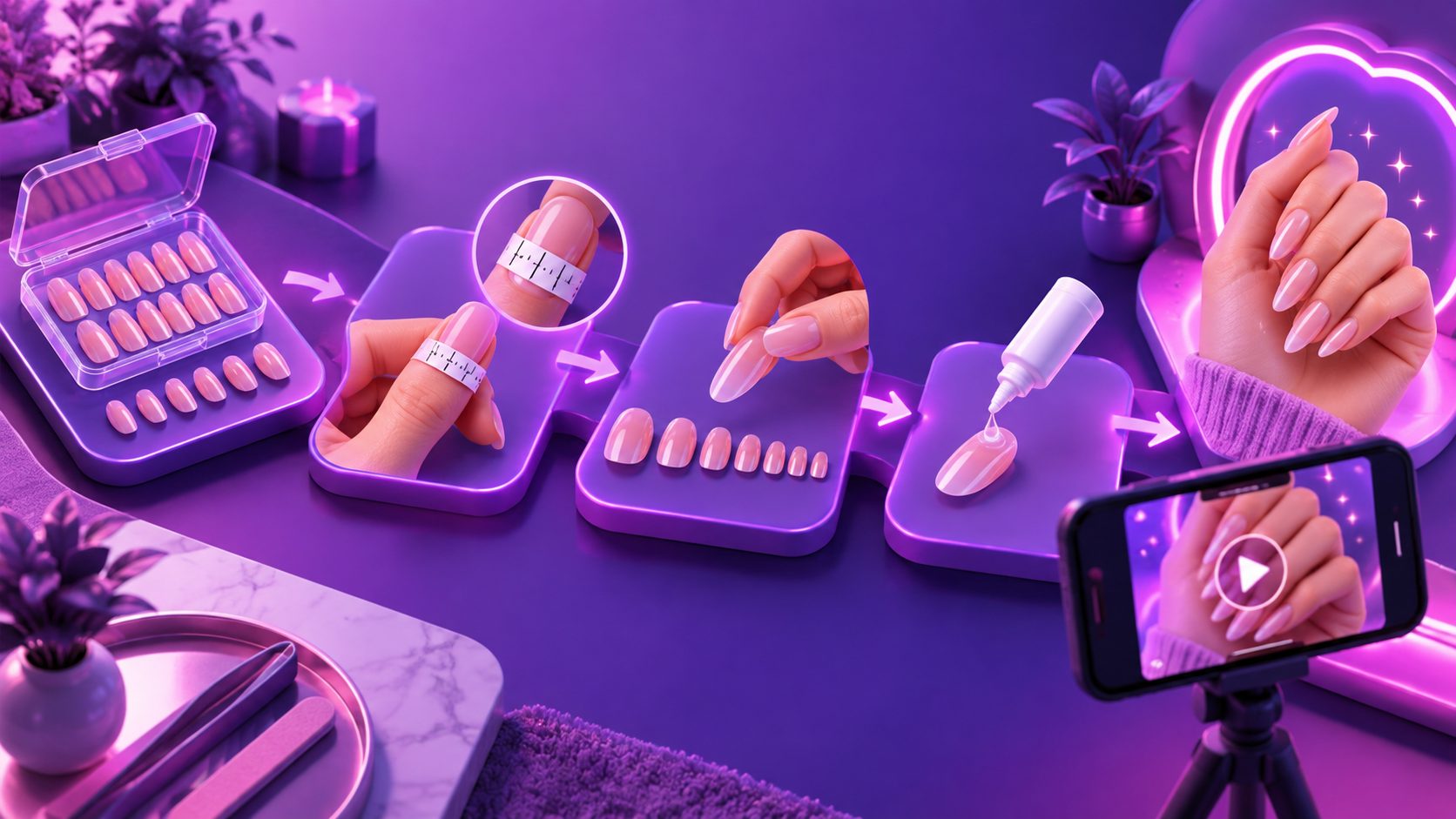
A press on nails size chart video should show shoppers how to measure one natural nail, read the result in millimeters, and find the corresponding entry on your product’s chart. For a US DTC nail brand, a useful 15-second tutorial demonstrates that sequence—not just an animated sizing table.
The goal is a better-informed purchase, not a promise of perfect fit. Use the following storyboard and Measure–Match–Confirm framework to connect your static chart to the size selector, then test whether sizing-related problems actually decline.
What should a nail sizing video teach?
A nail sizing video is a short demonstration of the measurement method your brand uses and the next purchasing step. It should answer three questions: where to measure, how to read the width, and which chart applies. Keep the full chart accessible beside the video rather than squeezing every size onto one screen.
A practical at-home method uses clear tape, a fine-tip pen, and a millimeter ruler:
- Place tape across the widest part of the natural nail.
- Mark both sidewall edges.
- Remove the tape and measure between the marks.
- Repeat for all ten nails, recording each hand separately.
Pressed Addict documents this tape-and-ruler sequence, including measuring all ten nails. Nori & Co. also tells shoppers to measure both hands rather than assume matching fingers are identical. (pressedaddict.com)
Demonstrate one finger in 15 seconds; explicitly instruct viewers to repeat for all ten. The video’s runtime is not the time required to complete the task.
How do you script the 15-second tutorial?
Build the tutorial around one continuous example: measure, read, match, repeat. Start with the nail and measuring tools already visible. Reserve the final seconds for a clear next step. The following timing is a proposed production template, not a measured performance benchmark.
| Time | Shot | On-screen text |
|---|---|---|
| 0–2 seconds | Natural nail with tape positioned across it | “Find your nail size” |
| 2–5 seconds | Close-up of both sidewall marks | “Mark the widest part” |
| 5–8 seconds | Tape flattened against a millimeter ruler | “Read between marks in mm” |
| 8–11 seconds | Actual matching entry highlighted on your chart | “Match this product’s chart” |
| 11–13 seconds | Left- and right-hand recording sheet | “Repeat for all 10 nails” |
| 13–15 seconds | Size selector and sizing-kit option | “Choose your fit—or check a kit” |
Suggested voiceover:
“Mark your nail’s widest edges on tape. Measure between the marks in millimeters. Match our chart, then repeat for all ten nails. Unsure? Check our sizing kit.”
Only include the sizing-kit CTA if your store offers one. Keep the chart available to pause, enlarge, or read separately; do not make a fast-moving frame the only reference.
Why must the chart match the exact product?
The video must use the chart for the nail tips being sold, not a generic XS–L table. Treat millimeter widths, tip numbers, preset set sizes, and nail shapes as separate labels. A shopper should see exactly how their recorded measurement connects to the option they can order.
Pressed Addict distinguishes numbered tips from preset sizes and notes that shape and length can affect fit. Teri Wells offers shape-specific sizing kits, reinforcing why a kit should correspond to the intended product. (pressedaddict.com)
Do not publish a universal “between sizes” rule. Pressed Addict recommends sizing up, while Stey Gold recommends the smaller size when between sizes. Those instructions belong to different products and should not be blended into one rule. (pressedaddict.com)
Instead, add your verified guidance beneath the chart. If a customer’s measurements do not match a preset bundle, direct them to your actual custom-sizing process, sizing kit, or support route.
What is the Measure–Match–Confirm framework?
Measure–Match–Confirm is a proposed acceptance framework for this tutorial. It separates measurement accuracy from purchasing accuracy: a shopper can read the ruler correctly yet still choose the wrong product option. Approve the video only when all three stages connect without an unexplained jump.
| Gate | Approval question | Reject the video when… |
|---|---|---|
| Measure | Can viewers identify both marks and the unit? | Fingers hide an edge or ruler markings are unreadable |
| Match | Does the demonstrated result map to the correct chart entry? | The highlight uses another shape’s chart |
| Confirm | Can viewers identify their next ordering step? | The video ends without explaining presets, custom sizes, or uncertainty |
For example, if the filmed measurement reads 13 mm, highlight the verified 13 mm entry—not an invented tip number. This is an illustrative production example, not a universal nail size conversion.
Keep a master record containing the product identifier, shape, chart version, and approved clip. Recheck the video whenever the corresponding chart changes.
How can AdsTurbo support production without replacing proof?
Use real footage for the measurement evidence, then use editing and caption tools to package it. A generated beauty shot may introduce the product, but it should not serve as proof of ruler accuracy, sidewall placement, or physical fit. Keep those instructional details visibly verifiable.
AdsTurbo supports Clip by Clip editing, Video Subtitle, Video Translation, and AI Upscaling. Its subtitle tool can transcribe speech, generate time-synchronized captions, and export either a captioned video or a separate subtitle file. (adsturbo.ai)
A recommended workflow is:
- Film the tape, marks, and ruler in a steady close-up.
- Assemble the sequence around the approved storyboard.
- Add short captions without covering the measurement.
- Compare every number with the master chart.
- Review the exported video on a phone, muted.
The ecommerce instructional-video workflow provides a broader task-first structure. For translated versions, use the multilingual subtitle QA workflow, keeping millimeters, chart entries, and ordering instructions consistent.
How should you test conversion and sizing outcomes?
Test the tutorial as a purchasing aid, not merely a video engagement asset. Place it beside the size selector and compare it against the same product page without the tutorial. Keep the chart, offer, and return policy unchanged so the comparison remains interpretable.
Use these proposed measures:
- Purchase conversion: orders divided by eligible product-page sessions.
- Sizing-issue order rate: orders with a tagged sizing problem divided by delivered orders.
- Sizing support rate: sizing-related contacts per 100 delivered orders.
- Fit-resolution cost: sizing-related refunds, replacements, and reshipping costs per delivered order.
Allow the same post-delivery observation period for both groups. Report raw counts alongside percentages, and separate manufacturing defects from measurement or selection errors.
A press on nails size chart video succeeds when it improves purchase decisions without hiding uncertainty. More orders alone are not enough if sizing complaints rise. Likewise, fewer returns are inconclusive if the policy or product mix changed during the test.
Frequently asked questions
Can shoppers use any press-on nail size chart?
Use the chart supplied for the exact product. Shape and length can affect fit, so another seller’s numbered tips or preset sizes should not substitute for your verified chart. (pressedaddict.com)
Should the tutorial show inches or millimeters?
Show millimeters when that is the unit used by your chart. The cited tape-measure guides use millimeters; keep the ruler, captions, and chart consistent rather than introducing an unnecessary conversion. (presse-nails.com)
Can a 15-second clip replace a sizing kit?
Do not present it as equivalent. A tutorial explains measurement, while a product-specific kit lets shoppers try the actual tip shape. Teri Wells instructs customers to select their desired shape before ordering its kit. (teriwells.com)
Can the video guarantee fewer returns?
No. Treat return reduction as a hypothesis to test. The tutorial addresses measurement and selection confusion; it does not resolve every possible fit or product issue.
Start with one product, one verified chart, and one complete measurement sequence. Create your tutorial with adsturbo.ai.