


作者:adsturbo.ai|发布日期:2026年9月14日|更新日期:2026年9月14日
The most effective way to turn product features into video ads is to connect each feature to a customer problem, show the product solving it, add credible proof, and finish with one clear call to action. This approach is more useful than simply listing specifications on screen.
A feature describes what a product has. A video ad must demonstrate why that feature matters now.
What is the difference between a product feature and a customer benefit?
A product feature is a measurable attribute or capability. A customer benefit explains how that attribute improves a buyer’s situation. Video ads perform better when the feature is shown as part of a problem-and-solution story rather than presented as isolated product information.
For example:
| Product feature | Customer problem | Benefit | Visual proof |
|---|---|---|---|
| Leak-resistant seal | Liquid spills in a bag | Fewer messes during travel | Tip, shake, or place it beside loose items |
| Adjustable light modes | One brightness does not fit every task | Better control for work or relaxation | Show two use cases with different settings |
| Lightweight construction | Product feels difficult to carry | Easier daily use | Show the product moving from home to work |
| Automatic tracking | Manual updates take time | Less repetitive effort | Display the feature operating in real time |
A practical rule is: one video angle should usually focus on one primary feature and one buyer outcome. Including five features in a 15-second ad often makes none of them memorable.
How do you convert a feature into a video ad angle?
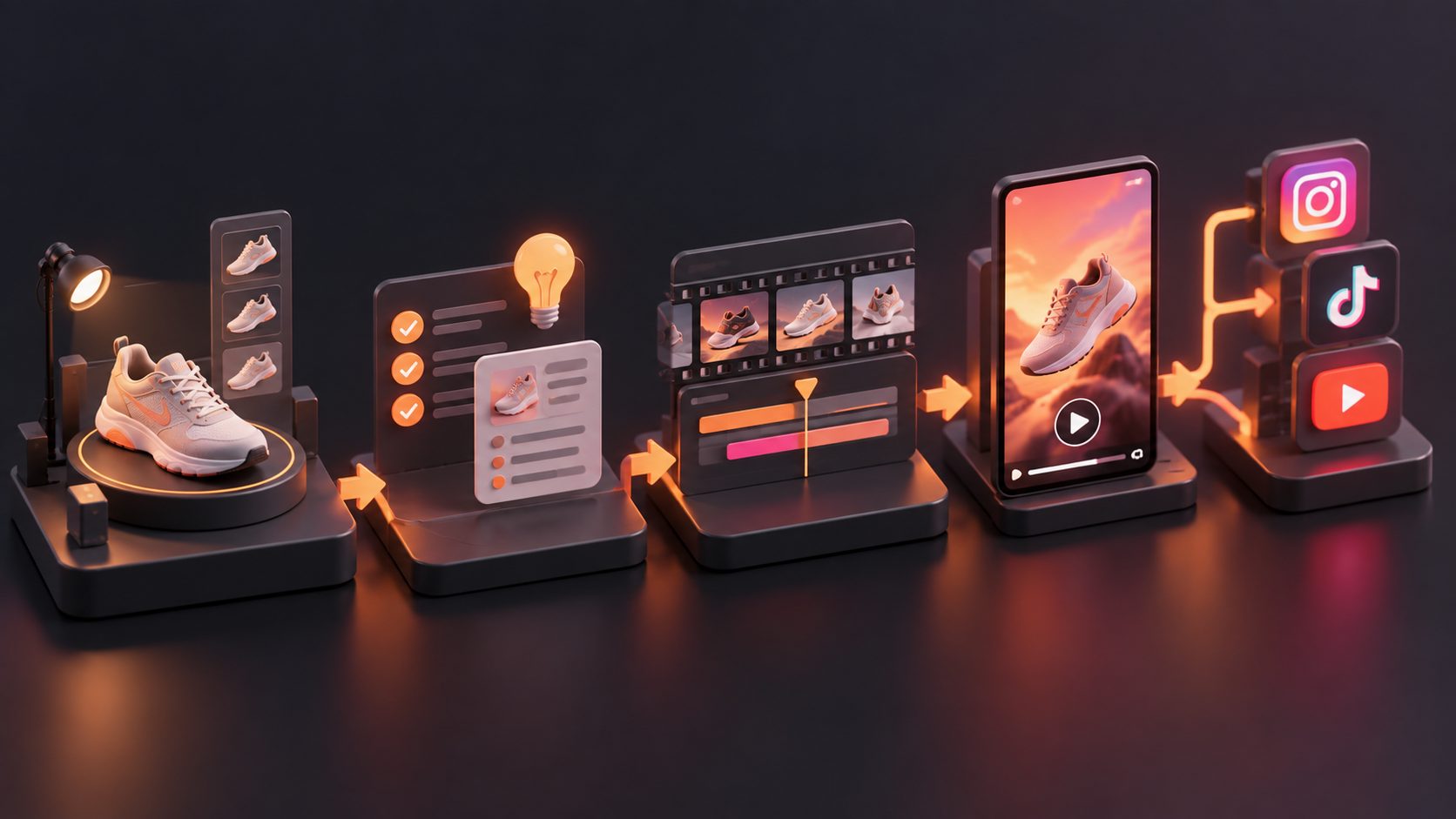
Use the sequence Feature → Friction → Benefit → Proof → CTA. This five-part framework turns technical product information into a visual sales message without inventing unsupported claims.
1. Start with the feature
Write the feature precisely. Avoid vague language such as “premium design” unless you can explain what makes the design different.
2. Identify the friction
Ask what makes the customer hesitate, waste time, feel uncomfortable, or risk making the wrong purchase. The friction may come from the old solution, not from the product category itself.
3. State the benefit
Translate the feature into a practical outcome. “Three temperature settings” becomes “choose the right comfort level without replacing the product.”
4. Choose proof that can be seen
Proof may include a product demonstration, close-up detail, comparison, customer review excerpt, usage sequence, or on-screen explanation. The proof should directly support the claim being made.
5. Match the CTA to the angle
Use a CTA that continues the same thought: “See how it works,” “Shop the new color,” “Compare the settings,” or “Try it today.” A generic CTA can weaken an otherwise specific message.
This framework is an editorial model for creative planning, not a promise of a particular conversion rate. Its value is that every line of the script has a defined job.
How should a product feature video ad be structured?
A short ecommerce ad should make the problem recognizable immediately, demonstrate the product quickly, and leave enough time for the viewer to understand the next step. A simple 20-second structure is:
-
0–3 seconds: Hook
Show the problem, surprising result, or most visually distinctive product action. -
3–7 seconds: Product introduction
Make the product clearly identifiable. Use a close-up, hand-held shot, product image, or creator-style presentation. -
7–14 seconds: Feature demonstration
Show the selected feature in use. Avoid switching to unrelated benefits before the main idea is understood. -
14–17 seconds: Proof or objection handling
Answer one question such as “Will it fit?”, “Is it easy to use?”, or “What makes it different?” -
17–20 seconds: CTA
Display the action, offer, product name, and destination clearly.
For more detailed launches, a longer structure can introduce two or three benefits, but each should still have its own visual evidence. A product launch video workflow can help organize the message when a product needs more explanation than a single short-form ad.
How can you create multiple ad variations from the same product feature?
Change one creative variable at a time so that the test produces a useful learning signal. Replacing the entire concept in every version makes it difficult to understand what affected performance.
A practical variation matrix looks like this:
| Variable | Version A | Version B | Version C |
|---|---|---|---|
| Hook | Customer frustration | Product result | Direct question |
| Presenter | Product-only demo | AI actor | Voiceover with captions |
| Proof | Close-up demonstration | Before-and-after sequence | Review excerpt |
| CTA | Shop now | See how it works | Explore the collection |
Start with three hooks for one feature, then test different presenters or proof styles. This creates a controlled creative set instead of a random collection of videos.
AdsTurbo supports product video creation from JPG or PNG product images, with optional selling points and promotional information. Its library includes more than 300 AI actors and over 100 product advertising templates, which can support testing different presentation styles without changing the core product message.
For teams producing many variations, AdsTurbo’s advanced plans support team workflows, API access, and custom workflows. All generation tasks run asynchronously, with completion events available through status polling or Webhook callbacks.
How do you keep AI-generated product ads accurate?
Treat the product image and product claims as fixed inputs, not creative suggestions. AI can help build scenes and variations, but the final video should be checked for shape, color, labels, included accessories, feature behavior, text, and promotional terms.
Use these safeguards:
- Upload a clear product image, preferably with a simple or solid-color background.
- Keep the product’s non-negotiable details in the creative brief.
- Show only features that the product actually provides.
- Review generated text for incorrect discounts, dates, sizes, or guarantees.
- Confirm that the CTA destination matches the offer shown in the video.
- Inspect hands, packaging, logos, and product controls before publishing.
AdsTurbo Product Image supports JPG and PNG uploads and can automatically analyze a product’s shape, color, and category. It can also create product visuals in nine aspect ratios for channels such as Amazon, Shopify, TikTok Shop, and Instagram.
When the original footage is usable but low-resolution, AdsTurbo’s AI Upscaling tool provides before-and-after previewing and supports 4K video export. This is useful for improving presentation quality, but it should not be used to imply product details that are not visible in the source.
How do captions, localization, and formats affect the final ad?
Captions should reinforce the visual message rather than repeat every spoken word in a crowded layout. Keep the most important benefit readable, use strong contrast, and place text where platform interface elements will not cover it.
For broader distribution, create versions for:
- 9:16 for TikTok, Instagram Reels, and YouTube Shorts
- 1:1 for square feed placements
- 16:9 for wider video placements and selected YouTube campaigns
AdsTurbo Video Subtitle can automatically transcribe speech, generate time-synced captions, and export either a video with embedded subtitles or a separate subtitle file. Its subtitle layouts are designed for formats used by TikTok, Instagram Reels, and YouTube Shorts.
Localization should adapt more than the voiceover. Consider changing the hook, examples, presenter, currency, offer language, and CTA for each market. AdsTurbo supports video translation, AI actors, lip sync, character replacement, and multilingual product visuals, allowing the same core feature angle to be adapted for different audiences.
For a complete production workflow, an AI product video generator for ecommerce ads can connect product images, selling points, scripts, and output formats in one process.
What should you measure after launching the ads?
Measure the creative at three levels: attention, understanding, and action. A strong opening with a weak product explanation may earn views without creating qualified interest.
Track:
- Early retention: whether viewers continue past the hook
- Product engagement: clicks, landing-page visits, or product-page views
- Conversion efficiency: purchases, leads, or revenue per ad spend
- Creative patterns: which feature, proof style, presenter, or CTA appears in stronger variants
Do not change the hook, product angle, audience, and landing page simultaneously. Instead, keep the feature constant while testing the first three seconds, or keep the hook constant while testing proof.
AdsTurbo provides ad cloning and creative production tools that can help reconstruct the structure, pacing, shot logic, and CTA pattern of a reference ad without copying its product claims. Its automated ecommerce ad testing workflow is useful when a seller needs a repeatable system for producing and comparing variations.
Frequently asked questions
Should every product feature appear in one video ad?
No. One ad should usually prioritize one main feature and one customer outcome. Additional features can become separate creative angles for testing.
Can a product photo become a useful video ad?
Yes, when the photo clearly shows the product and the ad uses motion, context, captions, or a demonstration to explain the feature. A static slideshow alone may not provide enough proof.
What if the product has no video footage?
Start with a clear JPG or PNG product image, then build a product scene, AI actor presentation, voiceover, or close-up demonstration. Review the output carefully to confirm that the product remains accurate.
How long should a product feature ad be?
Use the shortest length that communicates the hook, feature, proof, and CTA. A 15–20-second version is often suitable for a focused social ad, while a longer version may be appropriate for product education or launch campaigns.
Can one feature video be localized for multiple markets?
Yes. Adapt the narration, subtitles, presenter, on-screen copy, and CTA while keeping the underlying product claim consistent. Confirm that every translation accurately represents the product.