Solar 4G Security Camera Video Ad: A Night-Vision Script Framework

Summarize with
Summary
Learn how to create a solar 4G security camera video ad that demonstrates no-WiFi installation, outdoor night vision, and off-grid use. Build a clearer product story with AdsTurbo.
By adsturbo.ai | Published 2026-11-14 | Updated 2026-11-14
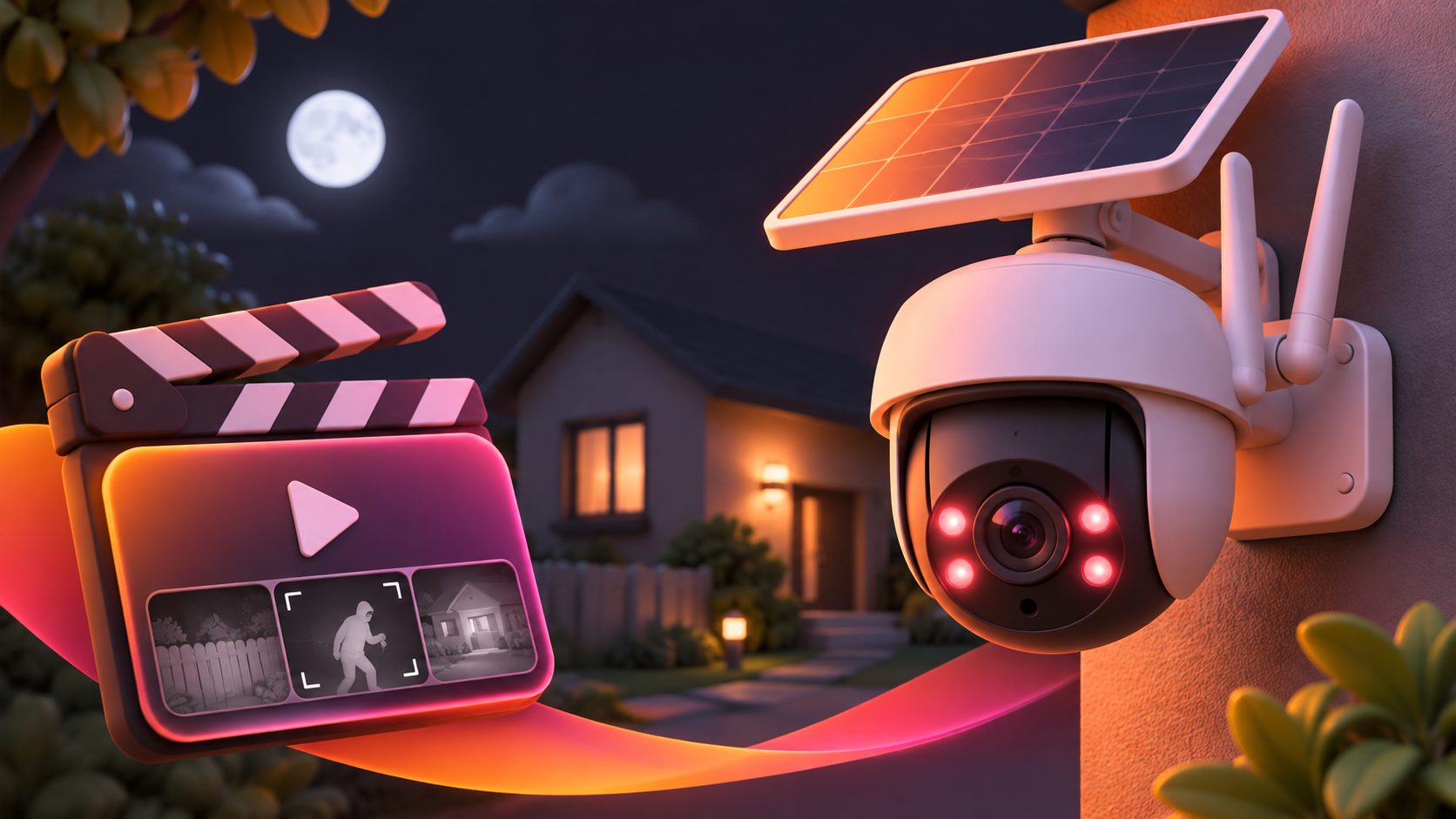
A solar 4G security camera video ad should make one promise immediately clear: the camera can monitor an outdoor location where Wi-Fi, fixed power, or convenient wiring may not be available. The strongest creative demonstrates that promise through a simple day-to-night story, rather than listing technical specifications.
What should a solar 4G security camera ad communicate?
A solar 4G security camera uses cellular connectivity instead of relying on a local Wi-Fi network, while its solar panel helps support battery-powered outdoor operation. In an ad, the viewer should quickly understand where the camera works, what problem it removes, and what the footage looks like after dark.
Search results for these products commonly emphasize no Wi-Fi, solar power, cellular access, motion detection, remote viewing, weather resistance, and night vision. Product listings and specialist pages also frequently show rural properties, barns, fences, farms, construction areas, and other locations where traditional installation is inconvenient. (solarwatchcam.com)
The opportunity is to connect those features into a believable use case:
- Location problem: No router or nearby electrical outlet.
- Installation solution: Mount the camera and solar panel outdoors.
- Connectivity proof: Show a phone receiving or viewing footage through 4G.
- Security proof: Show movement detected in daylight and at night.
- Purchase reason: Reduce installation friction without hiding important requirements such as cellular coverage or a data plan.
This structure is more persuasive than opening with “2K,” “360-degree view,” or a long feature list.
The best 30-second story: from disconnected site to visible protection
The most effective script for this product category usually follows a five-part sequence. It turns a technical product into a visual before-and-after transformation.
1. Open with the real outdoor problem
Use the first two seconds to show a place that is difficult to connect: a shed, driveway, garden gate, storage area, or remote worksite. Avoid exaggerated break-in imagery. A quiet location with a simple caption can feel more credible.
On-screen text:
No Wi-Fi. No nearby outlet. Still need visibility?
The visual should show the absence of infrastructure, not manufacture fear. This is particularly important for household and property-security products, where trust matters as much as urgency.
2. Show the solar and 4G setup
Move from the location problem to the physical solution. Show the camera, solar panel, mounting position, and SIM or cellular concept if the product packaging supports it.
Suggested voiceover:
“Place it where coverage reaches—even when Wi-Fi and fixed power do not.”
Do not claim universal coverage. The ad should encourage buyers to confirm compatible cellular service and signal strength for their installation location.
3. Demonstrate daytime monitoring
Show a person, vehicle, package, gate, or animal entering the camera’s field of view. Use a clean transition from the outdoor scene to a smartphone interface or recorded clip.
A useful creative device is a split screen:
| Outdoor scene | Viewer takeaway |
|---|---|
| Camera mounted beside a shed | Installation is practical |
| Person approaches the gate | Movement is easy to understand |
| Phone displays the scene | Monitoring can happen remotely |
| Solar panel remains visible | Power source is part of the product story |
Keep the interface readable. If the app view is too small, the viewer may remember the camera but not understand the remote-access benefit.
4. Make night vision the proof moment
Night vision should not appear as a decorative effect at the end. It is the central proof point for an outdoor security camera.
Show the same location after sunset, using a consistent camera angle. If the product supports color or infrared night vision, use the manufacturer’s actual footage or clearly label simulated scenes. Avoid adding brightness that makes the camera appear better than the real output.
Suggested caption sequence:
- “Daytime view”
- “After dark”
- “Movement still visible”
The comparison should reveal useful details such as a person’s outline, vehicle movement, or activity near a gate—not promise identification quality that the camera specifications do not support.
A practical shot list for ecommerce sellers
A product video can be produced from a small set of clips if each shot answers a buyer question.
- Wide location shot: Show the outdoor area and why wiring is inconvenient.
- Product close-up: Show the camera lens, solar panel, mounting hardware, and antenna.
- Installation shot: Demonstrate placement without implying that every property has the same mounting requirements.
- Connectivity shot: Show a phone viewing the camera feed or receiving an event notification.
- Daylight event: Capture a person, vehicle, or package entering the frame.
- Night scene: Repeat the same angle after dark.
- Feature overlay: Add only verified specifications from the product listing.
- Call to action: Direct viewers to check cellular compatibility, coverage, storage, and included accessories.
This sequence is also suitable for TikTok, Instagram Reels, YouTube Shorts, and paid social placements. A 9:16 master can be adapted into square and landscape versions, but keep the camera footage and captions inside a central safe area.
For sellers who need additional footage from existing product assets, AdsTurbo can help create and refine ecommerce video variations. Its product-video workflow supports JPG or PNG product images and can combine the product with selling points and promotional information. For an existing clip that looks soft after cropping, an AI video enhancer can improve the presentation before export, but enhancement should not invent details that the original camera did not capture.
What competing ads often miss
A review of current US search results shows that many product pages repeat the same claims: “no Wi-Fi,” “solar powered,” “4G LTE,” “night vision,” “motion detection,” and “remote access.” Retail listings often provide useful specification language, but they rarely explain how to prove these benefits in a short advertising narrative. (walmart.com)
The missing layer is verification design. A strong ad should answer four questions visually:
- Where is the camera installed?
- How does it connect?
- What happens when motion occurs?
- Can the viewer compare daytime and nighttime results?
This leads to a useful production rule: one claim, one visual proof. If the ad says “no Wi-Fi,” show the remote location. If it says “solar powered,” show the panel and outdoor mounting. If it says “night vision,” repeat the scene after dark. If it says “4G access,” show the phone view without implying that cellular service is free or unlimited.
Some specialist product coverage also warns that solar performance can depend on sunlight, battery capacity, and usage intensity. Heavy video access during cloudy periods may affect battery recovery, so responsible advertising should avoid absolute claims such as “never needs charging” unless the manufacturer can substantiate them for defined conditions. (digitalcameraworld.com)
How to create multiple ad variations without losing clarity
Create variations around the buyer’s location, not random visual changes.
Remote-property angle
Focus on a barn, gate, driveway, or storage building. The hook is infrastructure freedom.
Construction-site angle
Show a temporary location where running cable is inconvenient. The hook is flexible deployment and remote visibility.
Rural-home angle
Show a property boundary or outbuilding. The hook is monitoring beyond the reach of home Wi-Fi.
Night-monitoring angle
Start after sunset and reveal the daytime installation afterward. The hook is visibility when the environment changes.
Each version can preserve the same proof sequence while changing the opening shot, voiceover, and CTA. AdsTurbo’s Ad Clone workflow can analyze a reference ad’s structure, pacing, screen text, and CTA logic, then help create variations for creative testing. The reference video analysis endpoint supports clips up to 12 seconds for this workflow, making short-form structure especially suitable for rapid iteration.
For multilingual campaigns, keep the visual proof consistent while adapting voiceover and subtitles. AdsTurbo Video Subtitle can transcribe speech, create time-synced captions, and export either embedded-caption videos or separate subtitle files. This helps sellers test English, Spanish, and other localized versions without rebuilding every scene.
Common questions
Does a 4G security camera need Wi-Fi?
No, a 4G security camera can use a cellular network instead of a local Wi-Fi connection. It still requires compatible cellular coverage and, depending on the product, a SIM card or data service.
What should a solar camera video ad show at night?
It should show a comparable camera angle before and after sunset. The night scene should demonstrate practical visibility, such as movement near a gate or vehicle area, rather than relying only on a glowing night-vision effect.
Should an ad promise that the camera never needs charging?
Use caution. Solar performance depends on sunlight, battery capacity, weather, recording behavior, and transmission frequency. Use the manufacturer’s verified wording instead of an absolute promise.
What is the strongest opening hook?
A specific infrastructure problem usually works better than a generic security scare: “No Wi-Fi at the gate?” or “Need visibility beyond the reach of your home network?” The hook should match the location shown in the next shot.
Can one product video be adapted for several platforms?
Yes. Produce a vertical master for short-form placements, keep key text within the safe area, and create square or landscape crops for other placements. Test different hooks while preserving the same installation and night-vision proof.