
By adsturbo.ai | Published 2026-10-18 | Updated 2026-10-18
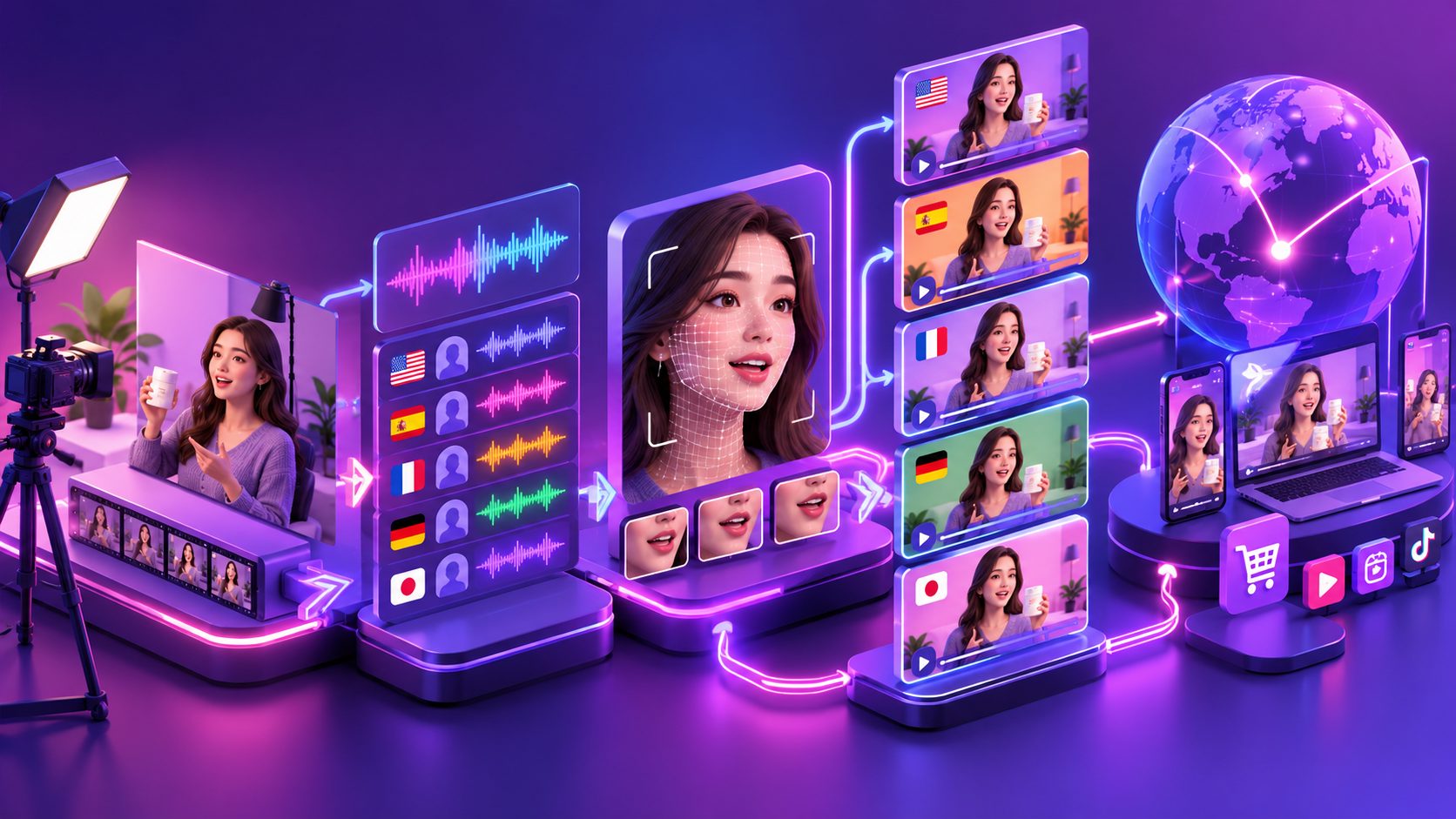
Cross-border sellers can use video ad translation lip sync to turn one product video into localized versions with translated speech, synchronized mouth movements, subtitles, and market-specific on-screen text. The strongest workflow does more than replace audio: it protects the original hook, product proof, pacing, and call to action while adapting the parts that need to feel native.
What is AI video ad translation with lip sync?
AI video ad translation is the process of adapting a video’s spoken language, subtitles, on-screen text, and sometimes the presenter’s mouth movements for another market. Lip sync adds a visual layer by modifying mouth movements so the speaker appears to deliver the translated dialogue naturally.
A localized ecommerce ad usually contains four language layers:
- Voice or dialogue: translated narration, creator speech, or product explanation.
- Lip movement: mouth timing and facial movement matched to the new audio.
- Subtitles: translated captions formatted for mobile viewing.
- On-screen text: prices, benefits, discount codes, claims, and calls to action.
This distinction matters because a video can be technically translated but still feel foreign. A direct voice replacement may preserve the original visuals, while a complete localization workflow also checks timing, text length, cultural phrasing, and conversion intent. Commercial platforms commonly position AI dubbing, subtitles, on-screen text translation, and lip sync as separate but connected parts of ecommerce localization. (vozo.ai)
Why lip sync matters for product ads
Lip sync is most valuable when the presenter’s face is central to the ad. If a creator explains a product, demonstrates a use case, or delivers a personal recommendation, mismatched mouth movements can make the localized version appear dubbed or artificial.
For product demonstrations dominated by B-roll, close-ups, screen recordings, or animated text, subtitles and translated voiceover may provide enough localization. For face-led UGC, testimonials, and talking-head ads, synchronized speech can help preserve the original delivery and perceived authenticity.
A useful decision rule is:
| Original ad format | Recommended localization depth |
|---|---|
| Product montage with music | Translate text and subtitles first |
| Voiceover over product footage | Translate voiceover and captions |
| Talking-head UGC | Add translated audio and lip sync |
| Creator testimonial | Add lip sync, subtitle review, and tone adaptation |
| Promotional sale video | Translate voice, text, offer details, and CTA |
TikTok’s US-facing Lipsync Dubbing guidance illustrates the production constraints sellers should check before translation: supported videos use a defined duration range, require enough spoken content, and can retain background audio while adding captions. (seller-us.tiktok.com)
What should be translated—and what should stay unchanged?
The best localization keeps the ad’s persuasive structure but adapts its language and market references. Do not translate every word mechanically.
Preserve the performance structure
Keep the elements that already make the ad work:
- The first-second visual hook
- The product reveal
- The problem-solution sequence
- Demonstration shots
- Social proof or creator reaction
- Offer timing
- Final CTA placement
AdsTurbo’s ad creative variation framework is useful when a seller wants to separate the parts that should remain stable from the parts that should be tested.
Adapt the language layer
Review the following before export:
- Idioms and slang
- Sentence length and speaking speed
- Currency and measurement references
- Discount wording and promotional conditions
- Product claims
- Subtitle line breaks
- Text inside product screenshots
- Call-to-action phrasing
A literal translation may be grammatically correct but too long for the original shot. This creates rushed narration, awkward pauses, or subtitles that cover the product. The practical fix is to create a timing-aware translation: preserve the meaning, then rewrite the sentence so it fits the available speech window.
A five-step workflow for multilingual ecommerce ads
1. Select a proven source creative
Start with a video that already has a clear hook, product benefit, and CTA. Avoid localizing a weak ad merely because it is easy to translate.
For cross-border sellers, the source video should also have:
- Clear facial visibility if lip sync is required
- Limited background noise
- Understandable speech
- Stable lighting
- Product shots that do not depend on untranslated text
- A short, focused message
If the original video is too compressed or blurry, use an upscaling step before translation. AdsTurbo supports AI video upscaling with before-and-after preview and 4K export options, which can help prepare lower-resolution footage for further editing.
2. Extract the script and offer details
Create a working transcript that separates spoken dialogue from on-screen copy. Mark every conversion-critical detail, including:
- Product name
- Key benefit
- Discount percentage
- Coupon code
- Shipping promise
- Guarantee language
- Call to action
This prevents a common failure: translating the voiceover while leaving an English discount badge or product instruction on screen. AdsTurbo also provides script extraction and video subtitle workflows for turning spoken content into editable text and timed captions.
3. Translate for selling context, not dictionary accuracy
Give the translator or AI system the product category, target audience, tone, and offer context. “Lightweight” for a travel bag, a moisturizer, and a power bank may require different natural phrasing even when the dictionary translation is identical.
A practical translation brief should specify:
- Target country and language
- Formal or conversational tone
- Maximum speaking duration
- Required product terminology
- Words that must not be translated
- CTA and promotion rules
- Whether the speaker should sound energetic, premium, technical, or friendly
4. Generate voice, lip sync, and subtitles
The localized version should be reviewed as a complete asset, not as separate audio and text files. Check whether:
- The translated speech starts and ends with the correct shots
- Mouth movement matches stressed syllables
- Facial expressions remain natural
- Subtitles match the spoken words
- Captions remain readable on mobile
- The CTA appears long enough to understand
AdsTurbo provides video translation, lip sync, subtitle generation, and post-production controls such as character replacement and resolution enhancement. Its Video Subtitle workflow can produce either a video with embedded captions or a separate subtitle file.
5. Export market-specific variants
Do not create one “global” file and assume every placement will fit. Export variants for the channels and placements you actually use. AdsTurbo’s Ad Clone workflow can analyze a reference video of up to 12 seconds and generate parallel ad variations, while its broader video tools support formats such as 9:16, 1:1, and 16:9.
For a wider production workflow, the bulk paid social video ad SOP explains how to organize creative batches instead of producing one file at a time.
An original localization scorecard for launch decisions
A useful way to avoid subjective approval is to score each localized version from 0 to 2 across five dimensions:
| Dimension | 0 points | 1 point | 2 points |
|---|---|---|---|
| Speech timing | Noticeably rushed or delayed | Minor timing issues | Natural pacing |
| Lip movement | Distracting mismatch | Acceptable in short shots | Convincing at normal speed |
| Offer clarity | Offer is unclear | Understandable with effort | Immediately clear |
| Subtitle readability | Overlapping or dense | Usable but crowded | Easy to scan |
| Cultural fit | Literal or awkward | Mostly natural | Native-sounding |
Use the total as a production gate:
- 0–4: revise before publishing
- 5–7: suitable for a small test
- 8–10: ready for broader creative testing
This scorecard is not a performance guarantee. It is an editorial quality filter that helps teams compare language versions consistently before spending media budget.
How to test translated ads without confusing the data
Change one major variable at a time. If the English source uses a creator testimonial, do not simultaneously change the hook, offer, product angle, and landing page in every translated version.
A practical testing sequence is:
- Keep the product, offer, placement, and CTA constant.
- Compare the original against one localized version.
- Review thumb-stop rate, three-second retention, video completion, click-through rate, and conversion rate.
- Check comments for confusion about the product or promotion.
- Create a second version only after identifying a specific weakness.
For example, if retention is stable but clicks are weak, the translation may be understandable while the localized CTA or offer framing is not persuasive. If retention falls immediately, inspect the opening sentence, subtitle density, and speaker timing before changing the entire ad.
The ecommerce video translation guide provides additional context on adapting voiceovers, subtitles, and on-screen text as one workflow.
Common questions about translated video ads
Is lip sync necessary for every translated ad?
No. It is most useful for face-led videos where the speaker’s mouth is visible. Product montages, voiceovers, and screen-recording ads may perform well with translated audio and subtitles alone.
Can AI translate the script and subtitles together?
Yes, but both outputs still need review. Spoken language may need to be shorter than written subtitle language, especially when the target language takes more time to express the same idea.
What type of source video produces the best result?
Clear speech, visible faces, steady lighting, limited background noise, and short product-focused scripts usually produce more reliable localization than crowded scenes or heavily compressed footage.
Should sellers translate the CTA?
Yes. The CTA, discount code, shipping promise, and promotional conditions should be localized together. Leaving only the CTA in English can create friction at the moment of conversion.
How can teams produce many language versions?
Use a structured asset system: one approved source script, a translation brief, a review checklist, standardized naming, and batch exports. For larger teams, AdsTurbo supports asynchronous generation with status polling or Webhook completion events, and higher-level plans support team workflows, API access, and custom workflows.
Final takeaway
AI translation becomes more useful for ecommerce when it is treated as creative localization, not simple dubbing. Preserve the winning structure, adapt the language to the market, synchronize the presenter when facial delivery matters, and evaluate every version with the same quality scorecard before testing.