


作者:adsturbo.ai|发布日期:2026-09-04|更新日期:2026-09-04
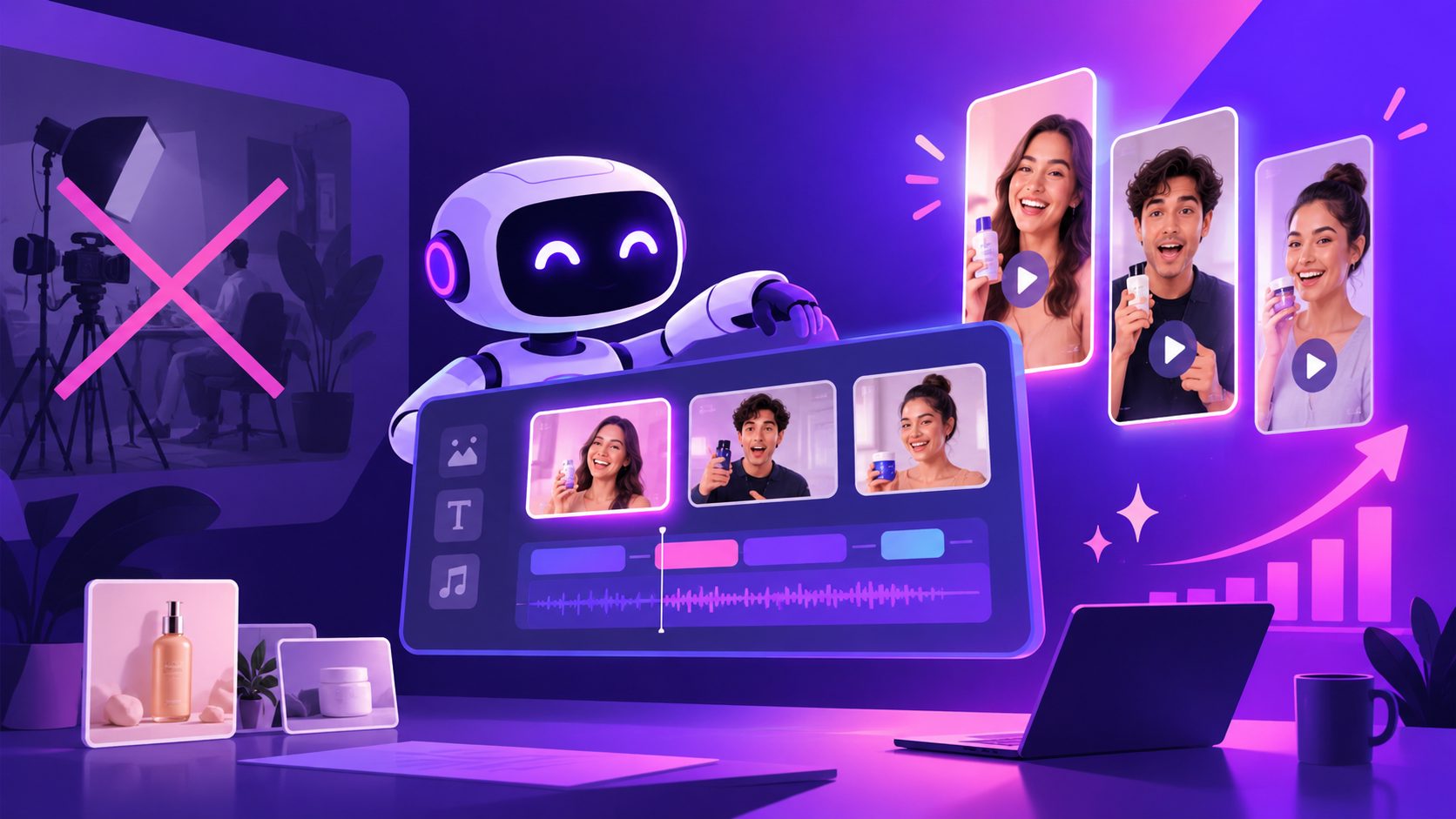
AI UGC ads are short, creator-style product videos generated with AI instead of a traditional creator shoot. For ecommerce sellers, the real advantage is not “one perfect video.” It is the ability to test hooks, personas, offers, captions, and product demonstrations at a pace that matches paid social.
The practical question is simple: how do you turn one SKU into enough believable short-form ad variations without making them feel fake? This guide breaks that workflow into a repeatable system for Shopify, Amazon, TikTok Shop, and DTC teams.
What are AI UGC ads?
AI UGC ads are paid social videos that imitate the casual structure of user-generated content while using AI-generated or AI-assisted scripts, actors, voice, captions, translation, or editing. They usually look like product demos, reviews, unboxings, problem-solution clips, or creator-style recommendations.
They work best when the product is visible early, the claim is specific, and the video feels like a helpful demonstration rather than a synthetic testimonial. Treat them as performance creative, not as a shortcut for fake social proof.
A strong AI-assisted UGC-style ad usually includes:
- A hook in the first 1–3 seconds
- A visible product or use case
- One core buyer pain point
- A simple proof point or demonstration
- Captions designed for silent viewing
- A direct call to action
- A platform-safe disclosure when required
AdsTurbo supports ecommerce teams with tools such as Product Video, Ad Clone, Lip Sync, Character Swap, Video Translation, Video Subtitle, AI Upscaling, Background Replace, product image generation, and API access for more advanced workflows.
Why ecommerce teams use AI-generated UGC-style video
Ecommerce sellers use AI-generated UGC-style video because creative fatigue is faster than production cycles. A winning ad angle may stop working before a creator brief, shoot, revision, and export process can produce enough replacements.
The useful shift is from “make one polished ad” to “build a testing system.” Instead of asking whether one video is good, ask whether you can generate 12–36 controlled variants around the same product.
For example, one hero product can become a test set:
| Variable | Example options | Why it matters |
|---|---|---|
| Hook | Problem, curiosity, comparison | Controls thumb-stop rate |
| Persona | Parent, student, office worker | Changes audience relevance |
| Format | Demo, unboxing, reaction | Changes trust and clarity |
| Offer | Discount, bundle, free shipping | Changes purchase intent |
| Language | English, Spanish, Japanese | Supports localization tests |
| Aspect ratio | 9:16, 1:1, 16:9 | Fits TikTok, Meta, Shorts, placements |
A practical production system should separate idea generation, video generation, compliance review, and media buying feedback. If those steps are mixed together, teams often generate many videos but learn very little.
A 5-step workflow for creating AI UGC ads at scale
The cleanest workflow is: choose one SKU, define the buyer angle, generate controlled video variants, review for realism and compliance, then launch a small creative test. Scaling comes after you know which hook and format deserve more versions.
-
Pick one product and one job-to-be-done
Start with a SKU that already has demand signals: add-to-cart activity, repeat purchases, or organic comments. Avoid starting with your hardest product. -
Write three buyer angles
Use angles such as “saves time,” “solves discomfort,” “looks better on camera,” or “easier than the old way.” Do not begin with features only. -
Create a 12-cell creative matrix
Combine 3 hooks × 2 personas × 2 formats. This is enough to learn without flooding your ad account. -
Generate the videos and captions
Use short scripts, visible product moments, and captions. AdsTurbo’s AI video ad generator workflow for ecommerce product ads is useful when turning product inputs into short-form ad concepts. -
Review before launch
Check mouth movement, product accuracy, caption timing, landing-page consistency, and any required disclosure.
For teams managing many SKUs, a bulk process matters more than a single-video editor. The bulk SKU video generation workflow explains how ecommerce teams can think about catalog-level production without manually rebuilding every asset.
The creative matrix: a better way to avoid random variants
A creative matrix is a structured table of ad variables. It prevents AI UGC ads from becoming random outputs by changing one or two variables at a time while keeping the product, offer, and landing page consistent.
Here is a practical 12-video matrix for a mid-priced ecommerce product:
| Test cell | Hook type | Persona | Format | CTA |
|---|---|---|---|---|
| 1–2 | “I didn’t expect this…” | First-time buyer | Unboxing | Shop today |
| 3–4 | “Stop doing this the hard way” | Busy professional | Demo | See how it works |
| 5–6 | “I compared both” | Practical shopper | Product showdown | Compare options |
| 7–8 | “This fixed my daily annoyance” | Parent | Problem-solution | Try it now |
| 9–10 | “Three things I noticed” | Category enthusiast | Review-style | View details |
| 11–12 | “Before you buy…” | Skeptical buyer | Objection handling | Check the offer |
Original framework: score each generated video on a 1–5 scale before it reaches Ads Manager.
| Review factor | Pass signal | Reject signal |
|---|---|---|
| Product clarity | Product visible in first 3 seconds | Product appears late or unclear |
| Human realism | Natural pauses and gestures | Over-polished, robotic delivery |
| Claim safety | Matches product page | Implies unsupported results |
| Platform fit | Strong vertical crop and captions | Text too small or off-frame |
| Variant learning | One clear variable changed | Too many changes at once |
Only launch videos scoring 4 or 5 on product clarity and claim safety. A video can survive imperfect acting, but it should not survive inaccurate claims.
How to make AI UGC videos feel less fake
AI UGC videos feel believable when they behave like short product explanations, not exaggerated testimonials. The safest formula is “show, explain, compare, invite” rather than “pretend a real customer had a personal experience.”
Use these rules:
- Show the product before the first major claim.
- Keep the script under one main idea.
- Replace vague praise with observable details.
- Use normal speech patterns, not ad-copy language.
- Add captions for TikTok, Instagram Reels, YouTube Shorts, and silent viewers.
- Localize language only after the core message works.
AdsTurbo’s Video Subtitle can automatically transcribe speech and generate time-synced subtitles, with subtitle styling suitable for TikTok, Instagram Reels, and YouTube Shorts. Its Video Subtitle tool also supports downloading a video with embedded subtitles or exporting a separate subtitle file.
If a reference ad already works, do not copy the brand, creator, or protected elements. Instead, analyze the structure: hook timing, shot sequence, pacing, product reveal, objection handling, and CTA. AdsTurbo’s Ad Clone workflow for ecommerce ad variations is designed for this kind of structural reconstruction, including preserving the opening rhythm and CTA logic while creating new variants.
Compliance checks before publishing
AI-assisted UGC-style ads still need ordinary advertising discipline. The FTC’s guidance on endorsements, influencers, and reviews emphasizes truthful marketing and clear disclosure of material connections when endorsements are involved, while its native advertising guide for businesses warns against making promotional content appear independent when it is advertising.
For TikTok, the platform’s Ads Manager documentation says AI-generated, synthetic, or significantly manipulated media can require an AI-generated content disclaimer. TikTok describes this in its official page on ad disclaimers in TikTok Ads Manager.
Before launch, check:
- Is the ad clearly an ad in the placement context?
- Does an AI actor imply real product experience?
- Are testimonials based on real customer claims?
- Are before/after claims substantiated?
- Are health, finance, earnings, or beauty claims exaggerated?
- Does the platform require an AI or synthetic media label?
- Do the video claims match the landing page?
For U.S. ecommerce sellers, the safest policy is simple: avoid fake first-person testimonials unless the experience is real and substantiated. Use AI actors to demonstrate, explain, compare, and localize—not to impersonate customers.
Where AdsTurbo fits in the production stack
AdsTurbo is useful when ecommerce teams need a repeatable system for video ad generation, localization, and post-production. It provides more than one-off generation: teams can work with Ad Clone, Product Video, Lip Sync, Character Swap, Motion Control, Video Translation, Video Subtitle, AI Upscaling, AI Eraser, Background Replace, and product image tools.
For UGC-style workflows, the most relevant capabilities are:
- Product Video: upload a JPG or PNG product image, optionally add selling points or promotion information, and generate UGC-style short video ads.
- Ad Clone: upload a reference video or paste a link so AI can analyze structure and create ad variants.
- Lip Sync and Character Swap: adapt voice, delivery, or on-screen character for audience testing.
- Video Translation and subtitles: turn a working ad into localized versions with audio and captions.
- Clip by Clip editing: refine short videos section by section.
- API access: available on every plan, while advanced plans add team workflows and custom workflow support.
AdsTurbo also provides 300+ AI actors and 100+ product ad templates. For teams testing movement-led formats, the Motion Control guide for AI video ads is a useful companion when a static product or character needs more dynamic action.
A simple testing plan for the first 14 days
A 14-day test should identify winning hooks, not declare a final winner too early. Launch a small, structured batch, let platforms gather signal, then create second-generation variants from the best opening seconds and clearest product demonstrations.
A practical plan:
-
Days 1–2: Build the matrix
Generate 12 videos from one SKU, using three hooks and two formats. -
Days 3–5: Launch a small test
Keep budget, audience, landing page, and offer consistent. Do not test everything at once. -
Days 6–7: Read creative signals
Look at thumb-stop rate, 3-second views, hold rate, click-through rate, comments, and add-to-cart quality. -
Days 8–10: Generate second-round variants
Keep the winning hook structure. Change persona, caption style, CTA, or product scene. -
Days 11–14: Scale or retire
Scale only the pattern, not just the individual video. A winning pattern may produce several new variants.
This turns AI UGC ads into a learning loop. The output is not only videos; it is a clearer map of what buyers respond to.
Common mistakes that weaken performance
Most weak AI-generated UGC-style ads fail before media buying begins. The problem is usually not the AI model; it is an unclear brief, unsupported claim, generic script, or missing product demonstration.
Avoid these mistakes:
- Using a fake “life-changing” testimonial for a simple product
- Showing a talking head for too long before showing the item
- Generating 50 random variants with no test structure
- Changing hook, persona, offer, and landing page at the same time
- Ignoring captions and safe-zone placement
- Localizing before the core English ad works
- Copying a competitor’s creative too closely
- Sending traffic to a product page that does not repeat the ad’s promise
The best UGC-style AI video ads are specific, restrained, and easy to verify. They help the buyer understand the product faster.
Frequently asked questions
Are AI UGC ads the same as real creator UGC?
No. Real creator UGC is made by actual people, often with their own experience or endorsement. AI-generated UGC-style ads imitate the format but may use AI actors, AI voice, generated scripts, or synthetic editing. Treat them as ads, not independent customer content.
Can ecommerce sellers use AI-generated UGC-style ads on TikTok and Meta?
In many cases, yes, but sellers must follow platform policies and advertising law. TikTok documents mandatory disclaimers for AI-generated, synthetic, or significantly manipulated media in certain ad contexts. Always check the current rule inside the platform before publishing.
What products work best for AI UGC-style video?
Products with visible use cases usually work best: beauty tools, accessories, home gadgets, apparel, fitness items, pet products, kitchen tools, and problem-solution products. Abstract services or highly regulated claims need more careful scripting and review.
How many variants should a seller create first?
Start with 12 controlled variants: three hooks, two personas, and two formats. That is enough to learn which message direction works without creating a reporting mess.
What should be human-reviewed before launch?
Review product accuracy, claims, captions, AI disclosure needs, landing-page consistency, voice quality, character realism, and whether the ad implies a real customer experience. Human review is especially important for testimonials, health claims, beauty claims, and financial claims.