By adsturbo.ai | Published 2026-10-18 | Updated 2026-10-18
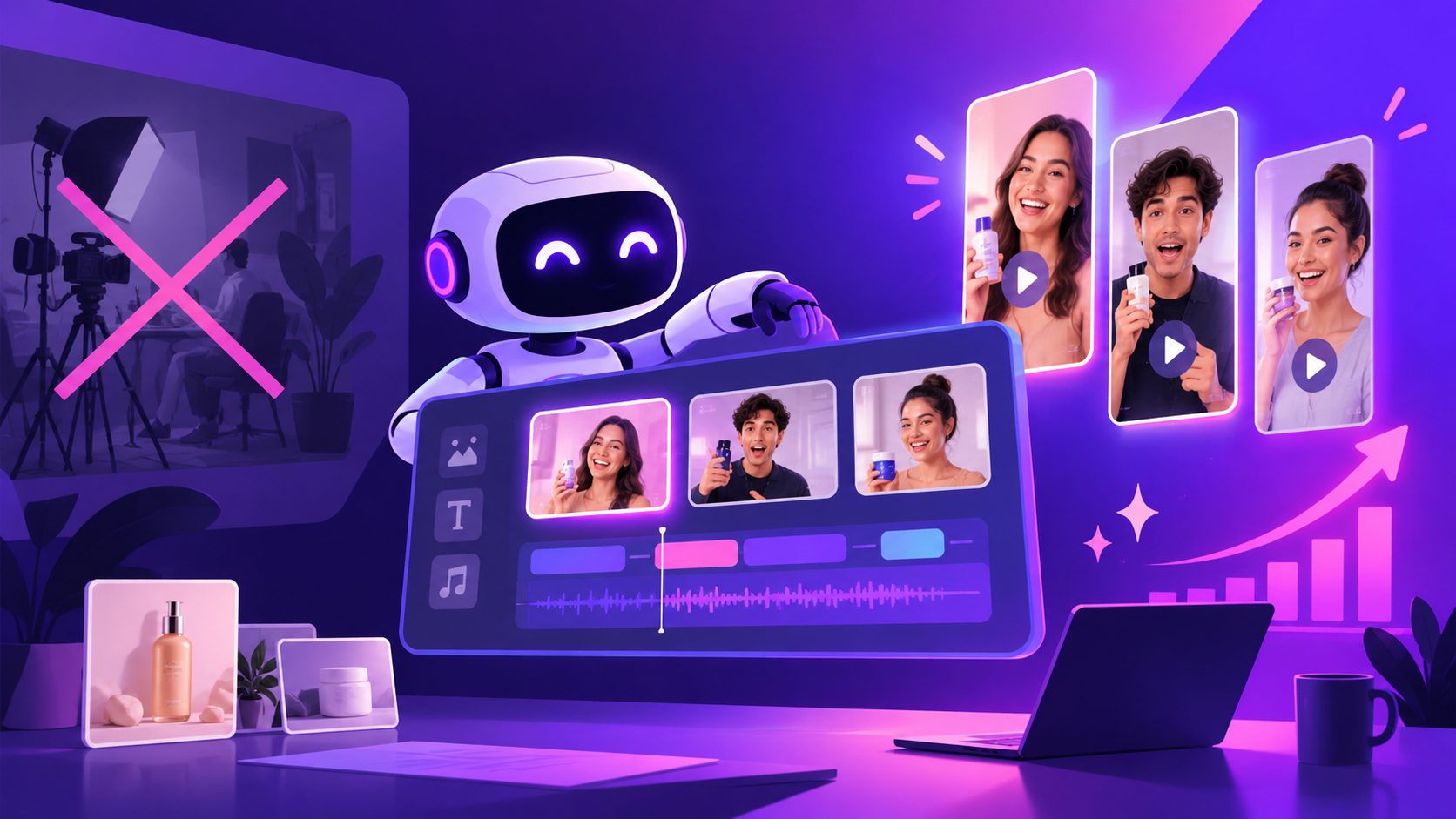
An AI UGC video ad generator helps ecommerce sellers create creator-style product ads without treating every variation as a separate production. The useful goal is not to fabricate happy customers. It is to combine a believable presenter, accurate product visuals, and a testable message.
For D2C brands and TikTok Shop sellers, start with one verified product demonstration, then vary its hook and delivery. The workflow below provides reusable prompts, a 12-variant planning matrix, and a product-proof review framework—not claimed campaign results.
What is an AI UGC video ad generator?
An AI UGC video ad generator creates advertising in the visual style of creator content, using inputs such as product images, scripts, and AI presenters. “UGC-style” describes the presentation; it does not establish that the speaker is a real purchaser or that a customer experience actually happened.
Keep three formats separate:
| Format | Appropriate foundation |
|---|---|
| Presenter-led product introduction | Verified product facts delivered by a spokesperson |
| Unboxing-style demonstration | Accurate packaging, contents, and handling |
| Customer testimonial | A genuine, supportable customer experience |
This distinction matters for US advertising. The FTC prohibits specified fake or false testimonials, including those that misrepresent a nonexistent person or an experience that never occurred. Its guidance does not impose a blanket ban on AI avatars, but their use can still be deceptive. FTC guidance on reviews, testimonials, and AI avatars explains the distinction. (ftc.gov)
Use AI to stage an explanation—not invent evidence.
What should you prepare before generating a batch?
Prepare a compact “truth pack”: approved product photographs, verified claims, packaging references, usage footage, and offer terms. For this workflow, treat those assets as fixed references. Prompts may change the presentation, but they should not change what the product contains, looks like, or demonstrably does.
For a hypothetical travel organizer, the pack might contain:
- Front and interior photographs showing the actual compartments.
- A verified list of included accessories.
- Real footage of the zipper opening and closing.
- Approved dimensions and material descriptions.
- The exact promotion and its exclusions.
AdsTurbo Product Video accepts JPG or PNG product images up to 10MB, with optional selling points and promotional information, and supports product introductions, demonstrations, and review-style videos. These are production formats, not proof of customer experience.
For input preparation, use the TikTok Shop product-image-to-video workflow. Keep a separate approved-claims sheet so generated scripts can be checked against it.
How do you prompt realistic unboxing and product-demo ads?
Write prompts as shot instructions rather than requests to “make it authentic.” Specify the setting, action, pacing, product constraints, and prohibited claims. The following templates are creative briefs—not promises that every generator supports every instruction. Review the output against the source assets before publishing.
Unboxing-style prompt
Create a vertical, creator-style product introduction for [product]. Use soft window light and a plain tabletop. Show the approved package, then the actual included contents. Use one action per shot and relaxed delivery. Preserve the product’s color, logo, proportions, and accessories. Do not imply a personal purchase, invent packaging, or add unsupported claims. End with: “[approved CTA].”
Feature-demonstration prompt
Explain [verified feature] to [audience] in conversational US English. Open with “[hook].” Cut to approved footage demonstrating the feature. Describe only what the footage establishes. Avoid invented ownership history, exaggerated reactions, and unverified comparisons. Finish with “[CTA].”
For more shot-planning detail, use the ecommerce unboxing tutorial.
How can you build 12 useful variants without changing everything?
Build a small factorial batch: three hooks × two demonstrations × two delivery styles = 12 creative combinations. This is a proposed experimental design, not a tested performance benchmark. Its purpose is to make each variation explainable while keeping product facts, offer terms, and landing-page destination consistent.
| Variable | Options for the hypothetical organizer |
|---|---|
| Hook | Packing frustration; compartment overview; size question |
| Demonstration | Interior walkthrough; packing sequence |
| Delivery | Calm explanation; concise energetic explanation |
Use descriptive filenames such as size-interior-calm-v1. Keep the CTA and caption treatment fixed for the first round.
Do not automatically launch all 12 together. If the budget cannot support meaningful purchase comparisons, start with three hooks using one demonstration and delivery style. Expand the strongest direction afterward.
The ecommerce creative-variation framework provides a complementary planning approach. The key discipline is simple: write down what each variant is supposed to teach you before generating it.
Where does AdsTurbo fit into this workflow?
Use AdsTurbo for generation and controlled revision while keeping the truth pack as the approval reference. Its product-video tools, Ad Clone, Clip by Clip editing, Lip Sync, translation, and subtitles support different production tasks. None replaces verification of the product or the script’s claims. (adsturbo.ai)
A practical sequence is:
- Create the base concept. Supply the product image and approved selling points.
- Develop structural variations. Ad Clone can analyze reference-video structure and reconstruct scripts, pacing, shot logic, and CTA structure.
- Revise individual segments. Use Clip by Clip editing to address a weak section rather than changing the entire concept.
- Prepare localized versions. Translation and subtitle tools support language adaptation; review meaning and offer details separately.
Use reference material you have permission to use. Borrowing a hook structure is different from copying another brand’s identity or claims.
For automated production, AdsTurbo tasks run asynchronously, with completion received through status polling or Webhook callbacks.
How do you check realism without manufacturing proof?
Use a Product–Person–Proof gate: verify the object, the speaker’s implied identity, and the evidence behind every claim. This proposed review framework prioritizes trust over surface polish. A natural-looking face should never compensate for an inaccurate product or invented customer story.
| Gate | Review question | Reject or revise when |
|---|---|---|
| Product | Does the item match approved references? | Shape, label, contents, or operation changes |
| Person | What does the speaker imply about themselves? | The script invents purchase or usage history |
| Proof | What supports each spoken and visual claim? | Benefits exceed the available evidence |
For unboxing sequences, inspect the contents revealed at every cut. When a synthetic action could imply unverified functionality, replace it with approved real footage.
TikTok requires disclosure for significantly edited media and AI-generated content through its AIGC label or a clear disclosure. Disclosure is a separate check—not permission to make misleading claims. See TikTok’s edited-media and AIGC advertising policy. (ads.tiktok.com)
Frequently asked questions
Can AI presenters deliver customer reviews?
Do not invent a review for a fictional customer. The FTC distinguishes avatar use from fake testimonials, but warns that avatar portrayals can still be deceptive. A factual product introduction avoids implying an experience that never happened. (ftc.gov)
Do AI-generated TikTok ads need a label?
TikTok requires disclosure for fully AI-generated or significantly AI-modified advertising media. Its Ads Manager also provides an AI-generated-content disclaimer option. Follow the applicable requirements for the actual creative. (ads.tiktok.com)
Which metrics should the first batch track?
Record production metrics—attempts, accepted exports, and review time—separately from advertising metrics such as clicks, purchases, and acquisition cost. Define the primary campaign outcome before launch; a visually convincing export is not itself a business result.
What is the best first use case?
Start with one product, one verified feature, and one clear demonstration. Build three hook variations before expanding actors, languages, and offers. That creates a manageable first batch with a specific learning objective.