


作者:adsturbo.ai|发布日期:2026-09-04|更新日期:2026-09-04
Bulk SKU video generation is the process of turning a product catalog into repeatable videos at scale. Instead of hand-building each ad, teams standardize a source image, a template, and a set of variable fields, then export many SKU-specific cuts for social ads, product pages, and marketplace listings.
The best systems do not try to make every SKU look unique. They make every SKU consistent, shippable, and channel-ready. That means fewer bottlenecks in creative ops, fewer mismatched prices or offers, and faster testing across hero products and long-tail inventory.
What bulk SKU video generation actually means
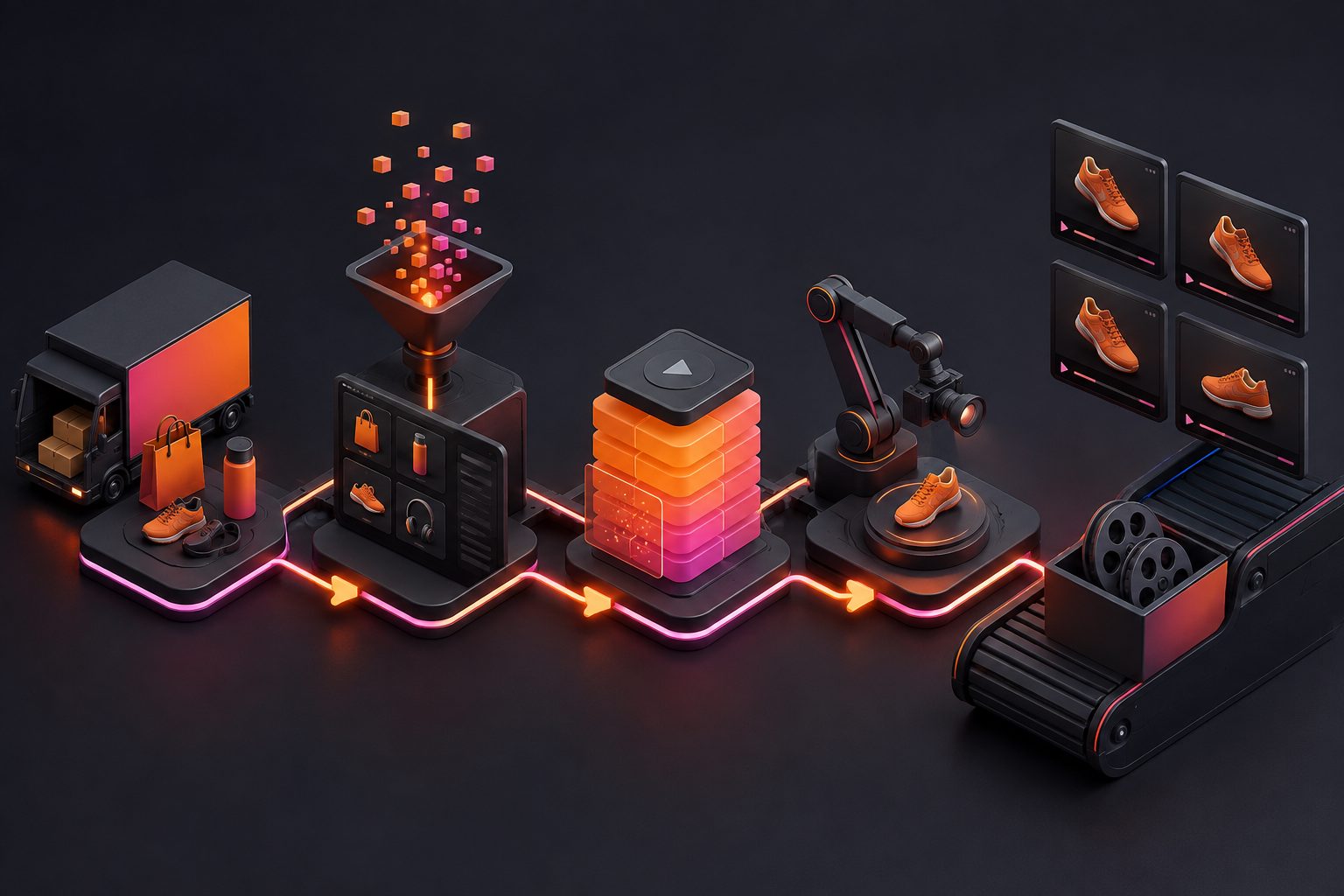
Bulk SKU video generation means one workflow, many outputs. A catalog feed, CSV, product URL list, or image library becomes the source. A single brand template becomes the engine. Then SKU-specific fields such as name, price, color, offer, and locale change from one render to the next.
That is why the strongest bulk systems are not just “video generators.” They are catalog production systems. The goal is to move from one-off editing to repeatable creative operations. If a team can define the input fields once, it can generate product videos, ad cuts, and localized versions without rebuilding the whole story for every SKU.
For a broader setup that starts from a product page or listing, the AI Video Ad Generator Workflow for Ecommerce Product Ads is a useful companion framework.
The workflow that turns a catalog into a video system
A scalable workflow has four parts: normalize, group, generate, and export. Most teams skip the first two and pay for it later in revisions.
| Step | What to standardize | Why it matters |
|---|---|---|
| Normalize product truth | Title, variant, price, offer, locale, category | Prevents mismatched overlays |
| Group by creative family | Hook, pacing, CTA, subtitle style | Reuses one logic across many SKUs |
| Generate in batches | Template, voice, crop, subtitle, format | Keeps production predictable |
| Export by channel | 9:16, 1:1, 16:9, marketplace-safe cuts | Avoids manual resizing later |
Start with clean inputs. If your catalog photos are inconsistent, fix them before video generation. A clean source photo is usually easier to scale than a “creative” photo that changes background, lighting, and framing from SKU to SKU. For that reason, Background Image White for Ecommerce Product Photos is worth using early in the pipeline.
Then define one master template per product family. A skincare serum, a kitchen gadget, and a clothing accessory should not follow the same narrative logic. They may share the same brand system, but their opening frame, proof point, and CTA should differ.
A SKU video readiness score helps decide what gets custom creative
Not every SKU deserves the same amount of attention. A useful approach is to score each item before production. That keeps the team from overspending on low-impact products and underinvesting in high-value ones.
Use a simple 0–2 score across four factors:
- Margin importance
- Visual distinctiveness
- Promo urgency
- Localization need
A SKU scoring 6–8 should get a custom or semi-custom video. A SKU scoring 3–5 should use a family template with swapped overlays. A SKU scoring 0–2 should receive a lightweight catalog cut or a repurposed format from an existing winner.
This is the main information gain most competing pages miss: bulk does not mean flat. The trick is to reserve bespoke creative for the products that can actually move revenue, then use templated production everywhere else.
How AdsTurbo fits a bulk SKU workflow
AdsTurbo is built for that kind of operational split. Its Product Video flow can turn uploaded JPG or PNG product images into short video ads, while Product Image supports JPG and PNG uploads and works best with clear product photos on a pure background. That makes it easier to standardize source assets before batch production.
For ad testing, Ad Clone is especially relevant. It can analyze a reference video, preserve the strongest opening, pacing, and CTA structure, and generate testable variations. That is useful when one winning concept needs to be scaled across a SKU family instead of remade from scratch.
AdsTurbo also supports Video Subtitle, which can generate time-synced captions and export either burned-in subtitles or standalone subtitle files. For localization-heavy ecommerce teams, that matters because the same product cut can be adapted for TikTok, Instagram Reels, and YouTube Shorts with less manual editing.
At the workflow level, generation tasks run asynchronously, so large batches can be queued and tracked by polling or webhook callback. API access is available on every plan, and advanced plans add team workflows and custom workflow support, which is the right shape for catalog-scale operations.
Where teams usually lose time
The bottlenecks are usually not “making videos.” They are decision bottlenecks.
Common failure points include:
- No SKU taxonomy, so every product needs a new prompt
- No overlay rules, so prices and offers drift between versions
- No export matrix, so a single render must be resized by hand
- No QA gate, so one typo breaks an entire batch
- No repurposing plan, so a winning long video is not cut into shorts
A better model is to treat video like merchandising: one system, many variants. When the promotional layer changes, the template should update quickly. For launch campaigns, AdsTurbo’s Event Poster workflow is also useful because it supports JPG and PNG brand assets, multiple aspect ratios, and multilingual promo copy for fast seasonal production.
How to turn one batch into more inventory
The highest-efficiency teams do not stop at the first render. They reuse the same asset system across ad formats and social cuts.
If a long product explainer works, slice it into short-form variants. If a product demo performs well, rebuild it with new openers, subtitles, or localized voice. If a catalog photo is strong but visually flat, turn it into a video with motion and caption overlays first, then export to multiple placements.
That is where a bulk SKU video generation pipeline becomes a growth system rather than a one-time production trick. It feeds paid social, PDPs, marketplaces, and launch campaigns from the same structured source.
For teams focused on quick social testing, Short Form Video Ad Generator for Ecommerce Creative Testing is a useful next read.
Common questions about bulk SKU video generation
How many SKUs can be handled in one batch?
The practical answer depends on your catalog hygiene, template complexity, and channel mix. A clean CSV, consistent photo set, and fixed export rules matter more than the raw SKU count.
Do all SKUs need unique videos?
No. Unique videos should be reserved for high-margin, high-velocity, or visually distinctive products. Most SKUs perform better with a shared template and selective variable changes.
What kind of source files work best?
Clear JPG or PNG product images with consistent framing are the easiest to scale. Mixed backgrounds, inconsistent crops, and low-resolution assets slow down every downstream render.
How should teams localize at scale?
Keep the visual system stable and swap only the fields that need to change: language, subtitle file, offer text, and CTA. That keeps the video recognizable while making it region-ready.
What is the fastest first step?
Start with one product family, one template, and one export matrix. Once the workflow is stable, expand to more SKUs, more languages, and more placements.
The practical takeaway
Bulk SKU video generation works when the catalog is treated like a system, not a pile of separate jobs. Standardize the inputs, score the SKUs, lock the template logic, and only vary what actually drives performance. That is how ecommerce teams move from hero-product videos to a scalable content engine.