Anti Tarnish Jewelry Test Video Ad Script: Proof-First Examples

Summarize with
Summary
Build an anti tarnish jewelry test video ad script with controlled shots, macro proof, claim-safe wording, and reusable 15-second templates. Start testing.
By AdsTurbo Team | Published 2026-11-10 | Updated 2026-11-10
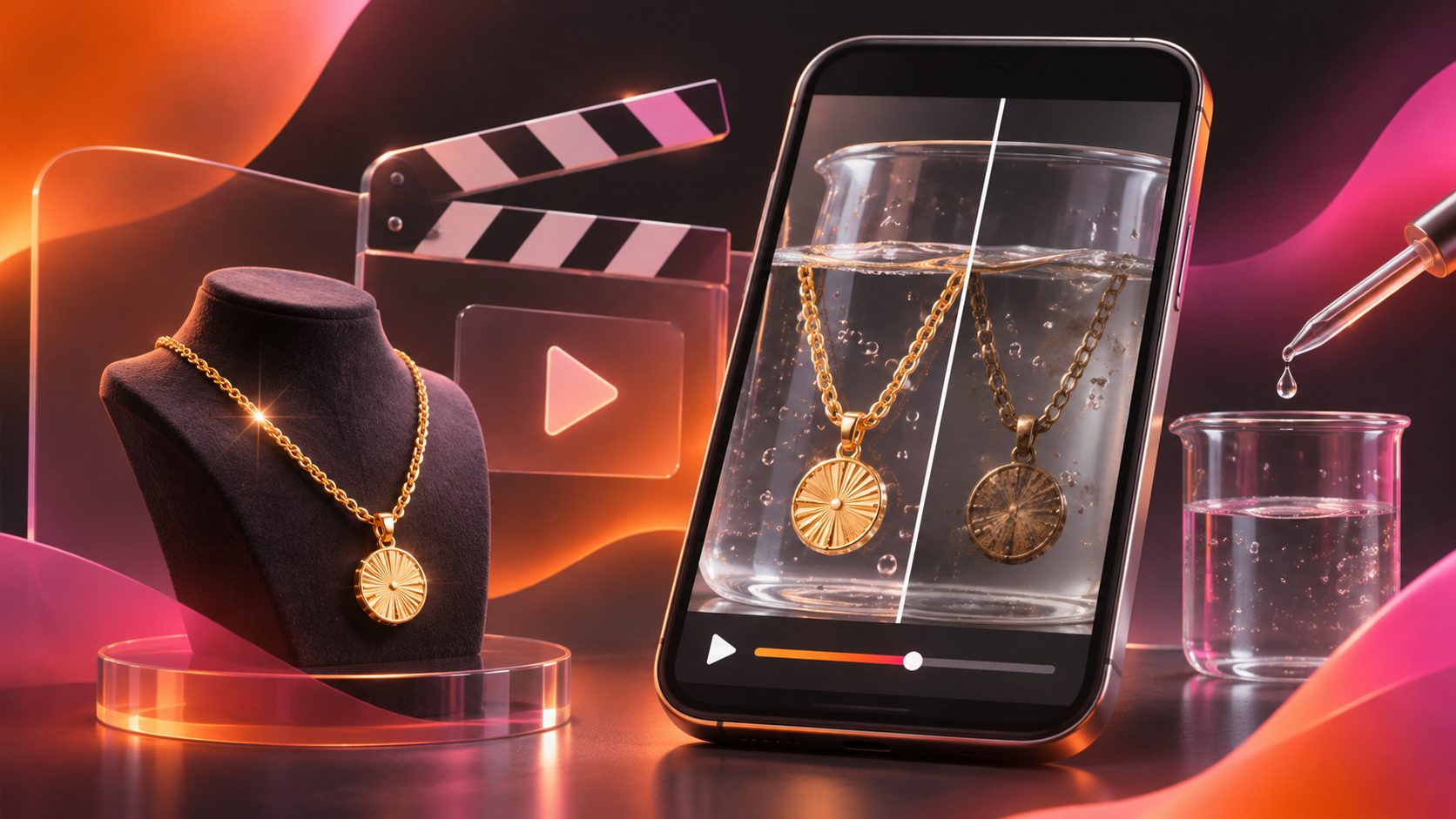
An anti tarnish jewelry test video ad script should show a defined exposure, a controlled comparison, and a claim that matches the evidence. Instead of saying “never tarnishes,” show the starting condition, test setup, close-up result, and care boundary in a short sequence viewers can understand without sound.
For DTC jewelry brands, the strongest format combines macro detail, real-world friction, water or sweat exposure, and a clear after-test comparison. The result is not just a prettier product video—it is a proof asset that answers the buyer’s biggest objection.
What should an anti tarnish jewelry test video prove?
An anti tarnish jewelry test video should prove one narrow statement under named conditions, not promise unlimited durability. Define the material, exposure, test duration, comparison sample, and visible pass condition before filming.
The Federal Trade Commission’s Jewelry Guides emphasize truthful representations of jewelry qualities such as durability and serviceability. Its supporting discussion also notes that no single test can demonstrate performance under every real-world wearing condition. (ftc.gov)
Use this test brief:
| Test element | What to document |
|---|---|
| Jewelry type | Ring, necklace, bracelet, earrings, or plated detail |
| Material and finish | Sterling silver, stainless steel, gold-filled, plated, or stated coating |
| Exposure | Fresh water, artificial sweat, saltwater, chlorine, soap, or friction |
| Duration | Actual exposure period, not the edited video length |
| Comparison | Untested control, baseline photo, or identical second sample |
| Pass condition | No visible color shift, peeling, corrosion, or finish loss under the test |
A useful original framework is the 4C proof check: Condition, Contact, Comparison, Claim. If the video does not show all four, viewers may remember the promise but not understand what was actually tested.
How to structure a 15-second jewelry durability ad
A concise jewelry durability ad works best when every shot answers a separate question: What is the product? What was tested? What changed? What should I do next?
15-second anti tarnish test script
| Time | Visual | Voiceover or on-screen text |
|---|---|---|
| 0:00–0:02 | Macro shot of the clean piece beside a control sample | “Will this finish hold up to daily wear?” |
| 0:02–0:04 | Rotate the clasp, chain links, setting, and high-contact edges | “Starting condition: bright finish, close-up.” |
| 0:04–0:07 | Show the actual water, sweat, soap, or friction test | “Tested with [condition] for [duration].” |
| 0:07–0:09 | Rub one defined section using a consistent cloth and stroke count | “[Number] controlled rub cycles.” |
| 0:09–0:12 | Recreate the original camera angle and lighting | “After test: [observed result].” |
| 0:12–0:15 | Show the jewelry worn at normal scale with product name | “Tarnish-resistant under this test. Shop the finish.” |
The important detail is the matched before-and-after shot. Keep the lens distance, lighting direction, background, and jewelry orientation as consistent as possible. A dramatic lighting change can make a finish appear brighter or duller even when the product has not changed.
For more visual guidance, a jewelry macro video ad workflow can help you plan sparkle, scale, clasp details, and close-up movement before editing.
Which test concepts work best for DTC jewelry?
Different tests answer different buyer objections. Choose one primary objection per ad rather than combining water, scratching, sweat, and chemical exposure into a confusing montage.
1. Controlled water exposure
Use a measured amount of fresh water and show the exposure clearly. Avoid calling the item “waterproof” if the test only covers splashes or a short rinse.
Script angle:
“Water test, not a vague promise. Here is the piece before, here is the exposure, and here is the finish after.”
2. Sweat and daily-wear simulation
A sweat-focused video can show a controlled solution, a defined time period, and attention to areas that contact skin. Keep the result specific to the method used.
Script angle:
“Skin contact is where everyday jewelry gets tested. We checked the chain, clasp, and underside after [duration].”
3. Friction or rub test
A rub test is useful for showing whether visible finish loss occurred on a selected area. It should not be presented as a complete substitute for long-term wear.
Script angle:
“Same cloth. Same pressure. Same number of passes. Here is the close-up before and after.”
4. Multi-condition comparison
For a stronger retargeting ad, split the screen into two or three labeled conditions: fresh water, friction, and sweat simulation. Keep each test short and show the final comparison for at least two seconds.
What should the script say—and avoid saying?
The safest claim is the narrowest claim supported by the test. “No visible tarnish after [named test]” is more defensible than “never tarnishes,” because it tells viewers exactly what the footage demonstrates.
| Avoid broad wording | Use precise wording |
|---|---|
| “Never tarnishes” | “No visible tarnish after [test condition]” |
| “100% waterproof” | “Tested in [water condition] for [duration]” |
| “Scratch-proof” | “Resisted visible scratching during [defined test]” |
| “Wear it anywhere forever” | “Designed for daily wear with stated care” |
| “Hypoallergenic” | Name the material or provide a supported test result |
Do not use a fast dip in water to imply months of showering, gym use, or swimming. If the exposure happened earlier and the video only shows the setup and result, label the footage honestly as a test demonstration.
A practical rule: the claim and its qualifier should appear in the same frame. This prevents a bold headline from being separated from the limitation in a later caption.
How to film macro jewelry proof that looks credible
Jewelry is difficult to film because polished metal reflects the camera, lights, and surrounding colors. Use soft, diffused lighting and lock the camera position for the before-and-after sequence.
Prioritize these details:
- Show scale: Include a finger, wrist, neck, ruler, or coin so the piece does not look larger than it is.
- Show weak points: Film the clasp, underside, chain links, stone setting, and edges.
- Use repeatable framing: Mark the camera position and rotate the product to the same angle.
- Keep labels visible: Add “before,” “after,” test condition, and test duration.
- Edit for sound-off viewing: Captions should explain the test even when the viewer does not hear narration.
For brands building several versions, use one master test and vary only the first hook, presenter style, caption language, or final CTA. AdsTurbo supports product videos, ad cloning, video subtitles, translation, lip sync, character replacement, and AI upscaling. Its AI video enhancer can help improve the clarity of low-resolution test footage before export.
Three reusable script variations
Script A: Objection-first UGC
Hook: “Will this necklace turn dull after everyday wear?”
Demo: “I recorded the finish before testing it with [condition] for [duration].”
Proof: “Here is the same angle afterward—look at the clasp and chain.”
CTA: “See the material details before you order.”
Script B: Split-screen comparison
Hook: “Same lighting. Same test. Different finish.”
Demo: Show the control sample and tested sample side by side.
Proof: Add labels for exposure, duration, and visible result.
CTA: “Compare the finish and choose your piece.”
Script C: Macro-first product ad
Hook: “The detail most jewelry ads skip.”
Demo: Move from the surface to the clasp, underside, and chain connection.
Proof: “After [test], no visible [specified change] under this setup.”
CTA: “Watch the full test, then shop the collection.”
Frequently asked questions
Can a short video prove jewelry will never tarnish?
No. It can document a defined test and its observed result, but it cannot prove unlimited performance across every wearer, climate, chemical, or period.
Is “anti tarnish” the same as “waterproof”?
No. Anti-tarnish language concerns resistance to visible discoloration under stated conditions. Waterproof language implies a broader water-performance claim and requires stronger evidence.
How many jewelry samples should a brand test?
Use at least three identical samples when possible: one untouched control, one tested sample, and one repeat sample. This makes the comparison easier to interpret than testing a single item with no baseline.
Should the ad show a scratch test and water test together?
Only if the video clearly labels each test. For cold audiences, one objection-first test is usually easier to understand; use separate variants for water exposure, friction, and sweat simulation.
Can AI create the full test result?
AI can help with editing, subtitles, localization, and creative variations, but the durability result should come from the real product and the documented test. Do not generate a fictional before-and-after and present it as physical evidence.
Final checklist before publishing
- The material and finish are stated accurately.
- The exposure condition and duration are visible.
- A control or matched baseline is included.
- The macro shot shows likely wear points.
- The result is described narrowly.
- The same qualifier appears beside the claim.
- Captions work without sound.
- The final CTA tells viewers one clear next step.
- The footage does not imply a short test equals unlimited wear.
A strong anti tarnish jewelry test video ad script turns an abstract promise into a small, understandable experiment. Show the condition, contact, comparison, and claim—and let the proof carry more weight than the superlative.