Reduce Apparel Returns Fabric Stretch Test Video: A Shopify Guide

Summarize with
Summary
Reduce apparel returns with a fabric stretch test video that shows fit, recovery, drape, and movement. Learn a practical Shopify workflow and start testing.
By adsturbo.ai | Published 2026-10-28 | Updated 2026-10-28
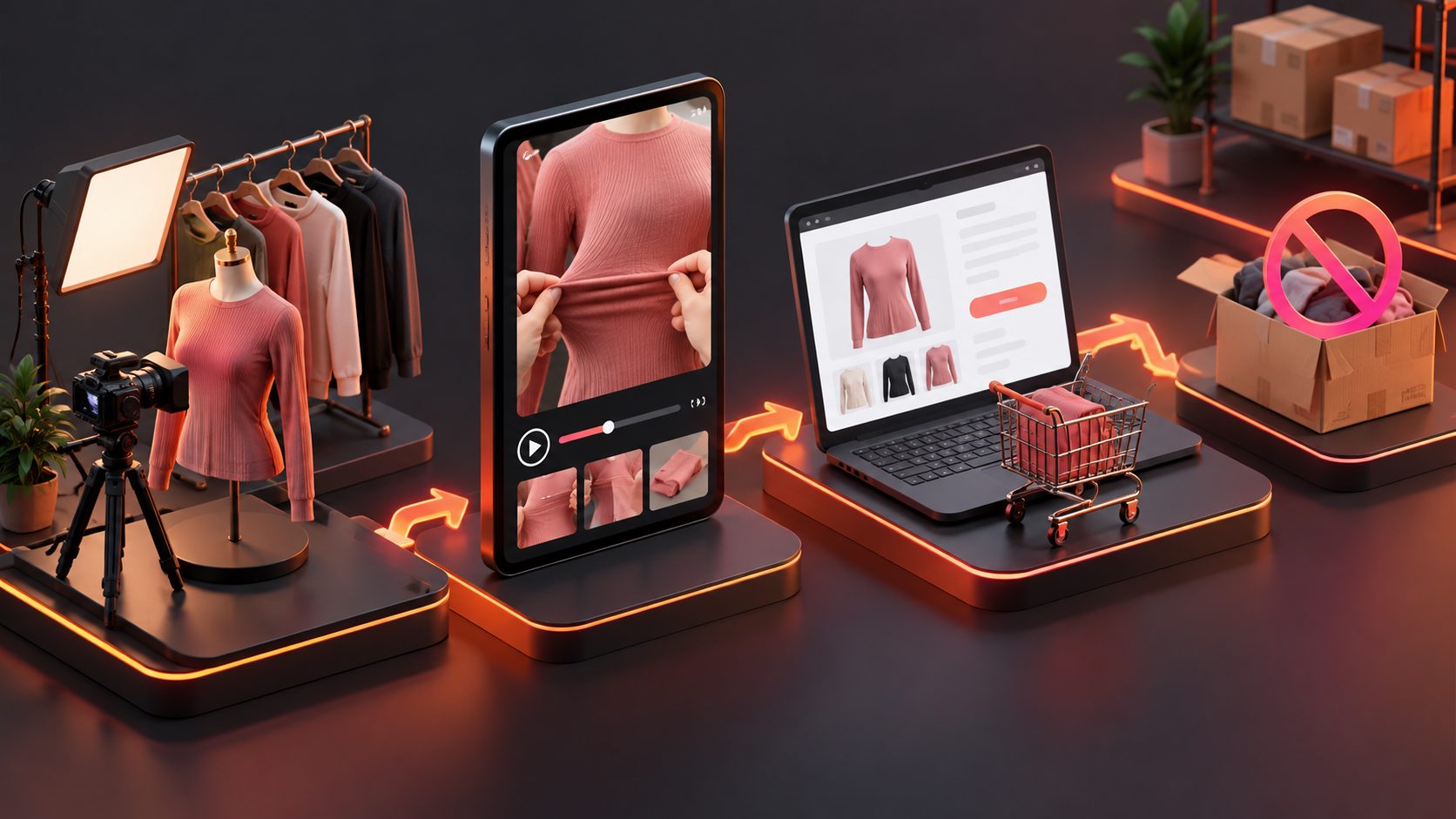
A reduce apparel returns fabric stretch test video gives shoppers visual proof of how clothing stretches, recovers, drapes, and moves. For Shopify women’s apparel and activewear stores, this can reduce the gap between what customers expect online and what they experience after delivery.
Online apparel returns are heavily influenced by sizing and fit. One apparel report estimates that 24.4% of ecommerce apparel items were returned in 2023, with size or fit representing 38% of returns. (podean.com) The practical lesson is simple: a size chart tells shoppers what the garment measures, but a test video helps them understand how the fabric behaves.
Why does fabric behavior affect apparel returns?
Fabric behavior affects returns because shoppers often cannot predict stretch, compression, recovery, thickness, or movement from static product photos. A pair of leggings may look flexible in a posed image but feel restrictive when someone squats. A fitted top may appear smooth but become sheer or lose its shape under tension.
Fit-related uncertainty is especially important in women’s apparel, jeans, leggings, bras, bodysuits, and performance clothing. Research on virtual fitting also identifies realistic simulation of stretch, movement, and drape as a continuing challenge. (diva-portal.org)
A useful product page should answer four questions before checkout:
- How far does the fabric stretch?
- Does it return to its original shape?
- What happens during ordinary movement?
- How should the shopper use this information when choosing a size?
A stretch test video should not replace garment measurements. It should make those measurements easier to interpret.
What should a fabric stretch test video show?
A fabric stretch test video should combine a controlled close-up with an on-body movement demonstration. The most useful version usually lasts 15–30 seconds and follows the same sequence for every SKU.
1. Show the relaxed fabric first
Begin with the garment lying flat or hanging naturally. Include a ruler, grid, or visible reference line beside the fabric when possible. State the material composition and the relaxed measurement on-screen if those details are verified by your product team.
For example:
“Relaxed waistband: 28 inches. Demonstrated stretch: 34 inches.”
Avoid presenting the maximum possible pull as the recommended wearing range. A fabric that can technically stretch to 38 inches may not be comfortable, opaque, or durable at that tension.
2. Demonstrate controlled stretch
Use two hands to pull the fabric horizontally at a steady speed. Film the front and side angles if the garment has different stretch zones, such as a waistband, bust panel, thigh area, or compression panel.
For activewear, test the areas most affected by movement:
- Waistband during a squat
- Seat and thigh area during a lunge
- Shoulder and back panel during an arm raise
- Knee area during bending
- Hem during walking or reaching
The goal is not to make the garment look artificially flexible. The goal is to show a repeatable behavior shoppers can compare with their own needs.
3. Show recovery after release
Recovery is often more informative than maximum stretch. Hold the fabric for three seconds, release it, and show whether it returns smoothly or remains visibly loose.
A simple recovery sequence can include:
- Original width
- Stretched width
- Width immediately after release
- Width after 10 seconds
This creates a useful distinction between stretch capacity and wearable stretch. Two fabrics may reach the same maximum width but provide very different fit experiences.
4. Add a movement test
A close-up test explains the material. A movement test explains the garment.
Use one model and one consistent routine:
- Stand naturally.
- Sit or squat.
- Raise both arms.
- Turn sideways.
- Walk toward and away from the camera.
For women’s clothing, show whether the fabric pulls across the bust, rides up at the waist, gaps at the back, or stays in place during movement. For sportswear, include the movement most relevant to the product rather than a generic dance clip.
How can Shopify sellers structure the video for size confidence?
The strongest fit video connects physical evidence to a buying decision. A suggested 20-second structure is:
| Time | Visual | Buyer question answered |
|---|---|---|
| 0–3 seconds | Full garment and model | What does the item look like on a body? |
| 3–8 seconds | Macro stretch test | How flexible is the fabric? |
| 8–12 seconds | Release and recovery | Will it lose shape? |
| 12–17 seconds | Squat, reach, or walk test | How does it behave during movement? |
| 17–20 seconds | Size and fit note | Which size or fit preference is relevant? |
Use plain labels such as “moderate stretch,” “firm compression,” “relaxed fit,” or “size up for a looser fit.” Only publish a recommendation when it is supported by garment measurements, fit samples, or customer data.
A useful product-page note might read:
“Model is 5'8", wearing size S. Fabric has moderate stretch. Choose your usual size for a close fit; size up for more room through the hips.”
This is more actionable than saying only “true to size.”
For a broader fit-content system, pair the test video with wide-width shoe try-on video guidance or a plus-size clothing try-on framework when your catalog serves different body proportions.
What is the Stretch Evidence Score?
The Stretch Evidence Score is a practical framework for judging whether a product video gives enough information to support a sizing decision. It is an original editorial checklist, not an industry-standard metric.
Score each category from 0 to 2:
| Category | 0 points | 1 point | 2 points |
|---|---|---|---|
| Relaxed measurement | Not shown | Mentioned in text | Shown visually and labeled |
| Stretch range | No test | Uncontrolled pull | Controlled before-and-after test |
| Recovery | Not shown | Brief release | Timed recovery comparison |
| Movement | Posed only | One movement | Two or more relevant movements |
| Fit context | No model details | Model shown | Height, size worn, and fit note |
| Transparency | Exaggerated claims | General wording | Specific, verifiable wording |
A product video scoring 8 or higher out of 12 usually gives shoppers a stronger basis for comparison than a purely aesthetic fashion clip. The score does not predict a return-rate reduction by itself. It helps your team identify missing evidence before publishing.
How should sellers measure whether the video reduces returns?
Do not judge the video only by views or conversion rate. The important question is whether it changes fit-related outcomes.
Run a controlled pilot with at least 12 apparel SKUs:
- Select six products with stretch-related return reasons.
- Match them with six similar products without the new video.
- Record the baseline return rate for four weeks.
- Add the stretch test video to the treatment group.
- Track results for another four weeks.
- Compare fit-related returns, exchanges, add-to-cart rate, and product-page engagement.
Use SKU-level data rather than store-wide averages. A video may help leggings but have little effect on structured denim or woven shirts.
Track return reasons in more detail than “wrong size.” Add labels such as:
- Too tight at waist
- Too loose at hips
- Not enough stretch
- Fabric became loose
- Too sheer when stretched
- Rides up during movement
- Length different from expectation
This classification creates an important feedback loop: the next video should demonstrate the exact behavior that caused the previous returns.
How can AdsTurbo support apparel video production?
AdsTurbo provides product video generation, clip-by-clip editing, background replacement, subtitles, AI upscaling, and advertising creative workflows for ecommerce sellers. Its Product Video workflow accepts JPG or PNG product images and can generate product review, product introduction, and product demonstration videos.
For a stretch-test campaign, sellers can use a consistent creative brief covering:
- Product image and garment category
- Fabric composition and verified measurements
- Stretch zones to demonstrate
- Target movement
- Model or AI actor direction
- Size guidance
- Subtitle language and format
AdsTurbo also provides video subtitles that can automatically transcribe speech and create time-synchronized captions. Subtitle layouts can be adapted for TikTok, Instagram Reels, and YouTube Shorts.
If the original footage is soft or heavily compressed, 4K video upscaling for ecommerce ads can help improve detail visibility before export. For stores producing multiple regional versions, video translation for ecommerce creative can support localized audio and captions.
Frequently asked questions
Can a stretch test video replace a size chart?
No. A stretch video shows fabric behavior, while a size chart provides measurements. Use both together, including garment measurements and model details.
How long should the video be?
For a product page, 15–30 seconds is usually enough to show relaxed fabric, controlled stretch, recovery, movement, and a fit note. Keep the first few seconds visually informative.
Should the model stretch the fabric as far as possible?
No. Maximum stretch can mislead shoppers. Show a controlled, realistic range that reflects comfortable wear and explain the test conditions.
Which clothing categories benefit most?
Leggings, activewear, fitted tops, bodysuits, denim with elastane, shapewear-style garments, and knit dresses often benefit because stretch and recovery strongly affect perceived fit.
What is the most important metric?
Track fit-related returns by SKU and size, not only total returns. Also monitor exchanges, add-to-cart rate, and the specific complaints the video is designed to clarify.
A well-produced fabric test video does not promise that every shopper will choose the perfect size. It does something more practical: it replaces guesswork with observable evidence. That makes the product page more honest, gives shoppers clearer expectations, and gives Shopify sellers a measurable way to improve fit communication.