

作者:adsturbo.ai|发布日期:2025-06-15|更新日期:2025-06-15
A B2B video ad generator for manufacturing is an AI tool that converts factory footage, product photos, and spec sheets into short, structured videos designed to generate buyer inquiries. For industrial exporters and OEM factories, this matters because the traditional alternative—hiring a video crew to film a production line—often costs thousands of dollars per shoot and takes weeks, while AI generation compresses the cycle to hours.
This guide covers how the workflow actually works, what structure converts B2B buyers, and where manufacturers lose money when they get it wrong.
Why Do Manufacturers Struggle With Video Ads?
Most manufacturing marketing fails at video for three reasons:
- Production cost. A professional factory walkthrough video typically runs $2,000–$8,000, which is hard to justify per SKU when you manage a 200-item catalog.
- Slow iteration. B2B buyers in Germany, the US, and the Middle East respond to different selling points, but reshooting for each market isn't feasible.
- Spec-heavy content. Industrial products don't demo like consumer goods. Torque ratings, tolerance ranges, and certifications need to appear on screen, not just in a PDF.
According to Google's B2B research with Ipsos, roughly 70% of B2B buyers watch video during their purchase journey. Buyers already expect video; the bottleneck is production economics, not demand.
What Does a B2B Video Ad Generator for Manufacturing Actually Do?
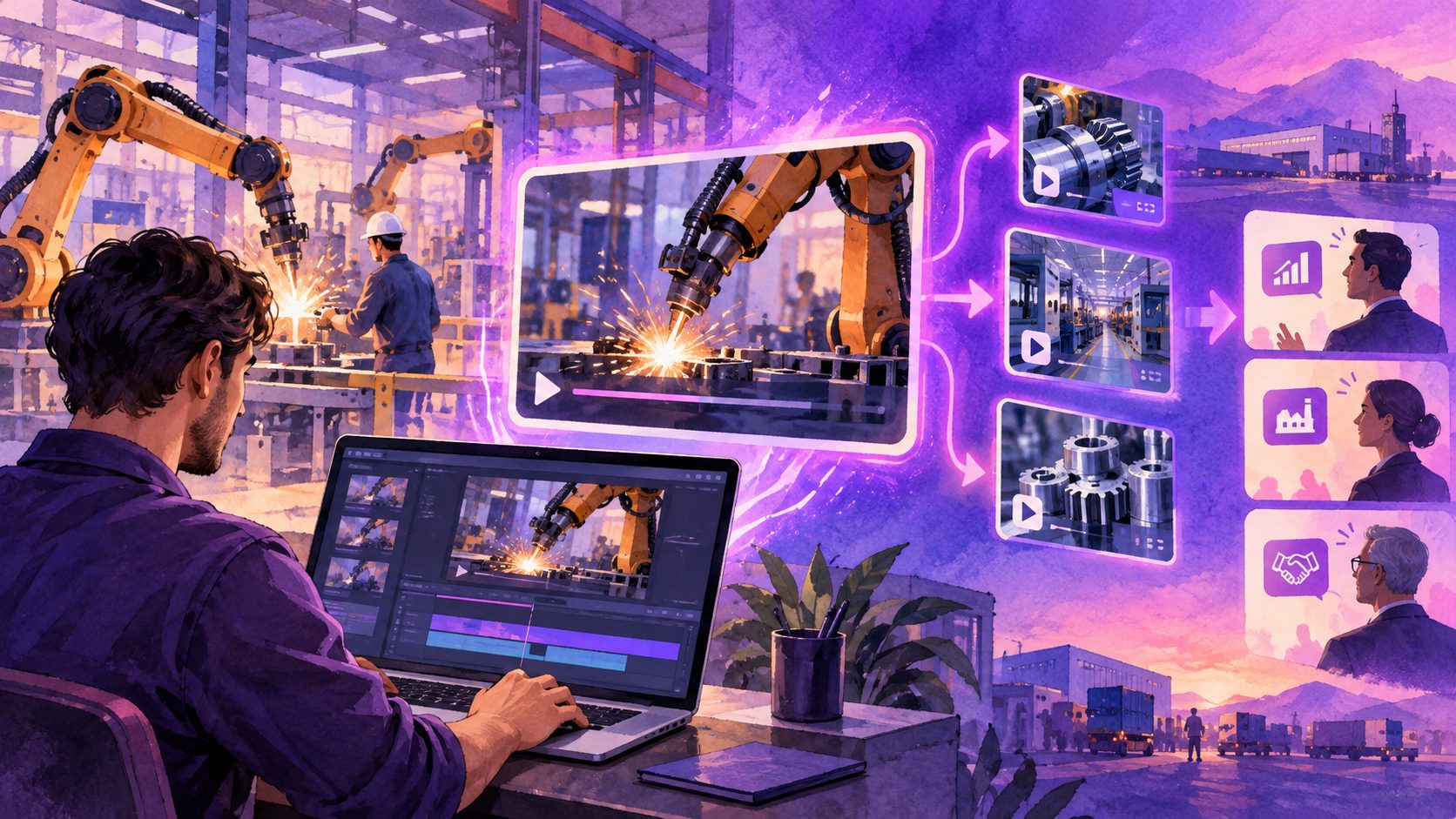
A B2B video ad generator for manufacturing is software that takes raw industrial assets—phone footage of a CNC line, product JPGs on a plain background, a spec table—and outputs structured short videos with on-screen specs, voiceover, captions, and market-specific variants.
The practical capability set looks like this:
| Manufacturing need | AI tool function |
|---|---|
| Show production capability | Clip assembly from raw footage, AI upscaling to 4K |
| Display specs on screen | Auto-generated captions and text overlays |
| Localize for export markets | Video translation with lip sync into multiple languages |
| Test different hooks | Batch variant generation from one master ad |
| Reuse a winning structure | Ad Clone: deconstruct a reference ad's pacing and CTA |
The key shift: one afternoon of phone footage becomes dozens of market-specific ads, instead of one expensive hero video.
The 5-Step Workflow: Factory Floor to Inquiry Ad
Step 1: Capture Raw Assets With a Phone
You don't need a film crew. Shoot 10–15 short clips: the production line running, QC inspection, packaging, warehouse scale, and a close-up of the finished product. Keep clips steady and well-lit. Low-resolution clips are fine—AI upscaling handles that later.
Also gather clean product photos (JPG or PNG on a plain background works best) and your spec sheet.
Step 2: Define the Inquiry Hook
B2B hooks differ from consumer hooks. Instead of emotional triggers, lead with proof:
- "0.02mm tolerance, verified on every batch"
- "12,000 units shipped monthly to EU distributors"
- "ISO 9001 certified — audit reports available"
Write 3–5 hook variants per product. You'll test them all.
Step 3: Generate and Structure the Video
Feed your footage, product images, and selling points into the generator. With AdsTurbo's product video workflow, you upload JPG/PNG product images (up to 10MB), add optional selling points, and the system auto-analyzes the product's shape and category to build a structured short ad.
A high-converting B2B structure runs 20–40 seconds:
- Hook (0–3s): spec or capability claim
- Proof (3–15s): production line, QC, capacity footage
- Product detail (15–30s): close-ups with on-screen specs
- CTA (final 5s): "Request a quote" / "Get the spec sheet"
Step 4: Localize and Create Variants
This is where AI beats traditional production decisively. Video translation with lip sync lets one English master ad become German, Spanish, Japanese, or Korean versions without reshooting. AdsTurbo's video translation runs at 5 credits per second of output, so a 30-second ad costs roughly 150 credits per language—a fraction of a single reshoot.
For a deeper look at the localization mechanics, see this AI localization guide for ecommerce video ads.
Step 5: Test, Measure, Iterate
Run variants across LinkedIn, YouTube, and Google Display. Track inquiry rate (form fills or quote requests per 1,000 views), not just view counts. Kill underperforming hooks after ~$200–$300 of spend each and double down on winners.
If you're running Google placements, the Performance Max video specs guide covers the asset requirements per placement.
What Video Structure Actually Converts B2B Buyers?
Short answer: proof-first structure outperforms brand-first structure for industrial products. In our work with manufacturing advertisers, ads that open with a verifiable spec or capacity claim in the first 3 seconds consistently hold attention longer than cinematic openers.
Three structural rules:
- On-screen text is mandatory. Many B2B viewers watch muted at their desk. Specs, certifications, and MOQs should be readable without audio.
- Show the process, not just the product. Buyers sourcing a supplier care about your QC line and capacity as much as the item itself.
- One CTA only. "Request a quote" or "Download spec sheet"—never both.
AdsTurbo's Ad Clone feature helps here: upload a reference ad (or paste a link) up to 12 seconds, and the AI deconstructs its pacing, shot logic, and CTA structure, then rebuilds it around your product—useful for adapting proven structures from competitors or adjacent industries.
Common Mistakes Manufacturers Make With AI Video Ads
- Using consumer-style music and pacing. B2B buyers interpret flashy editing as low credibility. Keep cuts deliberate.
- Skipping subtitles. AdsTurbo's subtitle tool auto-transcribes speech and formats captions for TikTok, Reels, and Shorts—use it on every export.
- One video for all markets. A US distributor and a Japanese trading company weight different proof points. Generate separate variants; translation alone isn't localization.
- Ignoring asset quality at the source. Upscaling fixes resolution, not blurry or shaky footage. Stabilize at capture.
Frequently Asked Questions
What is a B2B video ad generator for manufacturing?
It's an AI platform that converts factory footage, product images, and spec data into short structured videos built to drive buyer inquiries—handling editing, captions, translation, and variant generation without a production crew.
How long should a manufacturing video ad be?
20–40 seconds for paid placements. Open with a spec or capability claim within 3 seconds, show production proof in the middle, and end with a single quote-request CTA.
Can AI translate one factory video into multiple languages?
Yes. AI video translation with lip sync converts one master ad into multiple language versions. On AdsTurbo this costs 5 credits per second of output—far cheaper than reshooting per market.
What assets do I need to start?
Phone-shot footage of your production line, clean product photos (JPG/PNG on a plain background), your spec sheet, and 3–5 hook variants. AI upscaling can enhance lower-resolution clips to 4K.
Does this work for trade show and LinkedIn promotion?
Yes. The same generated assets export in 9:16, 1:1, and 16:9, covering LinkedIn feeds, YouTube pre-roll, and booth displays from a single production cycle.
Manufacturers don't need bigger video budgets—they need a repeatable pipeline that turns existing factory reality into tested, localized inquiry ads. Start generating your first manufacturing video ad with AdsTurbo.