Ecommerce Social Media Ad Creative Generator: A Practical Testing Framework


Summarize with
Summary
Choose an ecommerce social media ad creative generator with a practical framework for formats, hooks, localization, and variant testing. Build better ad systems with AdsTurbo.
By adsturbo.ai | Published 2026-11-04 | Updated 2026-11-04
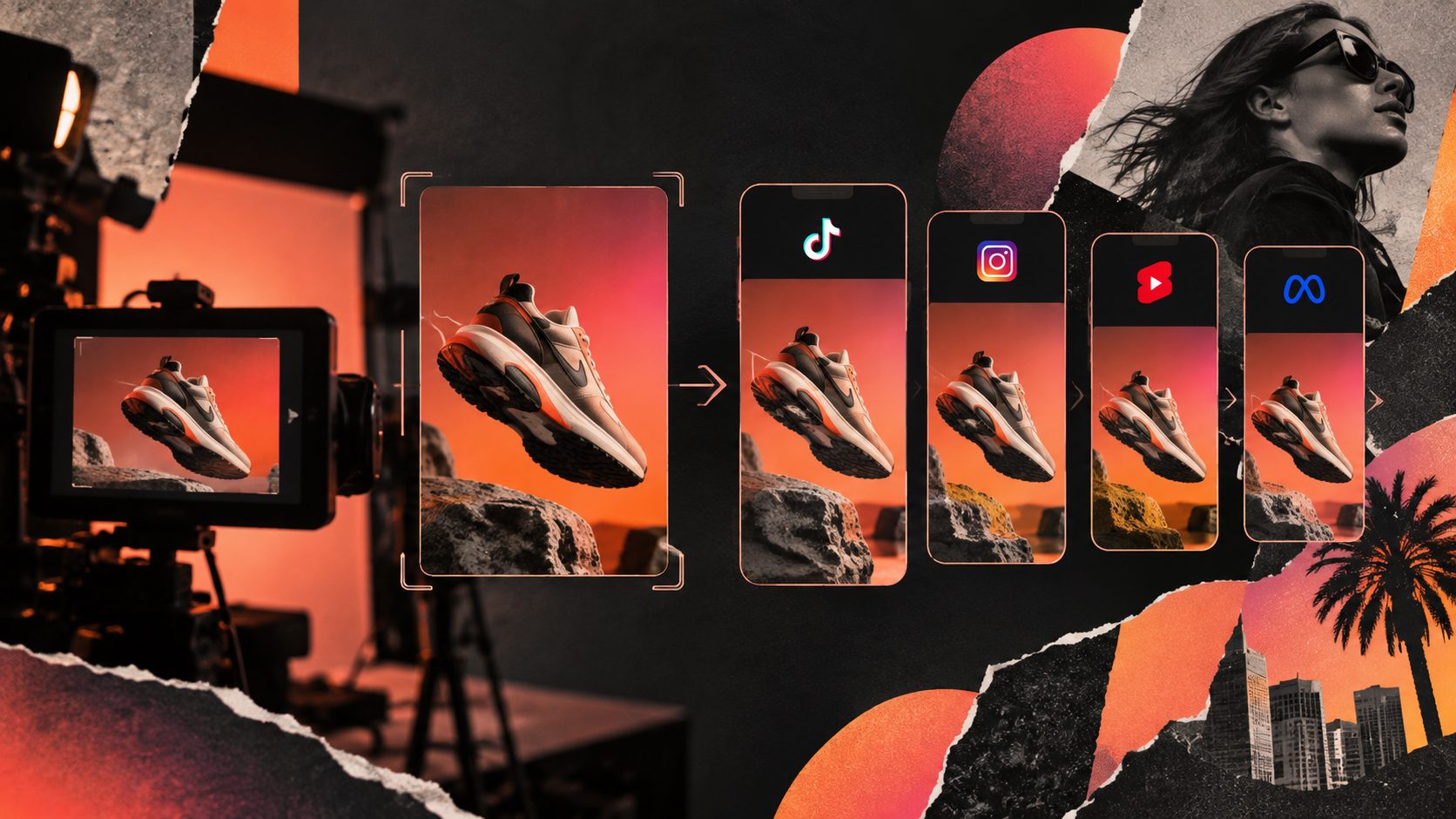
An ecommerce social media ad creative generator helps sellers turn product images, reference videos, selling points, and offers into multiple ad concepts for platforms such as TikTok, Instagram Reels, Meta, and YouTube Shorts. The best workflow is not simply “generate a video.” It is a repeatable system for creating, adapting, and testing different hooks, formats, messages, and audiences.
What is an ecommerce social media ad creative generator?
An ecommerce social media ad creative generator is an AI-assisted tool that creates advertising images, short videos, UGC-style assets, scripts, captions, subtitles, or creative variations from structured product inputs.
For ecommerce sellers, its value comes from reducing the distance between one product idea and a usable testing set. Instead of producing one polished video, a seller can develop several versions with different opening moments, benefits, presenters, languages, aspect ratios, and calls to action.
A useful generator should support more than visual production. It should help with:
- Product image and product video creation
- UGC-style advertising concepts
- Reference-video analysis and ad reconstruction
- Multiple aspect ratios for social platforms
- Localized voice, subtitles, and on-screen text
- Background replacement and image enhancement
- Clip-level editing and creative iteration
- API or workflow automation for larger teams
This distinction matters because creative performance usually depends on the message and structure, not only on visual quality.
Which capabilities should ecommerce sellers compare?
The right tool depends on where your production bottleneck occurs. A practical comparison should examine six capability groups rather than a long feature checklist.
| Capability | What to check | Why it matters |
|---|---|---|
| Product fidelity | Can the product shape, color, packaging, and details remain accurate? | Product distortion can weaken trust and reduce landing-page consistency. |
| Creative variety | Can the tool produce different hooks, scenes, presenters, and CTAs? | Testing requires meaningful differences, not cosmetic edits. |
| Platform adaptation | Can it export vertical, square, and landscape versions? | One concept often needs multiple placements. |
| Editing control | Can you replace a character, adjust motion, sync lips, or edit clips? | Controlled revisions are faster than regenerating everything. |
| Localization | Can it translate speech, subtitles, and visible copy? | Regional testing needs more than translated captions. |
| Workflow scale | Does it support batch generation, API access, webhooks, or team workflows? | Repetitive production becomes a process problem at scale. |
AdsTurbo combines product image generation, product videos, ad cloning, motion control, character replacement, lip sync, video translation, AI upscaling, subtitles, background replacement, and AI erasing in one creative workflow. Its API includes image generation, Persona, AI actors, ad cloning, video generation, and task-processing modules.
The important selection question is: Can the tool help you test a marketing hypothesis, or does it only produce attractive media?
How should one product become multiple ad variants?
The most reliable method is to separate creative variables before generating anything. A simple framework is 5 × 3 × 2:
-
Five hooks
Examples include a problem hook, demonstration hook, comparison hook, social-proof hook, and offer hook. -
Three selling angles
Use different reasons to buy, such as convenience, performance, or appearance. -
Two calls to action
Test a direct purchase CTA against a lower-friction CTA such as learning more or seeing the product in use.
This creates up to 30 combinations, but you do not need to produce all 30 immediately. Start with five to eight clearly different concepts. Keep the product, offer, and landing page stable while changing one major creative variable at a time.
For example, a portable kitchen product could use:
- Hook A: “Still wasting time on meal prep?”
- Hook B: A close-up product demonstration
- Hook C: A before-and-after workflow
- Angle 1: Faster preparation
- Angle 2: Less mess
- Angle 3: Easier storage
This is more informative than generating ten videos that use the same opening line and merely change background music.
AdsTurbo’s Ad Clone workflow can analyze a reference video and help reconstruct its opening rhythm, shot logic, script structure, and CTA pattern for a new product. The reference should guide structure, not justify copying another brand’s identity or claims.
How do dimensions and placements affect creative production?
A social ad should be designed for its placement, not resized as an afterthought. At minimum, plan for:
- 9:16 vertical: TikTok, Reels, and Shorts
- 1:1 square: Feed placements and product-focused posts
- 16:9 landscape: YouTube, websites, and selected display contexts
The core idea can remain consistent, but the first seconds, text placement, and product framing may need to change. Vertical video usually benefits from a large product or face in the center-safe area. Square formats need stronger visual hierarchy because the available height is limited.
A practical production sequence is:
- Build the strongest concept in vertical format.
- Review the first three seconds without sound.
- Adapt the opening frame for square placement.
- Recompose the landscape version instead of simply cropping it.
- Generate platform-specific subtitle layouts.
- Export a naming system that records hook, angle, CTA, language, and ratio.
AdsTurbo Event Poster supports nine aspect ratios for social media, display ads, email, and print formats. Its Product Image workflow can also produce multiple ecommerce image types, including banners, lifestyle images, close-ups, material-detail images, instruction images, and brand visuals.
For product photos, use a clear JPG or PNG image. AdsTurbo notes that product images on a plain-color background generally produce the best results for product-image generation.
How can sellers test creative quality before spending ad budget?
Use a pre-launch scorecard before uploading assets to an ad platform. Rate each creative from 1 to 5 across these five dimensions:
- Product clarity: Is the item recognizable within the opening moment?
- Message clarity: Can a viewer explain the benefit after one viewing?
- Proof strength: Does the video demonstrate, compare, or substantiate the claim?
- Scroll resistance: Does the first frame create a reason to continue?
- CTA continuity: Does the final action match the promise made at the beginning?
A useful rule is to reject assets that score below 3 on product clarity or message clarity, even if they look polished. These two weaknesses are difficult to fix with targeting or budget.
This scorecard is an independent operating framework, not a prediction of conversion results. Platform performance still depends on audience, offer, landing page, price, and delivery conditions. The goal is to remove obvious creative failure before paid testing begins.
For a more complete workflow, see the guide to ecommerce ad creative fatigue and hook variations and the practical dropshipping product screenshots to video ads workflow.
How should product images, subtitles, and localization fit together?
Creative localization is more than translating a voice track. A localized version should align:
- Spoken language
- On-screen subtitles
- Product benefits
- Currency or promotion details
- Presenter or character choice
- Reading speed
- CTA wording
AdsTurbo Video Subtitle can automatically transcribe speech, create time-synced captions, and export either a subtitled video or a separate subtitle file. Its subtitle styling is designed for short-form formats such as TikTok, Instagram Reels, and YouTube Shorts.
AdsTurbo also supports video translation, lip sync, character replacement, and AI upscaling. This allows a seller to adapt a proven creative to another market while preserving its basic structure. However, claims, prices, guarantees, and regulatory wording should still receive human review before publication.
What should an API-ready ad workflow include?
API access becomes valuable when a seller or team repeatedly generates creative from the same data structure. A practical input record might include:
- Product image URL
- Product name
- Three approved selling points
- Promotion or discount details
- Target country and language
- Reference video
- Hook category
- Aspect ratio
- Required subtitle format
AdsTurbo’s video generation API provides eight processing endpoints: shot analysis, lip sync, watermark removal, translation, upscaling, character swap, motion control, and subtitles. Its asynchronous tasks can be monitored through status polling or completion events delivered by webhook.
That architecture supports a useful separation: the ecommerce system supplies product and campaign data, while the creative platform produces and returns media assets. Higher-level AdsTurbo plans support team workflows, API access, and custom workflows.
Common questions about ecommerce ad creative generators
Can one product image generate a complete social ad?
Yes, a product image can be used as the starting point for product visuals, product videos, and ad concepts. Better results usually come from adding approved selling points, promotion details, and a clear audience instead of relying on the image alone.
Should sellers create images or videos first?
Start with the format that matches the campaign bottleneck. Images are useful for product clarity and offer testing, while short videos are better for demonstrations, motion, and UGC-style storytelling. Many sellers should test both rather than assume one format will win.
How many creative variants should be tested?
Begin with five to eight substantially different concepts. Change hooks, angles, or presenters—not only colors and music. Expand the winning concept into more language, ratio, and CTA variations after the first learning cycle.
Does AI replace creative strategy?
No. AI can accelerate production and variation, but sellers still need to choose the customer problem, proof, offer, audience, and testing logic. The strongest workflow uses AI for volume and humans for judgment.
What is the best starting input?
Use a sharp JPG or PNG product image, three concise benefits, one primary audience, and one desired action. For video cloning or localization, add a reference video that has a clear structure and a legally appropriate usage basis.
To build a product-led workflow, explore AdsTurbo Product Video or the Amazon PPC video ads launch strategy.