


By adsturbo.ai | Published 2026-10-02 | Updated 2026-10-02
Ecommerce solo founder creative workflow tools should reduce decisions, handoffs, and repetitive exports—not merely generate attractive images. For a one-person Shopify or Amazon operation, the practical goal is a repeatable system that turns one verified product photo into listing images, promotional graphics, short videos, and testable ad variations.
The strongest workflow separates product truth, creative production, and performance testing. That structure lets you produce faster without allowing AI-generated details, inconsistent offers, or disorganized files to reach customers.
What Should a Solo Ecommerce Creative Stack Actually Do?
A solo ecommerce creative stack is a connected set of tools and production rules for transforming approved product information into publishable images and videos. It should preserve product accuracy, reuse source assets, support multiple aspect ratios, and make revisions possible without rebuilding every creative from scratch.
Build the stack around five jobs:
| Workflow stage | Required capability | Primary output | Quality gate |
|---|---|---|---|
| Source preparation | Crop, cleanup, background removal | Approved master image | Product details match the item |
| Listing production | White-background and detail layouts | Store and marketplace images | Text remains readable on mobile |
| Campaign production | Promotional and lifestyle scenes | Social, email, and display graphics | Offer terms are accurate |
| Video production | Product motion, narration, subtitles | Short-form product ads | Claims match available evidence |
| Variation testing | Hook, scene, CTA, and format changes | Structured test batches | One major variable changes at a time |
A single platform can cover several jobs, but the workflow still needs an external source-of-truth document for prices, benefits, disclaimers, brand colors, and approved product claims.
How Do You Build a Product-Image-to-Ad Workflow?
Start with one controlled source package, then create assets in dependency order. Listing visuals come before ads because they establish the product appearance, approved language, and reusable scenes that downstream creative should follow.
- Create the product truth sheet. Record the exact product name, dimensions, materials, colors, verified benefits, restrictions, target customer, current offer, and prohibited claims.
- Prepare one master product photo. Use a sharp, well-lit image with the complete item visible. Keep the original file untouched and save edited copies separately.
- Generate the listing set. Produce a white-background image, feature graphic, close-up, lifestyle scene, usage image, and brand-led image.
- Build one modular video. Use a hook, problem or context, product demonstration, proof point, and CTA. Keep each section replaceable.
- Create controlled variants. Change the hook first, then the supporting scene, CTA, voice, or audience—not everything simultaneously.
- Export and log assets. Record the SKU, version, format, message, destination, publication date, and test result in a spreadsheet or lightweight database.
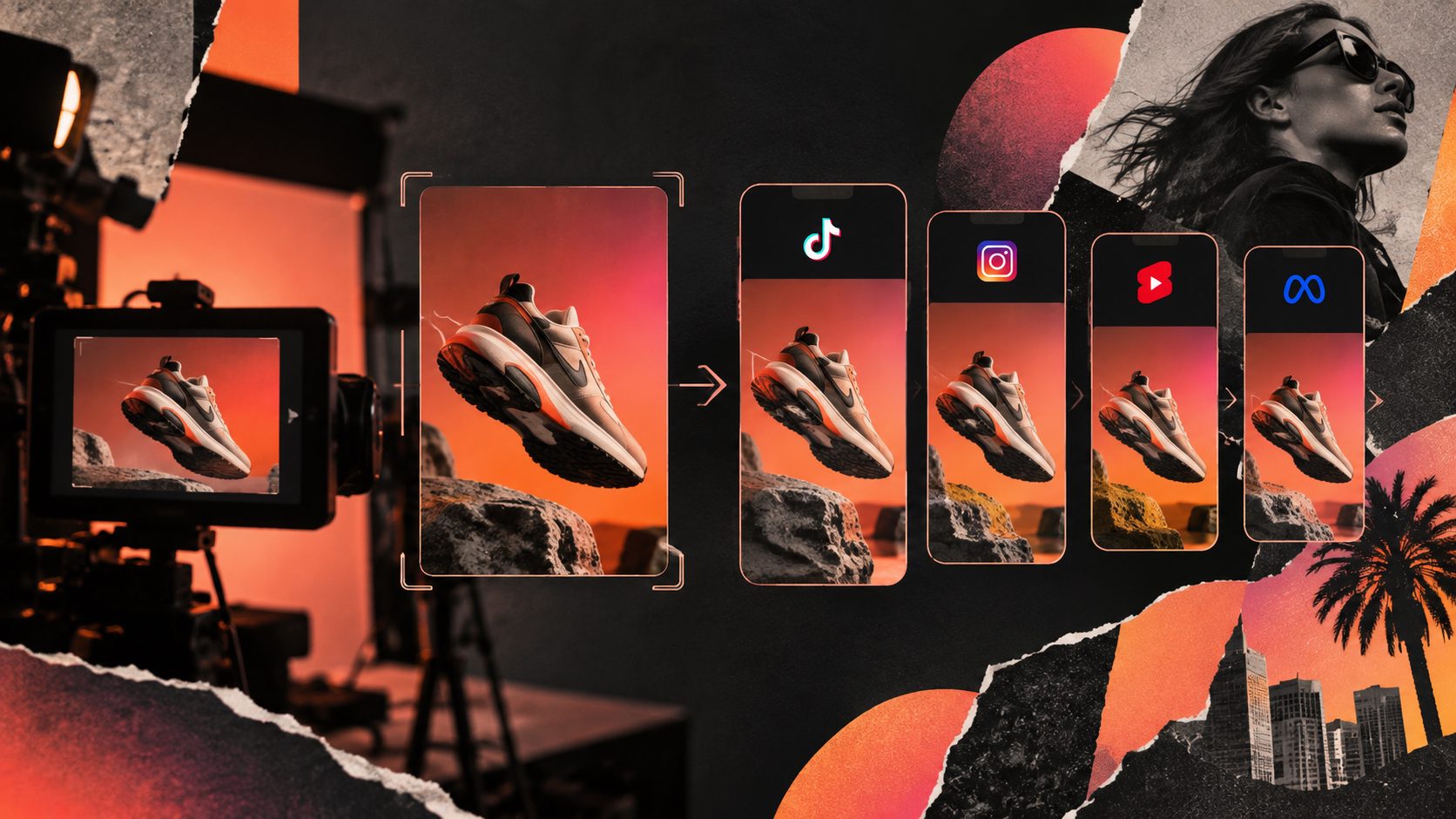
AdsTurbo Product Image accepts JPG and PNG product photos, with clear photos on solid-color backgrounds producing the best input. It can create six image categories and output nine aspect ratios for channels including Amazon, Shopify, TikTok Shop, and Instagram.
For video, the one-image TikTok Shop sales workflow explains how a product photo can become a short-form sales asset without a conventional shoot.
Which Tool Capabilities Matter More Than the Number of Tools?
The best stack is the smallest stack that can produce, revise, approve, and organize every required deliverable. Adding another generator is rarely useful if it creates a new login, naming convention, export process, or review queue.
Evaluate each tool against these criteria:
- Product fidelity: Does it preserve shape, packaging, labels, colors, and accessories?
- Reusable inputs: Can the same product image, script, or persona support multiple formats?
- Editing control: Can you replace one scene, subtitle, background, or character without restarting?
- Batch output: Does it support several ratios or variations from one brief?
- Localization: Can narration, on-screen text, and subtitles be adapted independently?
- Asset retrieval: Can you identify which source, offer, and creative hypothesis produced an export?
- Automation readiness: Are API access, webhooks, or task-status polling available when volume grows?
AdsTurbo provides product image generation, product videos, background replacement, Clip by Clip editing, subtitles, translation, lip sync, character replacement, and upscaling. Its generation tasks run asynchronously, with completion available through status polling or webhook callbacks.
How Can a Solo Founder Measure Workflow Efficiency?
Use a Solo Creative Throughput Score rather than counting raw generations. The score penalizes active production time, tool switching, and revision cycles, revealing whether a supposedly faster stack is creating hidden operational work.
Use this planning formula:
Usable assets ÷ (active hours + tool handoffs × 0.25 + revision rounds × 0.5)
Consider two illustrative workflows producing 12 approved assets:
- A fragmented stack requiring four active hours, five handoffs, and two revision rounds scores 1.92 usable assets per weighted hour.
- A consolidated workflow requiring two active hours, two handoffs, and one revision round scores 4.0 usable assets per weighted hour.
This is a capacity-planning model, not a universal performance benchmark. Apply your own time logs for four weeks and count only assets that pass review and can actually be published.
The metric exposes a common solo-founder problem: a tool may generate quickly while increasing cleanup, file transfers, and corrective revisions. Optimize the entire production loop, not the first output.
How Should Shopify and Amazon Assets Share One System?
Shopify and Amazon assets should share approved source material but use different communication priorities. Shopify gives a brand more freedom to build narrative and visual identity, while marketplace assets generally need to explain the product quickly within a more standardized shopping environment.
Create one reusable SKU creative packet containing:
- One approved master product image
- One white-background version
- Two lifestyle environments
- Three benefit statements
- Three opening hooks
- Two demonstration sequences
- Two CTAs
- Current offer terms and claim evidence
- Square, vertical, and landscape exports
This packet supports listing updates, organic posts, and paid campaigns without separate production briefs. A three-hook, two-body, two-CTA structure also creates 12 planned message combinations, although only the most useful combinations need to be rendered.
If video is new to the store, use a focused first ecommerce video ad workflow before expanding into large batches.
What Does a Sustainable Weekly Production Cycle Look Like?
A sustainable system batches similar decisions together. Instead of switching between copywriting, editing, publishing, and analytics every day, assign each stage a fixed place in the week and feed performance insights back into the next batch.
A practical weekly cycle is:
- Monday: Review ad and store data; choose one creative question.
- Tuesday: Approve hooks, claims, offers, and source assets.
- Wednesday: Generate listing visuals, scenes, and the master video.
- Thursday: Produce controlled variations, subtitles, and channel formats.
- Friday: Complete product-fidelity checks, publish assets, and update the test log.
When a winning ad begins to fatigue, preserve its strongest structural element and vary only the weakest layer. The hook-and-scene testing playbook shows how to refresh creative without discarding the logic that made the original effective.
For international campaigns, separate visual production from language adaptation. A multilingual product video workflow can help organize translated narration, synchronized subtitles, and regional versions around one approved master.
Frequently Asked Questions
How many creative tools does a solo ecommerce founder need?
Most solo sellers need capabilities rather than a fixed number of subscriptions: source-image cleanup, listing design, video production, controlled variation, and asset tracking. One integrated creative platform plus a spreadsheet or database may be more manageable than several disconnected generators.
Should listing images or video ads be created first?
Create the core listing images first. They establish the approved product appearance, benefits, terminology, and visual direction. Those elements can then become scenes, overlays, and proof points in video ads.
How many ad variants should be produced at once?
Begin with three to six variants built around one test question. For example, keep the video body and CTA constant while testing three hooks. Small controlled batches produce clearer insights than dozens of versions with unrelated changes.
Can one product photo support an entire creative workflow?
A clear product photo can support white-background images, lifestyle compositions, promotional graphics, and some product videos. However, every generated asset must be checked for altered labels, incorrect dimensions, missing components, unsupported usage scenarios, and misleading product details.
What should be automated first?
Automate repetitive, rules-based steps such as resizing, subtitle generation, file naming, task-status updates, and standard exports. Keep product-accuracy reviews, claim approval, offer validation, and final publishing decisions under human control.
A strong creative system gives the founder fewer moving parts and better experiments. Choose tools according to repeatability, organize production around reusable SKU packets, and measure approved output rather than generation volume.