By adsturbo.ai | Published 2026-10-12 | Updated 2026-10-12
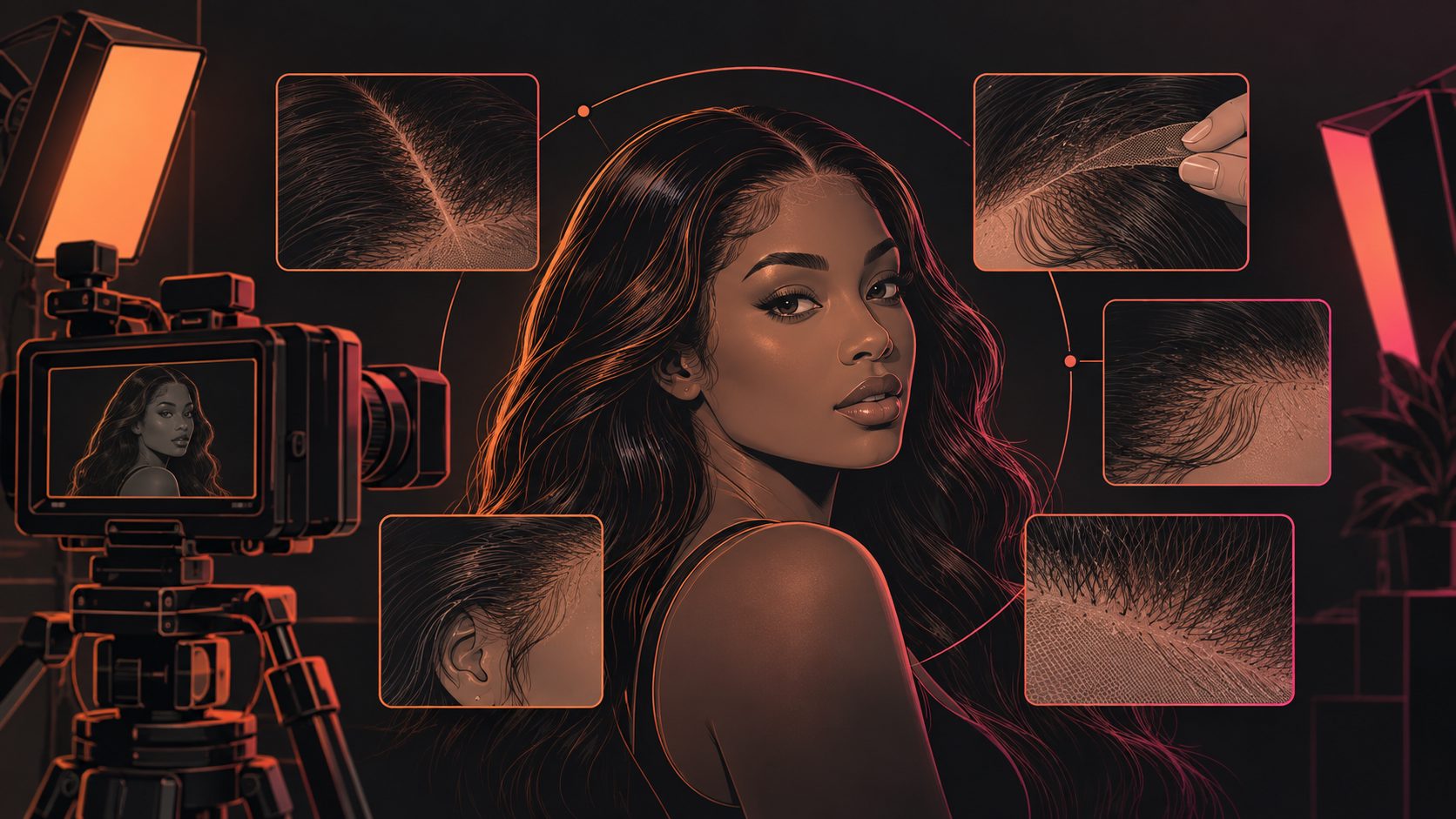
For high-ticket wig sellers, lace front wig video ads macro hairline showcase creative should prove realism before it promises transformation. A wide beauty shot can show length and density, but only a controlled close-up can help shoppers judge whether the lace edge, knots, baby hairs, and scalp transition look convincing.
This guide presents a five-shot evidence chain for TikTok Shop, Meta, and independent-store advertising. It is designed for sellers who need more than a polished model clip: they need visual proof that reduces uncertainty around a premium purchase.
What makes a lace front wig video ad persuasive?
A persuasive lace front wig video ad is a short visual proof sequence that answers the buyer’s main objections: Can I see the lace? Does the hairline look natural? Does it remain believable when the head moves?
The strongest product showcases typically combine a natural-light overview, a close-up of lace details, and a movement shot rather than relying on one static beauty image. Existing wig showcase pages commonly emphasize texture, density, transparent lace, and a seamless-looking hairline, while TikTok-oriented examples add a fixed macro camera and a quick reveal of the lace edge. (shop.luvmehair.com)
For ecommerce sellers, the practical lesson is simple: the ad should move from claim to evidence.
Use this order:
- Establish the full wig and overall styling.
- Reveal the hairline at a readable distance.
- Move into macro detail.
- Introduce motion and changing angles.
- End with a clear product and purchase cue.
This structure is more useful than beginning with a generic “Get ready with me” opening because it makes the product’s hardest-to-believe feature the center of the story.
What are the five shots in a macro hairline proof chain?
The five-shot proof chain is a repeatable format for showing lace realism without over-editing the footage. Each shot should answer one question and last long enough for a viewer to understand what is being shown.
1. The three-quarter establishing shot
Start with a three-quarter view from the front and side. Keep the face, hairline, parting, and overall silhouette visible for approximately two seconds.
Show:
- Wig length and density
- Hair texture and curl pattern
- Parting position
- The relationship between the hairline and the wearer’s face
Avoid opening with extreme beauty filters. They can make the hair look attractive, but they also weaken trust when the buyer later sees unfiltered customer content.
2. The forehead transition shot
Move closer to the front hairline while keeping part of the forehead and temple visible. This is the point where viewers look for a hard lace border, unnatural density, or a straight artificial edge.
Use a slow horizontal move from one temple toward the center. Do not cover the edge with text, hands, or decorative graphics. If the wig uses baby hairs, show them in their natural position rather than brushing every strand into a perfect line.
3. The macro lace-edge shot
The macro shot is the core of the lace front wig video ads macro hairline showcase format. Frame the lace edge, knots, and first row of hair at a stable angle. The goal is not to make the lace disappear through blur; it is to let viewers inspect how the material transitions into the skin.
A useful capture rule is:
- One neutral-light macro shot
- One slight side-angle macro shot
- No beauty filter
- No rapid transition during the proof moment
- At least one frame where the lace edge is visible enough to evaluate
This is where many ads underperform. They say “undetectable” but never provide a view that supports the claim. A close-up product page from the wig category similarly treats lace detail as a dedicated visual selling point rather than burying it inside a general model shot. (geetahair.com)
4. The movement and lift test
A realistic hairline should remain credible when the wearer turns, tucks hair behind the ear, or gently lifts a small section near the front. Film one controlled movement instead of a fast hair flip that hides the attachment area.
Show two changes:
- A front-to-side head turn
- A gentle lift or separation of hair near the hairline
This does not prove every installation will look identical. It does show buyers how the lace and hairline behave when the viewing angle changes. That distinction matters for accuracy and helps avoid overpromising.
5. The final conversion frame
Close with the full hairstyle, product name, key construction detail, and a direct next step. The final frame can show the model facing forward while the text identifies the relevant feature, such as “HD lace,” “pre-plucked hairline,” or “glueless fit,” only when that feature is true for the product being sold.
Keep the CTA specific:
- “See the full lace detail”
- “Choose your texture”
- “View available lengths”
- “Shop the featured unit”
A CTA that repeats the proof is stronger than a generic “Buy now” because it connects the viewer’s concern to the next action.
How should sellers light and frame the hairline?
Use lighting that reveals texture without creating a false impression of invisibility. Soft, even front lighting works for the main shot, while a mild side angle can reveal whether the lace edge lies flat. Harsh overhead light may exaggerate shadows, but completely diffused lighting can remove the very detail shoppers need to judge.
A practical three-condition capture set is:
| Capture condition | What it proves | Common mistake |
|---|---|---|
| Soft front light | Overall blend and skin transition | Overexposing the forehead |
| 30–45° side angle | Lace edge and knot visibility | Hiding the temple |
| Natural movement | Real-world stability of the look | Using motion blur to conceal detail |
Keep the camera stable during the macro section. If the footage is soft or compressed, AdsTurbo AI Upscaling can improve video resolution and supports before-and-after previewing before export. It should enhance readable detail, not manufacture a result that the original footage cannot support.
For a broader production system, the TikTok ads creative production workflow for ecommerce sellers can help turn one approved proof sequence into a repeatable weekly testing process.
How can one wig become multiple ad variations?
Create variations by changing one evidence variable at a time. Changing the hook, model, lighting, and CTA simultaneously makes it difficult to identify what improved performance.
A useful testing matrix includes:
- Hook: “Where’s the lace?” versus “Watch the hairline in side light.”
- Proof order: Macro first versus full look first.
- Voiceover: Technical explanation versus buyer-focused objection handling.
- Model angle: Center front versus three-quarter view.
- CTA: Product-page inspection versus direct purchase.
AdsTurbo Ad Clone can analyze a reference video up to 12 seconds and generate advertising variations. For a safer workflow, use it to study pacing, shot order, and CTA structure, then adapt the resulting concept to your own product, footage, and claims. The guide to rebuilding reported video ads safely provides a useful compliance-minded approach to separating structure from copied execution.
For sellers launching multiple textures or lengths, Product Video can use a JPG or PNG product image, with optional selling points and promotion details, to create short UGC-style product videos. That is useful for testing creative direction before arranging a full shoot.
What should a 15-second script say?
A concise script should describe what the viewer can verify rather than making an absolute claim.
0–2 seconds: “The real test is the hairline.”
2–5 seconds: Show the three-quarter view and front transition.
5–8 seconds: “Here is the lace edge under close-up lighting.”
8–11 seconds: Turn the head and separate the front hair.
11–15 seconds: “See the full construction and available styles.”
Avoid phrases such as “invisible from every angle” unless the product and footage genuinely support that statement. “Designed for a natural-looking transition” is more defensible and still communicates the benefit.
For multilingual campaigns, AdsTurbo Video Subtitle can transcribe speech, generate time-synced captions, and export either a subtitled video or a separate subtitle file. Caption styling can be adapted for TikTok, Instagram Reels, and YouTube Shorts.
How should sellers review a hairline ad before publishing?
Use a five-point preflight before spending media budget:
- Visibility: Can a viewer clearly see the lace edge and hairline?
- Consistency: Does the macro shot match the full-view shot?
- Motion: Does the hairline remain credible when the head turns?
- Claim accuracy: Does every text overlay describe a real product attribute?
- Conversion clarity: Can the viewer identify the unit and next action?
This checklist is the main information advantage of the framework: it treats hairline realism as a sequence of observable proofs, not a single aesthetic impression. A premium wig ad earns trust when the buyer can inspect the same feature from multiple distances and angles.
Common questions
Should a wig ad show the lace edge or hide it?
Show it clearly during the proof section. Hiding the edge may create a smoother-looking ad, but it leaves the buyer’s central question unanswered.
Is macro footage enough to sell a lace front wig?
No. Macro footage proves construction detail, but a complete ad should also show overall density, texture, movement, and the final styled appearance.
Can AI improve a wig ad without changing the product?
AI tools can help with editing, subtitles, translation, resolution enhancement, and creative variations. Keep the source footage and claims accurate so enhancement does not become misrepresentation.
How many versions should a seller test?
Begin with a small controlled set, such as three hooks and two proof orders. Change one major variable at a time, then expand the winning structure across textures, lengths, or colors.
What is the best opening line for a hairline ad?
Use an objection-led line: “The real test is what the hairline looks like up close.” It immediately tells viewers why the next shots deserve attention.