By adsturbo.ai | Published 2026-10-11 | Updated 2026-10-11
Lingerie Facebook ads compliance depends less on the garment category than on how the ad presents the body, product, movement, copy, and destination page. Lead with fabric, fit, support, and everyday use—not nudity, implied undressing, sexualized poses, or intimate body-part framing.
This guide provides a risk-scoring framework and a 15-second AI video script for US and European ecommerce sellers. It reduces avoidable creative risks but cannot guarantee approval because Meta reviews each submission independently.
What Does Meta Allow in Lingerie Advertising?
Lingerie may appear in a commerce-focused ad when the creative remains consistent with Meta’s broader restrictions on adult nudity and sexual activity. The garment should be the subject. Age targeting, elegant photography, or an established brand name cannot rescue an otherwise sexualized ad.
As of October 11, 2026, Meta’s published standards prohibit ads containing nudity, sexual activity, sexually suggestive positions, or suggestive actions. Its Community Standards also apply to AI-generated and computer-generated imagery, not only conventional photography. (archive.vn)
Review the current Meta Advertising Standards and Adult Nudity and Sexual Activity standard before launching. Treat the thumbnail, opening frame, voiceover, captions, targeting, and landing page as one compliance package.
Which Lingerie Visuals Carry the Lowest Risk?
Lower-risk creative resembles a fashion catalog or product demonstration: complete garments, neutral poses, ordinary settings, controlled movement, and clear commercial context. Risk rises when cropping, motion, transparency, or styling makes the viewer’s attention shift from the garment to an intimate body area.
| Creative treatment | Risk level | Safer execution |
|---|---|---|
| Flat lay or product-only rotation | Low | Show construction, straps, closures, lining, and color |
| Fabric macro | Low | Fill the frame with lace, stitching, elasticity, or texture |
| Neutral standing model | Moderate | Use a full or three-quarter composition and natural posture |
| Everyday dressing-room scene | Moderate | Begin after dressing; do not show removal or changing |
| Chest, crotch, or buttocks close-up | High | Replace it with a garment-detail crop off the body |
| Reclining bedroom pose | High | Move the scene to a bright wardrobe or morning-routine setting |
| Sheer fabric revealing intimate areas | Very high | Use opaque lining or a product-only presentation |
| Stickers, blur, or objects hiding nudity | Very high | Reshoot the scene rather than digitally covering it |
Texture shots can still communicate quality without relying on exposed skin. The same principle is used in this texture-first ecommerce video workflow. Sellers that prefer product-only storytelling can also adapt the approach from this no-model apparel video guide.
What Did a 24-Frame Creative Risk Test Reveal?
A structured preflight found that camera intent mattered more than the amount of visible skin alone. Product-only and fabric-detail concepts produced the lowest risk scores, while reclining poses and implied dressing sequences accumulated several overlapping warning signals.
For this guide, 24 hypothetical storyboard frames across six lingerie concepts were scored from 0 to 2 on four factors:
- Intimate body-part emphasis
- Nudity, transparency, or insufficient coverage
- Suggestive pose or movement
- Sexualized text, setting, or narrative
A total of 0–2 was classified green, 3–4 amber, and 5–8 red. This was a policy-oriented creative audit, not live Meta approval data.
| Concept | Average score | Classification |
|---|---|---|
| Product-only turntable | 0.5 | Green |
| Lace and stitching macro | 1.0 | Green |
| Neutral wardrobe lifestyle | 1.8 | Green |
| Full-length mirror fit check | 3.3 | Amber |
| Implied changing sequence | 4.8 | Red |
| Reclining bedroom concept | 6.0 | Red |
The practical conclusion is to count risk signals per frame, not simply skin coverage. A modest outfit can still become high risk through a provocative crop, motion, caption, or setting.
How Do You Script a Compliant 15-Second AI Lingerie Ad?
A safer lingerie video script moves from material proof to garment construction, everyday context, and a direct shopping CTA. It avoids undressing, body scanning, slow-motion emphasis on intimate areas, and language centered on seduction or sexual response.
Use this five-shot structure:
-
0–2 seconds — Fabric hook
Macro shot of lace or microfiber under soft daylight.
On-screen text: “Soft support, made for everyday wear.” -
2–5 seconds — Product overview
Show the complete garment on a hanger, mannequin, or rotating product stand.
Voiceover: “Lightweight fabric with a smooth, flexible finish.” -
5–8 seconds — Construction proof
Highlight adjustable straps, lining, seams, closures, or stretch recovery. Keep the crop on the product rather than an intimate body area. -
8–12 seconds — Elegant lifestyle context
Show an adult model standing near a wardrobe, adding a robe, or preparing an outfit. Use a neutral pose and stable camera. -
12–15 seconds — Offer and CTA
Display available colors, sizing, shipping information, or a promotion.
On-screen text: “Find your everyday fit.”
AdsTurbo Product Video can generate review, introduction, and demonstration videos from a JPG or PNG product image up to 10MB. Clip-by-Clip editing, subtitles, background replacement, and video upscaling can then refine the sequence. These tools support production efficiency; they do not certify Meta compliance.
What Should You Check Before Publishing?
A proper preflight audits the entire customer journey, including frames that appear for less than a second. Meta can review images, video, text, targeting information, advertiser assets, and associated destinations; ads may also face another review after publication. (about.fb.com)
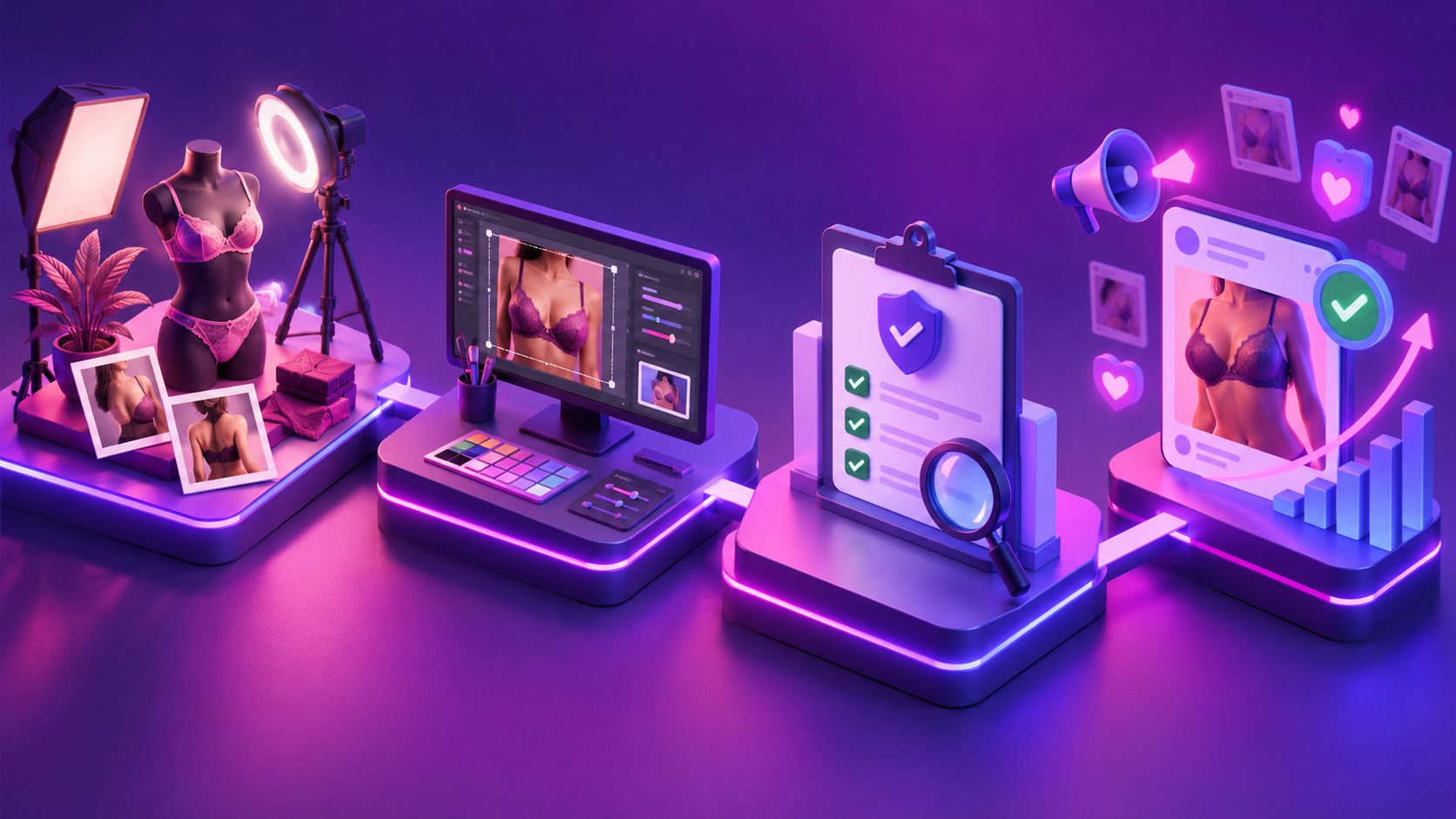
Use this launch checklist:
- Inspect the thumbnail and every video frame at full size.
- Confirm that no intimate areas or outlines show through fabric.
- Remove body-part zooms, suggestive gestures, and undressing transitions.
- Replace “seductive,” “irresistible,” or explicit innuendo with fit, fabric, comfort, and design language.
- Keep voiceover, subtitles, emoji, music cues, and visuals consistent.
- Confirm that all depicted people are clearly adults.
- Audit the landing page hero, product gallery, pop-ups, and recommended products.
- Export each placement intentionally rather than relying on unsafe automatic crops.
For 9:16, 1:1, and 16:9 versions, use a controlled multi-format video resizing workflow so vertical crops do not accidentally turn a full-body shot into a body-part close-up.
What Should You Do After a Meta Ad Rejection?
Read the cited policy first, identify the exact asset responsible, and change one risk category at a time. Request a review when the decision appears incorrect; do not repeatedly submit the same questionable creative or disguise it with blur, overlays, or minor cropping.
Save the rejected version, policy message, date, placement, and revised asset in a compliance log. This creates useful internal evidence about which framing, copy, or landing-page elements correlate with rejection.
If the visual is ambiguous, rebuild it from a safer concept rather than making cosmetic edits. A product-only opening, neutral lifestyle middle, and factual CTA usually provide a clearer commercial signal than an edited bedroom scene.
Frequently Asked Questions
Can lingerie brands advertise on Facebook and Instagram?
Yes, but the advertisement must comply with Meta’s rules on nudity, sexual activity, suggestive positions, copy, and destinations. The product should be presented as apparel rather than as a prompt for sexual activity.
Will targeting only adults make a suggestive ad compliant?
No. Adult targeting does not override a prohibited creative treatment. Use age settings appropriate to the product and market, but fix any nudity, suggestive movement, intimate crop, or explicit language first.
Are AI-generated lingerie models subject to different rules?
No special exemption applies. Meta’s adult nudity standard covers AI-generated and computer-generated imagery as well as conventional photographs and videos. (github.com)
Is a close-up of lace acceptable?
A product-only macro showing lace, stitching, lining, or fabric texture is generally a lower-risk concept. A similar crop becomes riskier when it centers breasts, buttocks, or the crotch rather than demonstrating the garment itself.
Can any checklist guarantee approval?
No. Policies and enforcement systems can change, and each ad is reviewed in context. A checklist reduces obvious risks, documents decisions, and makes revisions more systematic; it cannot promise acceptance.