


Author: adsturbo.ai|Published: 2026-08-30|Updated: 2026-08-30
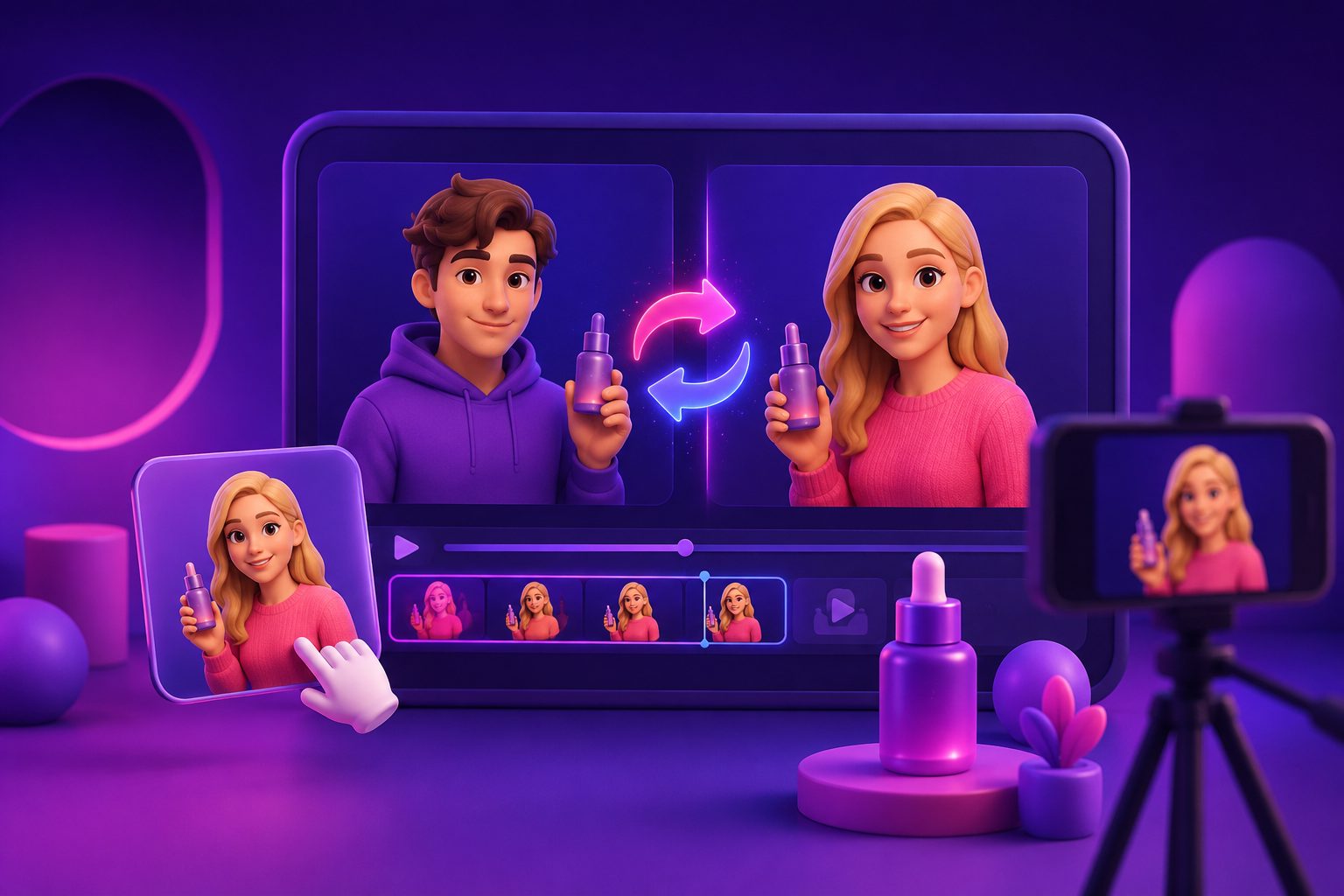
Swap character video AI means using artificial intelligence to replace the person or character in an existing video while keeping the original motion, pacing, camera movement, and scene structure. For ecommerce teams, the real value is not novelty. It is the ability to adapt one proven product ad into audience-specific variants without rebuilding the shoot from zero.
Most tutorials explain the upload-and-generate flow. That is useful, but incomplete. A product ad needs more than a clean face or body replacement. It needs a believable presenter, clear product interaction, readable captions, platform-safe framing, and usage rights that survive paid media review.
This guide focuses on how to swap a character in a product ad video with AI, when to use it, how to brief it, and how to judge whether the output is ready for TikTok, Meta, YouTube Shorts, Amazon-style PDP assets, or Shopify landing pages.
What is AI character swapping in video?
AI character swapping is a video-to-video editing workflow that replaces the on-screen person with a new identity or AI actor while preserving the source clip’s performance cues. In ecommerce ads, it is used to localize presenters, test audience fit, and refresh creative fatigue.
A full-body character swap is different from a basic face swap. A face swap usually changes facial identity while leaving the body, clothing, and much of the original footage intact. Character replacement can affect the whole visible person: face, body shape, styling, pose consistency, and sometimes wardrobe.
For ecommerce, that difference matters. A skincare ad with hands applying serum, a fashion try-on video, or a gadget demo depends on body motion and product handling. If only the face changes but the hands, sleeve, or silhouette feel inconsistent, the ad may look uncanny even if each individual frame seems sharp.
AdsTurbo includes Character Swap alongside tools such as Ad Clone, Lip Sync, Product Video, Video Translation, AI Upscaling, AI Eraser, Background Replace, and Video Subtitle, making it possible to combine identity changes with broader ad iteration workflows.
When should ecommerce teams use it?
Use character swapping when the source ad already has strong structure but the presenter no longer fits the audience, market, or campaign angle. It is best for creative adaptation, not for rescuing weak footage or hiding poor product storytelling.
Good use cases include:
- Regional localization: Replace a generic presenter with a character that better matches the target market, then pair the video with translated voiceover and subtitles.
- Audience testing: Compare creator archetypes, age ranges, styling, or persona types while keeping the same hook and CTA.
- Creative fatigue refresh: Keep a winning ad’s opening rhythm but update the visible actor so the asset feels new.
- Product-line adaptation: Reuse a proven demonstration structure for similar SKUs with different presenters or scenes.
- Brand consistency: Replace mismatched stock footage actors with a more consistent AI actor or approved persona.
Avoid using a swap when the original clip contains unclear hand-object contact, heavy occlusion, fast camera shake, reflective surfaces, or another person crossing in front of the subject. These details raise the risk of warped fingers, drifting identity, and inconsistent product scale.
For teams starting from a product page instead of an existing ad, a URL to Video AI workflow may be a cleaner starting point than forcing a character replacement onto unsuitable footage.
Character swap vs face swap vs motion control
The best workflow depends on what must change. If the body and clothing are already correct, face swap may be enough. If the whole presenter must change, use character swap. If the goal is to make a still persona perform a movement, motion control may be the stronger approach.
| Workflow | What changes | What stays stable | Best ecommerce use |
|---|---|---|---|
| Face swap | Face identity | Body, outfit, scene, motion | Minor presenter refresh |
| Character swap | Visible character identity | Source motion and scene logic | New actor or persona for the same ad |
| Motion control | Character movement | Reference action pattern | Making an AI actor perform a demo or gesture |
| Lip sync | Mouth movement | Visual presenter and scene | New voiceover, translated speech, offer updates |
| Ad clone | Hook, pacing, shot logic, CTA structure | Product-specific message can change | Rebuilding a proven ad format for another SKU |
A strong ecommerce workflow often combines more than one. For example, AdsTurbo’s Ad Clone can preserve a high-performing ad’s golden first seconds, rhythm, shot logic, and CTA structure. Character Swap can then change the presenter, while Lip Sync and Video Translation can adapt the spoken message for a new market.
For movement-heavy scenes, the companion guide on how to control motion in AI video ads explains when motion transfer should come before character replacement.
A practical 7-step workflow for product ads
To swap a character in a product ad video with AI, start with a clean source clip, define the new character, protect product visibility, generate short variants, review frame-level realism, then localize captions and export platform-specific ratios.
-
Choose a source clip with a proven job.
Pick an ad that already has a clear hook, visible product, simple action, and measurable reason to exist. A weak ad with a new actor is still a weak ad. -
Trim the test segment first.
Start with 6–12 seconds, especially around the hook and first product interaction. Short tests reveal identity drift faster and keep review cycles manageable. -
Prepare the target character image.
Use a clear reference image with visible face, consistent lighting, and styling close to the desired ad. For AdsTurbo Character Swap, provide a source video or image containing a person plus the target character image. -
Lock the product zone.
Before generation, mark mentally or in your brief which areas must not change: logo, packaging, hands touching the product, screen UI, color-critical materials, and offer text. -
Generate multiple audience variants.
Test different presenter archetypes only when they support a business hypothesis. “Different” is not enough. Tie each variant to audience, region, use case, or objections. -
Run a realism pass before a marketing pass.
Check face stability, hands, edges, shadows, eye direction, and product contact before debating hooks or copy. -
Finish with captions, ratios, and compliance.
AdsTurbo Video Subtitle can automatically transcribe speech and generate time-synced subtitles, with layouts adapted for TikTok, Instagram Reels, and YouTube Shorts. TikTok recommends vertical 9:16 creative and at least 720p in its creative best practices, while Google notes that vertical video assets are recommended for Shorts ads in its Shorts ads asset guidance.
The 5-layer quality check most tutorials skip
A usable swap character video AI output should be judged in layers: identity, motion, product truth, platform fit, and legal clearance. If any layer fails, the ad may look impressive in preview but underperform or get blocked in paid distribution.
Use this review sheet before exporting:
1. Identity stability
Watch the video at normal speed, then at half speed. The new character should not morph between frames, change age, lose facial structure, or shift hairstyle unnaturally. Minor variation is common, but identity drift near cuts or fast head turns is a warning sign.
2. Motion continuity
The new character must inherit the source performance without rubbery shoulders, floating hands, or broken pose transitions. Pay extra attention to gestures in the first three seconds, because short-form viewers judge authenticity quickly.
3. Product truth
This is the ecommerce-specific layer. The product must remain the same size, shape, color, and position. Packaging claims, labels, before/after visuals, app screens, and discount text should not be altered by the character swap.
4. Platform composition
Check whether the face, product, and captions fit inside vertical placements. For TikTok and Reels-style ads, keep essential information away from UI-covered edges. For feed placements, prepare square or 4:5 crops when needed rather than relying on automatic cropping.
5. Rights and disclosure
Do not swap in a real person’s likeness, voice, or recognizable persona without permission. TikTok’s ad disclaimer guidance lists AI-generated, synthetic, or manipulated media among mandatory disclaimer categories in TikTok Ads Manager. Meta has also expanded AI transparency for ads, including labels for images or videos created or significantly edited with its generative AI creative features, as described in Meta’s GenAI transparency update.
Original ecommerce scoring framework: the 20-point swap readiness test
Before sending a swapped character ad to paid media, score it out of 20. This framework is designed for ecommerce creative teams that need a simple go/no-go decision, not just a visual opinion.
| Category | Points | Pass condition |
|---|---|---|
| Hook clarity | 4 | Viewer understands the product or problem within 2 seconds |
| Character realism | 4 | Face, body, edges, and motion remain stable across the clip |
| Product integrity | 4 | Product shape, color, label, and hand contact stay accurate |
| Message fit | 3 | Voice, captions, offer, and CTA match the new character |
| Platform fit | 3 | Ratio, caption zone, and opening frame suit the target placement |
| Rights readiness | 2 | Likeness, voice, music, and source footage are cleared |
A score of 17–20 is ready for a small-budget test. A score of 14–16 needs editing before launch. Anything below 14 should be regenerated or replaced with a cleaner source clip.
The highest-leverage category is product integrity. A slightly imperfect cheek shadow may be acceptable in a fast social ad. A changed supplement label, distorted shoe sole, or inaccurate skincare texture is not acceptable because it affects trust and claim accuracy.
This is where many general character-swap guides fall short: they optimize for “does the person look swapped?” while ecommerce teams need “does the ad still sell the correct product honestly?”
How AdsTurbo fits into a character replacement workflow
AdsTurbo is an AI video ad generation tool for ecommerce sellers that supports character replacement, ad cloning, product video generation, lip sync, video translation, AI upscaling, subtitle generation, background replacement, and image workflows.
For character swapping specifically, AdsTurbo Character Swap supports uploading a source video or image with a person and a target character image. The workflow is designed to preserve the source action, lighting, and scene realism while replacing the visible character. That makes it suitable for producing audience-specific creative variants from an existing ad concept.
A practical sequence might look like this:
- Use Ad Clone for ecommerce video ads to understand the reference ad’s hook, pacing, shot logic, and CTA.
- Use Character Swap to test different presenters or personas.
- Use Lip Sync or Video Translation to localize speech.
- Use Video Subtitle to create time-synced captions for short-form placements.
- Use AI Upscaling if the winning variant needs higher-resolution export for additional channels.
AdsTurbo also provides more than 300 AI actors and more than 100 product ad templates. For teams with advanced needs, higher-tier plans support team workflows, API access, and custom workflow support. AdsTurbo’s API uses a standard REST architecture with Bearer API Key authentication, asynchronous task execution, status polling, and Webhook callbacks.
Developers can combine image generation, Persona, AI actor, Ad Clone, video generation, and task-processing modules. For video generation APIs, AdsTurbo provides endpoints including shot analysis, lip sync, watermark removal, translation, super-resolution, face swap, motion control, and subtitles.
Common mistakes that make character-swapped ads look fake
Most failed AI actor swaps come from bad inputs, not just weak models. The fastest improvement is to choose cleaner footage, simplify the action, and protect the product before generation.
Avoid these mistakes:
- Using a cluttered source clip. Crowded scenes confuse subject boundaries.
- Changing too many variables at once. Swap one major element first, then adjust voice, caption, or background.
- Ignoring hands. Hands are often where viewers notice AI artifacts in product demos.
- Letting captions cover the product. A perfect actor swap can still fail if subtitles hide the SKU.
- Using unauthorized likenesses. Public figures, creators, employees, and customers require careful rights handling.
- Testing only one variant. Character replacement is most valuable when used for structured A/B testing.
For ads where the background, not the actor, is the main mismatch, a background replacement workflow for ecommerce creatives may solve the problem with less risk.
How to plan variants for real A/B testing
A/B testing works best when each character variant represents a hypothesis. Do not create ten random presenters. Create three to five variants that isolate audience perception, trust signals, or market fit.
Example test matrix:
| Variant | Character angle | Hypothesis |
|---|---|---|
| A | Original presenter | Control benchmark |
| B | Expert-style presenter | Increases trust for technical products |
| C | Lifestyle creator | Improves engagement for beauty or fashion |
| D | Parent or household persona | Fits family-oriented products |
| E | Localized regional actor | Improves relevance in a new market |
Keep the hook, offer, product shots, and CTA consistent for the first test. If every variable changes, the results will not tell you whether the character swap mattered.
After the first round, combine the winning presenter with new hooks. This two-stage approach separates “who should say it?” from “what should they say?”
Frequently asked questions
Can AI replace a person in any video?
AI can replace a person in many videos, but not every clip is a good candidate. Simple lighting, one main subject, clear body edges, and moderate movement produce better results than crowded scenes, heavy blur, mirrors, or complex hand-object interactions.
Is character swap the same as deepfake?
Character swap and deepfake technology can overlap, but the intent and permissions matter. A compliant ecommerce workflow uses approved assets, authorized likenesses, synthetic actors, or brand-owned personas. It should not impersonate real people or imply endorsements without consent.
What input files work best for ecommerce character replacement?
Use a short source clip with a clearly visible presenter and product. For the replacement character, use a clean reference image with good lighting and a stable front-facing or three-quarter view. Avoid sunglasses, heavy filters, extreme angles, and mismatched lighting.
Should the voice change when the character changes?
Often, yes. If the new presenter looks different but the voice clearly belongs to the original actor, viewers may feel a mismatch. Lip sync, translated voiceover, or fresh subtitles can align the new character with the message.
What should be tested first: hook, actor, or product shot?
Start with the hook if the ad is new. Start with the actor if you already have a winning structure but need audience localization or fatigue refresh. Never sacrifice product clarity for a more dramatic character swap.
The bottom line
Swap character video AI is most useful when it extends a proven ecommerce ad, not when it becomes the idea itself. The winning workflow starts with a strong source clip, replaces the presenter for a clear audience reason, protects product truth, checks rights, and exports platform-ready variants.
For ecommerce sellers, the advantage is speed with structure: one reference ad can become multiple localized, audience-specific, captioned, and resized variants without a full reshoot. The brands that get the most from character swapping will treat it as a creative testing system, not a one-click novelty effect.


