Translation Video YouTube: Turn Review Content Into Multilingual Ads

Summarize with
Summary
Learn how to turn YouTube product reviews into multilingual ads with subtitles, dubbing, lip sync, and a practical localization QA workflow. Start creating.
By AdsTurbo.ai | Published 2026-10-22 | Updated 2026-10-22
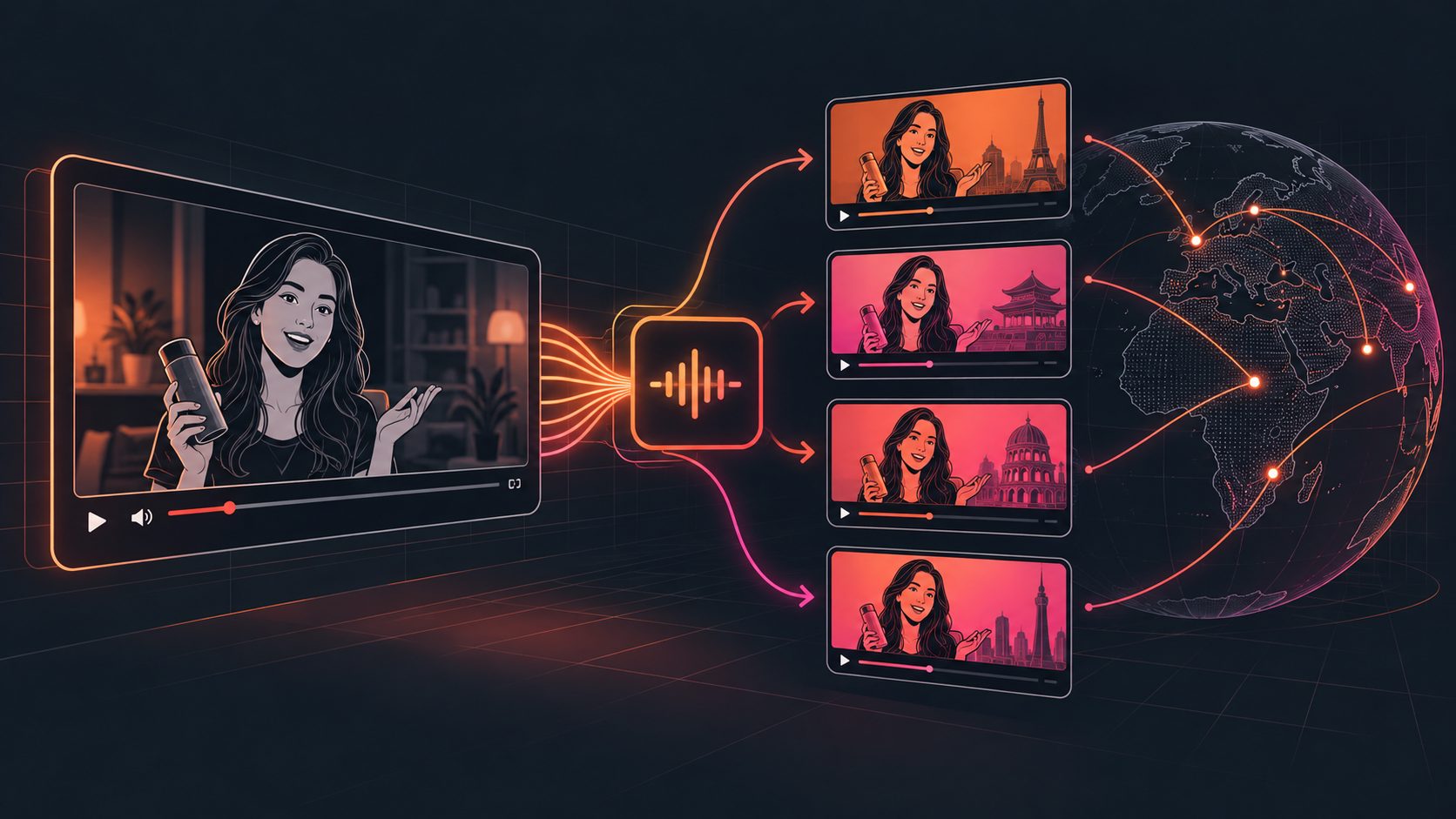
Translation video YouTube workflows can turn a strong product review into subtitles, dubbed versions, and short-form ad variations for new markets. The key is not translating every spoken word literally. It is preserving the review’s proof, pacing, product claims, and call to action while adapting the creative for each audience.
For ecommerce sellers, a YouTube review can contain valuable assets: a credible product demonstration, an authentic reaction, a comparison, and answers to buyer objections. With the right workflow, one long review can become a localized creative library rather than a single piece of content.
What is YouTube video translation for ecommerce?
YouTube video translation is the process of converting spoken audio, captions, on-screen text, and metadata into another language while keeping the original video understandable and persuasive. It may include subtitles, voice dubbing, translated titles and descriptions, or lip-synced dialogue.
YouTube itself supports translated captions and automatic dubbing for eligible videos. Its official guidance notes that automatic dubbing can contain errors involving pronunciation, accents, background noise, proper nouns, idioms, and industry jargon. (support.google.com)
That distinction matters for product advertising. A casual phrase may be acceptable in an entertainment video but damaging in a product ad if it changes:
- A product specification
- A warranty or return statement
- A discount or promotional deadline
- A safety or compliance claim
- The meaning of a reviewer’s comparison
- The intended action in the CTA
A useful translation workflow therefore has two layers: language conversion and creative adaptation.
Subtitles, dubbing, or both: Which format should you use?
The best format depends on the role of the video, the viewing environment, and how much the viewer needs to focus on the product demonstration.
| Format | Best for | Main advantage | Common limitation |
|---|---|---|---|
| Translated subtitles | Tutorials, reviews, comparison videos | Preserves original voice and emotion | Viewers must read while watching |
| Voice dubbing | Product explainers and performance ads | Easier hands-free viewing | Translation timing and voice quality need review |
| Lip-synced dubbing | Presenter-led UGC and testimonials | More natural visual continuity | Facial movement and phrasing require careful QA |
| Native ad remake | High-value campaigns | Strongest local creative control | Requires more editing and production work |
Subtitles are often the fastest way to test demand in a new market. Dubbing becomes more useful when the speaker’s delivery is central to trust or when the video relies on a direct presentation. For short ads, a localized remake may outperform a literal translation because the opening hook and CTA can be rewritten for the target audience.
YouTube’s own auto-dubbing documentation also warns that quality may vary by language and that translated audio can struggle with fast speech or unclear source-language settings. (support.google.com)
How to turn a YouTube review into a multilingual ad
A reliable process separates the source review into creative components before translating it.
1. Confirm content rights and extract the source structure
Only use a review or creator video when you have permission to repurpose it for advertising. Then identify:
- The first three to five seconds
- The product problem
- The demonstration or proof
- The reviewer’s strongest opinion
- The objection-handling moment
- The CTA or buying instruction
This structure is often more valuable than the full transcript. A ten-minute review may contain only 15–30 seconds of footage suitable for a paid ad.
AdsTurbo’s YouTube video translation workflow provides a useful reference for separating subtitles, dubbing, and localization decisions before production.
2. Build a translation brief before generating audio
A translation brief should define the product name, approved terminology, prohibited claims, target market, currency, offer details, and preferred tone.
For example, a beauty seller may require the product name to remain untranslated while adapting “glowy finish” into a phrase that sounds natural in the target market. A consumer electronics seller may need model numbers, units, and technical terms preserved exactly.
Do not translate the transcript as a single block. Divide it into scene-level lines so that each translation remains aligned with:
- The speaker’s breath and pacing
- The product shown on screen
- The subtitle reading time
- The visual CTA
- The intended emotional emphasis
3. Create subtitles first
Subtitles are a practical control layer because they reveal translation problems before voice generation. Check whether:
- Each caption is short enough to read
- Product names are consistent
- Numbers and units are correct
- Text does not cover the product
- The CTA is visible long enough
- The style fits TikTok, Instagram Reels, YouTube Shorts, or the destination ad placement
AdsTurbo Video Subtitle can automatically transcribe speech, generate time-synced captions, translate them, and export either a video with embedded subtitles or a separate subtitle file. Its automatic caption workflow for ecommerce video ads can help teams organize this stage.
4. Add dubbing or lip sync when the review depends on the presenter
Dubbing should preserve the reviewer’s intent, not necessarily the exact sentence length. A good localized line may be shorter or use different word order to match the target language’s natural rhythm.
Lip sync is especially useful when the presenter speaks directly to the camera. However, it should not hide a bad translation. Review the audio and the mouth movement separately before judging the final version.
AdsTurbo provides video translation, lip sync, face replacement, resolution enhancement, and subtitle-related tools for adapting video assets. For a product team, this makes it possible to test different combinations of language, voice, presenter, and CTA without rebuilding every ad from zero.
5. Re-edit the output into platform-specific variants
A translated long-form video is not automatically a good ad. Create separate cuts for:
- 9:16: Shorts, TikTok, Reels, and mobile-first placements
- 1:1: Feed placements and product-focused social posts
- 16:9: YouTube in-stream, landing pages, and desktop viewing
Use the same proof point, but vary the opening hook. One market may respond to convenience, while another responds to price, durability, design, or delivery speed.
AdsTurbo’s multilingual subtitle synchronization workflow is relevant when the same ad needs consistent caption timing across multiple language versions.
An original QA framework: the 4-layer localization gate
A common weakness in AI video translation is reviewing only whether the words sound correct. A stronger method evaluates four separate layers.
Layer 1: Meaning
Does the translated sentence preserve the original product benefit, limitation, and claim strength?
Layer 2: Timing
Does the voice or subtitle fit the scene without rushing, overlapping, or appearing after the relevant visual has disappeared?
Layer 3: Visual consistency
Are product labels, prices, buttons, measurements, and on-screen graphics readable and correct?
Layer 4: Conversion intent
Does the localized version still make the viewer understand what to do next?
A version passes only when all four layers work together. This framework is particularly useful for review-based ads because the persuasive value often comes from the relationship between the spoken opinion and the visual proof.
A practical test matrix can compare three variables at once:
| Test variable | Example variants |
|---|---|
| Opening | Problem hook vs. reviewer quote |
| Language treatment | Subtitles vs. dubbing |
| Presenter | Original reviewer vs. localized character |
| CTA | Shop now vs. Learn more |
| Proof sequence | Demonstration first vs. testimonial first |
This creates a more useful experiment than producing one “perfect” translation and assuming it will work everywhere.
Common mistakes in YouTube video translation
Translating the words but not the claim
A literal translation can accidentally strengthen or weaken a reviewer’s statement. Preserve the original level of certainty.
Keeping an unsuitable opening
The first seconds of a review may be slow, conversational, or designed for long-form viewing. For advertising, extract the clearest problem, result, or product reveal.
Ignoring on-screen text
Spoken audio may be translated correctly while prices, labels, banners, or product features remain in the source language. These elements should be reviewed scene by scene.
Using one version for every market
Language is only one part of localization. Offers, payment expectations, cultural references, units, and CTA wording may also require adaptation.
Treating YouTube auto-dubbing as final ad production
YouTube’s automatic dubbing is useful for accessibility and audience reach, but its official documentation acknowledges possible errors and uneven quality across languages. (support.google.com) For paid ecommerce ads, exportable, editable versions are usually easier to review and resize.
Frequently asked questions
Can I translate a YouTube video into another language?
Yes. Common methods include translated subtitles, dubbed audio, lip-synced dialogue, or a fully localized remake. The best option depends on whether the goal is accessibility, organic reach, or paid advertising.
Is dubbing better than subtitles?
Neither is universally better. Subtitles preserve the original voice and are efficient for testing. Dubbing is more natural for presenter-led content, hands-free viewing, and ads where spoken delivery drives trust.
Can a translated review become a short video ad?
Yes, if the review contains usable product proof and you have advertising rights. Select the strongest claim, demonstration, reaction, and CTA, then rebuild the sequence for the target platform.
How do I check whether an AI translation is safe to publish?
Review terminology, product claims, numbers, subtitles, audio timing, on-screen text, and CTA meaning. For regulated or sensitive products, add a qualified human review before publishing.
How can ecommerce teams scale the workflow?
Use a repeatable pipeline: source analysis, translation brief, subtitle draft, dubbing or lip sync, platform resizing, four-layer QA, and controlled creative testing. AdsTurbo supports asynchronous generation with status polling or Webhook completion events, while higher-tier plans support team workflows, API access, and custom workflows.
Start with one proven review, one target language, and two creative cuts. Then expand only after the localized version passes both language QA and conversion-focused testing.