


By adsturbo.ai | Published 2026-10-14 | Updated 2026-10-14
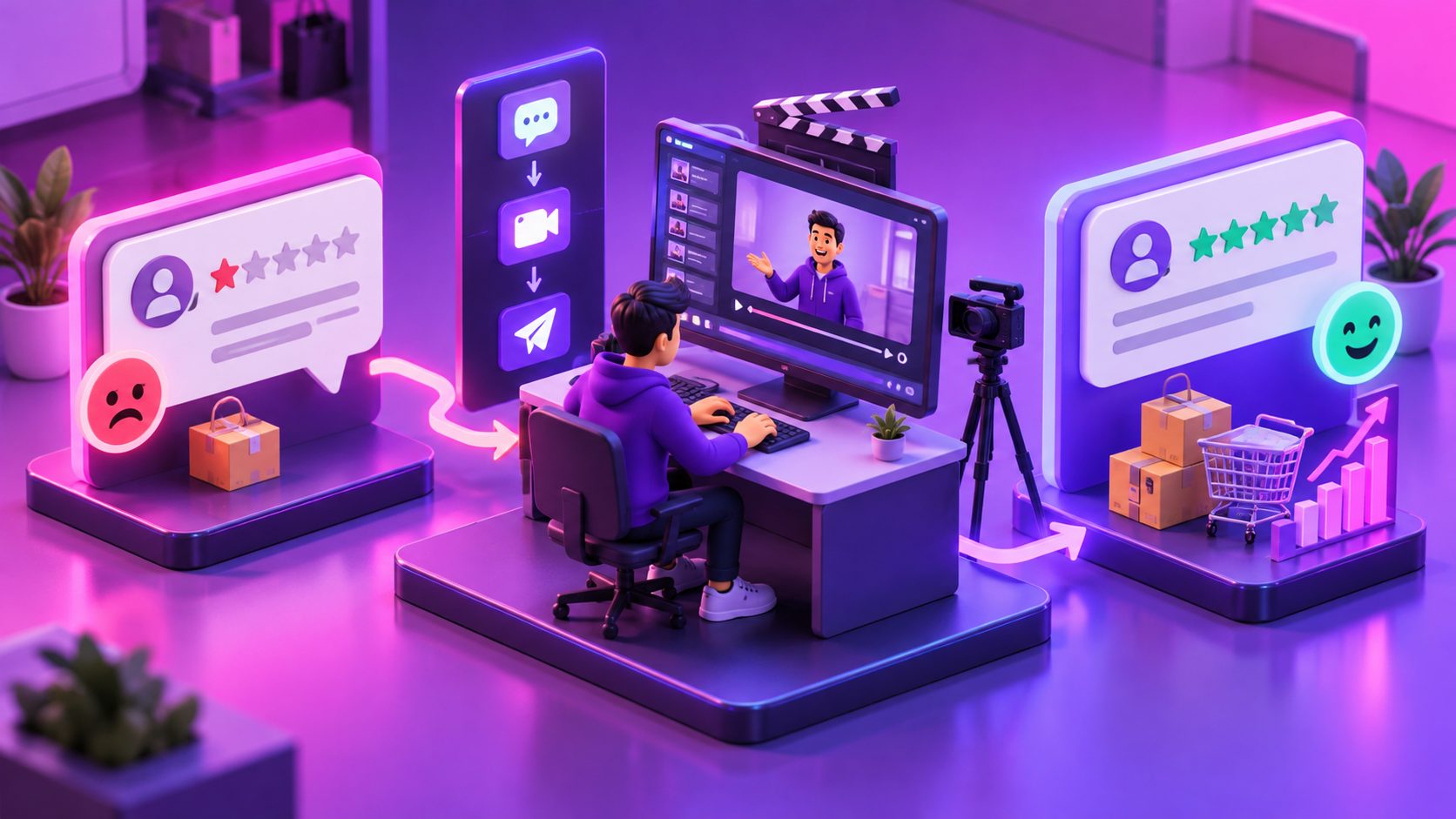
A Trustpilot bad reviews response video for ecommerce should answer one buyer concern with verifiable evidence—not argue with a reviewer. For a DTC brand, start with a written reply and private resolution, then create a 15-second clip showing what happened, what changed, or what shoppers should expect.
The central rule: AI can help present evidence; it must not manufacture evidence. Use the framework below to separate customer support from public reassurance, build a concise response, and test whether it helps purchasing decisions.
What is a review-response video—and where does it belong?
A review-response video is a short, brand-owned explanation of a complaint theme, supported by authentic records or footage. It supplements a written Trustpilot reply rather than replacing customer service. Its purpose is to help future shoppers evaluate a specific concern without exposing the original customer’s private information.
Trustpilot allows businesses with claimed profiles to reply to reviews. Its response guidance emphasizes professionalism and moving detailed conversations into private correspondence. (help.trustpilot.com)
Use two separate communication paths:
- Reviewer response: acknowledge the problem, offer a concrete next step, and provide a private support channel.
- Buyer-facing video: explain a recurring concern on your product page, delivery FAQ, or support page.
For example, apologize privately for a delayed parcel while publishing a general explanation of dispatch versus delivery. Do not turn an individual complaint into a public confrontation.
Keep the written answer useful without requiring anyone to watch the video.
Which complaints deserve a 15-second evidence video?
Choose complaints that contain a repeatable buyer question and have evidence you can show. A video is a poor choice when the facts remain disputed, the issue involves sensitive details, or your team has not resolved the underlying operational failure. Fix the problem before promoting the explanation.
Use this original Claim–Proof–Boundary matrix:
| Complaint theme | Appropriate evidence | Boundary the video must state |
|---|---|---|
| “Shipping takes too long” | Genuine dispatch records and published delivery estimates | Dispatch is not delivery |
| “The item looks different” | Unedited footage of the relevant SKU and variant | Lighting and screens can affect appearance |
| “Returns are confusing” | Current policy and actual return steps | Eligibility depends on the applicable terms |
| “The product arrived damaged” | Documented packaging improvements | Improved packaging does not guarantee zero damage |
The boundary prevents narrow evidence from becoming a sweeping promise.
For suspected fake reviews, use Trustpilot’s reporting process only when there is a guideline violation. Disagreement alone is not a reason for removal. (corporate.trustpilot.com)
How do you structure the 15-second response?
Use four beats: acknowledge the concern, show evidence, explain its limits, and offer a next step. Fifteen seconds is a production constraint here—not a proven optimum. If the issue needs more context, pair the clip with a written explanation rather than compressing away important qualifications.
This illustrative shipping storyboard is a template, not a customer case or measured result:
| Time | Visual | Spoken or on-screen message |
|---|---|---|
| 0–3 seconds | Neutral title card | “Delivery delays are frustrating.” |
| 3–8 seconds | Redacted, authentic carrier handoff record | “This record shows when one parcel reached the carrier.” |
| 8–12 seconds | Applicable delivery-estimate page | “Dispatch and arrival are different. Check your region’s estimate.” |
| 12–15 seconds | Support instruction | “Order overdue? Contact support privately.” |
Use the record only if it is authentic, relevant, and safe to publish. Do not imply that one successful handoff proves all orders arrive on time.
Avoid review screenshots unless reuse rights and privacy requirements have been checked.
What makes evidence credible enough to publish?
Evidence should be authentic, relevant to the claim, and traceable to an original asset. Before editing, create a proof ledger connecting every statement to its source. This proposed editorial framework makes verification explicit; it is not a Trustpilot requirement or a validated scoring system.
Record these fields:
- Claim: the exact sentence the video will communicate.
- Source: original footage, policy page, or operational record.
- Scope: product variant, region, and relevant period.
- Limitation: what the evidence cannot establish.
- Owner: the person responsible for checking accuracy.
Preserve originals separately. Redact names, addresses, order numbers, tracking identifiers, and payment details before processing or publishing customer records. Trustpilot’s business guidelines prohibit personal information, threats, and aggressive language in replies. (corporate.trustpilot.com)
For product appearance complaints, prefer genuine close-ups over generated lifestyle scenes. Ask one final question: Could a shopper reasonably infer more than this evidence proves? If yes, narrow the wording.
How can AdsTurbo help without creating false proof?
Use AdsTurbo for presentation and localization around verified assets—not as the source of factual evidence. AdsTurbo provides Clip by Clip editing, Video Translation, Video Subtitle, and other video-production tools. These capabilities can support an evidence-led workflow without turning generated visuals into documentation of real events. (adsturbo.ai)
A practical production sequence is:
- Approve the proof ledger and script.
- Prepare authentic footage and redacted records.
- Edit the explanatory sequence while preserving material context.
- Add captions and check every claim against the originals.
- Review translated versions against the applicable regional policy.
AdsTurbo Video Subtitle supports automatic, time-synchronized captions and downloadable captioned videos or separate subtitle files. Use the multilingual subtitle QA workflow to check meaning and timing.
Never create an AI customer saying, “They refunded me,” without a truthful underlying experience. FTC guidance explains that avatars are not categorically banned, but fabricated testimonials and deceptive portrayals can violate its rules. (ftc.gov)
Where should you publish—and how should you measure results?
Start where the concern arises: delivery information beside shipping questions, product evidence beside variant selection, or return guidance beside the returns policy. Treat these placements as test hypotheses. Do not assume that a reassuring video automatically improves conversion or compensates for poor customer service.
For pre-purchase placement planning, use the Shopify video trust-placement guide. For email distribution, consider the click-first video email workflow.
Test the same written explanation with versus without the video. Keep the offer, audience, and placement consistent. Define:
- Primary metric: purchase rate among assigned visitors.
- Guardrails: refunds, complaint tickets, and page performance.
- Diagnostics: video starts, completion, and support-link clicks.
Illustrative arithmetic: 40 purchases from 1,000 visitors is 4.0%; 44 from 1,000 is 4.4%. That is 0.4 percentage points, or 10% relative lift—not proof of a reliable effect.
Predefine sample size and stopping criteria. Report uncertainty rather than presenting a small difference as recovered revenue.
Frequently asked questions
Can you upload the video directly as a Trustpilot reply?
Use Trustpilot’s documented written-reply workflow; this guide does not assume native video replies. Publish the explanatory video on a suitable brand-owned page, and make the written response complete on its own. (help.trustpilot.com)
Should you ask the customer to delete the review?
Keep resolution separate from review changes. Trustpilot prohibits pressuring or incentivizing reviewers to edit or delete reviews. Offer appropriate support without making it conditional on changing their feedback. (corporate.trustpilot.com)
Is an AI presenter necessary?
No. Authentic product footage, readable captions, and a clear support instruction are enough. If using a synthetic presenter, identify its role clearly and avoid implying that it is the reviewer, a real employee, or an independent customer.
What if the complaint is accurate?
Acknowledge the failure and show only documented corrective action. If the problem remains unresolved, prioritize support and operational repair. A polished explanation should never substitute for delivering the remedy.
Start with one complaint theme, one verified proof asset, and one measurable placement.