


Author: adsturbo.ai|Published: 2026-09-04|Updated: 2026-09-04
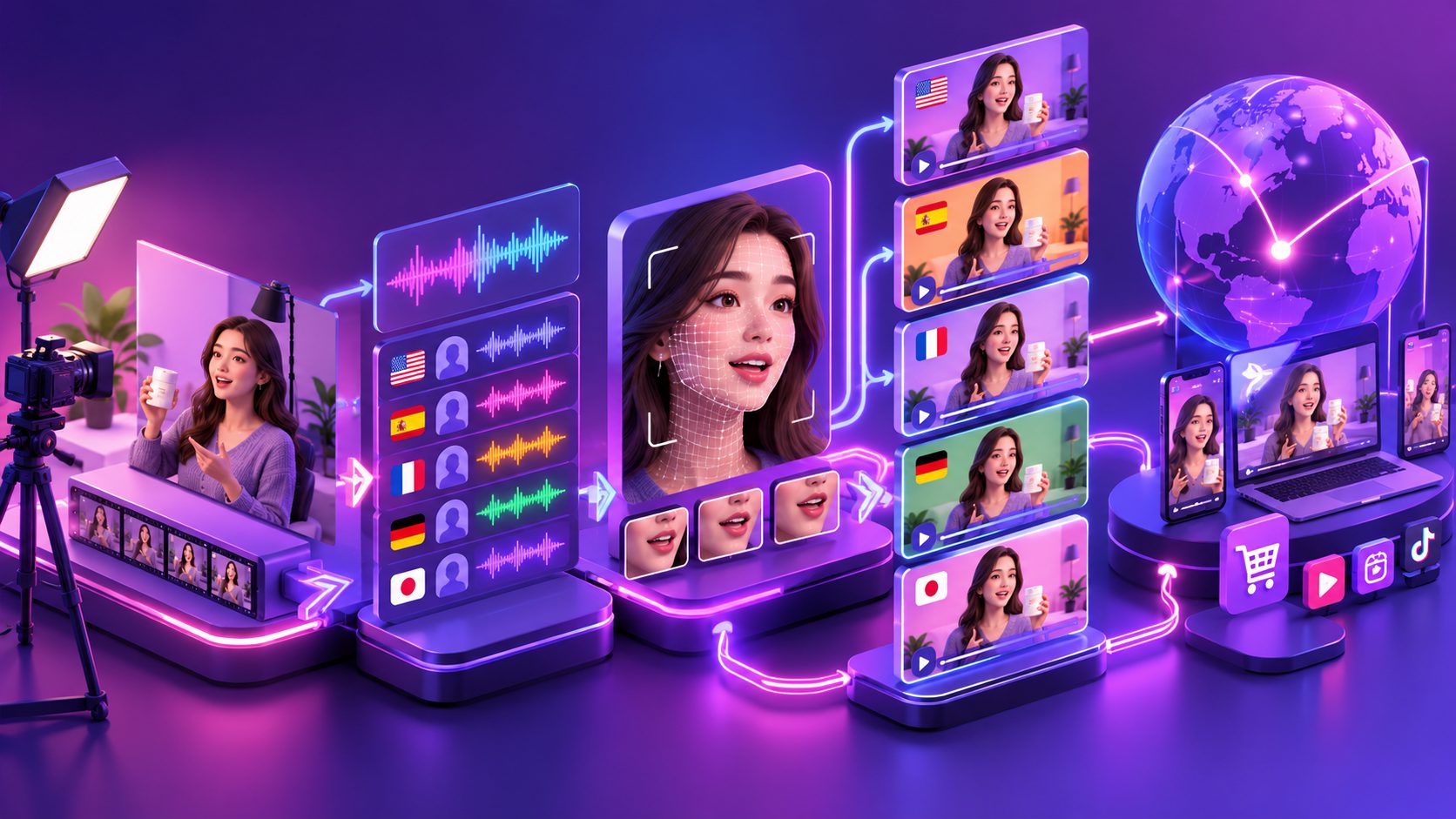
Video ad translation and dubbing is the process of turning one product ad into market-ready versions for other languages by adapting the script, voice, subtitles, on-screen text, timing, and cultural cues. For ecommerce teams, the goal is not “translated content.” It is a localized ad that can be tested on TikTok, Meta, YouTube Shorts, Amazon, or landing pages without reshooting.
A good localized ad keeps the original hook, proof, product demonstration, and call to action while making the viewer feel the message was created for their market. That requires more than machine translation. It requires ad logic, creative judgment, and a quality-control pass built for paid social.
What Is Video Ad Translation and Dubbing?
Video ad translation and dubbing means replacing or supplementing the original ad language with a target-market version that includes translated speech, localized voiceover, synced subtitles, and adapted visual text.
In ecommerce, the asset is usually short: a UGC testimonial, product demo, unboxing, offer video, or creator-style ad. The localization job has five layers:
- Transcript: accurate source-language speech and scene notes.
- Ad adaptation: shorter or rewritten phrasing for the target market.
- Dubbing: target-language voiceover or AI voice aligned to the edit.
- Lip sync and timing: speech that fits mouth movement and shot length.
- Export package: captions, aspect ratios, audio mix, and platform-ready files.
Subtitles alone can work for quick validation, but dubbing usually feels more native when the product needs emotional persuasion, creator trust, or demonstration-led selling. A skincare testimonial, for example, often benefits from dubbed speech and synced captions because tone and pacing carry credibility.
Why Ecommerce Teams Should Localize Winning Ads Before Reshooting
The fastest path is to localize proven ads first, then decide whether to reshoot. A translated loser is still a loser, but a localized winner can reveal demand in a new market within days.
Most ecommerce teams already know which videos have strong thumb-stop rates, hold rates, or conversion signals in the home market. Those videos contain tested creative patterns: the first three seconds, objection handling, demo rhythm, offer framing, and CTA. Localizing that structure is usually lower risk than producing a new market campaign from zero.
This matters because global ad platforms may reject or underperform ads when language, grammar, or market fit is wrong. Amazon Ads, for example, notes that its localization services help advertisers avoid common video campaign rejection issues related to unsupported language and grammar mistakes in the target country, according to Amazon Ads localization services.
A practical rule: translate concepts, not sentences. “No more messy bathroom counters” may become a space-saving angle in Japan, a family convenience angle in Mexico, and a premium organization angle in Germany. The product is the same; the buying trigger may not be.
A Practical Workflow for Localizing One Ad Into Multiple Languages
Use a six-step workflow: choose a proven source ad, extract the ad structure, adapt the script, generate dubbing and subtitles, review native-market accuracy, then export platform-specific variants.
-
Pick the source video Choose a 15–45 second ad with clear product visuals, simple claims, and measurable performance. Avoid videos where the entire punchline depends on local slang.
-
Break down the creative structure Identify the hook, problem, demonstration, proof, offer, and CTA. AdsTurbo’s Ad Clone workflow for ecommerce teams is useful when the goal is to preserve a winning ad’s opening, rhythm, shot logic, and CTA structure while rebuilding new variants.
-
Create a market-adapted script Translate the meaning, then shorten the copy to fit the available shot length. German, Spanish, and French lines may expand compared with English; Japanese or Chinese lines may compress visually but require different tone choices.
-
Generate the dubbed audio Match the voice to the product category. Beauty and wellness often need warm trust. Gadgets need clarity and pace. Discount-led products need urgency without sounding fake.
-
Add synced captions Captions are still important even with dubbing because many users watch social video with low or muted sound. AdsTurbo Video Subtitle can automatically transcribe speech and generate time-synced subtitles, with styles adapted for TikTok, Instagram Reels, and YouTube Shorts.
-
Export variants for channels Create 9:16 for TikTok, Reels, and Shorts; 1:1 for feed testing; and 16:9 when needed for YouTube or landing pages. AdsTurbo Ad Clone supports exporting a single reference video into 9:16, 1:1, and 16:9 formats for these placements.
The Ecommerce Localization Scorecard: 20 Points Before Launch
A localized ad should pass creative, linguistic, visual, and compliance checks. This 20-point scorecard gives teams a repeatable way to approve multilingual ad creative before spending media budget.
| Area | 5-point check | What to review |
|---|---|---|
| Hook fit | 5 | Does the first 3 seconds still name the pain, desire, or result clearly? |
| Voice naturalness | 5 | Does the dubbed voice sound native, age-appropriate, and product-appropriate? |
| Timing and lip sync | 5 | Do speech length, cuts, captions, and mouth movement feel aligned? |
| Market readiness | 5 | Are claims, currency, measurements, CTA, and offer terms localized? |
A score of 17–20 is ready for paid testing. 14–16 can run as a small-budget learning test. Below 14, fix the script or audio before launch.
This scorecard adds discipline where many teams rely on “sounds okay.” The most common hidden failure is not mistranslation. It is timing drift: the voice takes too long, the caption appears late, and the CTA arrives after the visual proof is gone.
Dubbing, Subtitles, Lip Sync, and Voiceover: What Should You Use?
Use dubbing when persuasion depends on tone, subtitles when speed matters, lip sync when a face is central, and voiceover when the speaker does not need to appear native.
| Method | Best for | Risk |
|---|---|---|
| Translated subtitles | Fast market validation, low-budget tests | Viewers may ignore or distrust text-heavy ads |
| Dubbed voiceover | Product demos, UGC explainers, testimonials | Poor voice choice can feel synthetic |
| Lip-synced dubbing | Face-led creator ads, founder ads, spokesperson clips | Needs tighter timing and review |
| Full remake | High-spend markets after proof | More cost and production time |
AdsTurbo provides Video Translation, Lip Sync, Face Swap, Character Swap, Video Subtitle, and AI Upscaling tools. That lets an ecommerce team choose the right localization depth: translate captions for early tests, dub and lip-sync the winner, or create localized character variants for audience-specific campaigns.
For a complete production workflow, pair localization with AI UGC ads for ecommerce sellers when the source creative needs new creator-style versions, not just new languages.
How to Adapt Scripts Without Losing the Original Ad’s Selling Power
A localized script should keep the conversion logic of the source ad while changing the words, proof points, and buying cues that do not travel well.
Use this structure:
- Hook: keep the emotional job, not the exact line.
- Problem: describe the local pain in familiar words.
- Demo: preserve the visual order because it already worked.
- Proof: localize units, examples, ingredients, sizing, or use cases.
- Offer: translate discount terms, dates, codes, and conditions clearly.
- CTA: match the buying action used in the market.
Example:
Source: “This mini blender saved my mornings.”
Spanish-market adaptation: “I make my smoothie before leaving, with no mess.”
Japanese-market adaptation: “A compact blender that fits even in a small kitchen.”
Neither version is a literal translation. Both protect the reason the ad sells: speed, convenience, and product size.
AdsTurbo can support this production pattern with product video generation, multilingual localization, subtitles, background replacement, and product image generation. For stores with many SKUs, the same logic can extend into a bulk SKU video generation workflow.
How AdsTurbo Fits Into a Multilingual Ad Production Stack
AdsTurbo helps ecommerce teams turn product assets and reference ads into localized video creative without rebuilding every campaign from scratch.
Relevant capabilities include:
- Video Translation for multilingual versions of existing ads.
- Lip Sync for matching dubbed audio to speaking faces.
- Video Subtitle for automatic transcription and time-synced captions.
- Ad Clone for preserving the structure, rhythm, and CTA of winning ads.
- Product Video for generating product review, introduction, and demo videos from JPG or PNG product images.
- Character Swap and Face Swap for creating audience or region-specific visual variants.
- AI Upscaling for improving low-resolution or compressed source videos.
AdsTurbo generation tasks run asynchronously, with completion available through status polling or Webhook callbacks. Higher-level plans support team workflows and custom workflow support (API access itself is available on every plan), which is useful when localization becomes a repeatable production pipeline rather than a one-off edit.
For teams that want programmatic production, the AdsTurbo API uses standard REST architecture with Bearer API Key authentication and offers composable modules for image generation, Persona, AI actor, ad clone, video generation, and task processing.
Common Mistakes That Make Localized Ads Feel Foreign
Most failed localized ads are not “bad translations.” They are ads that preserve the wrong thing: the sentence instead of the selling moment.
Avoid these mistakes:
- Literal hooks that sound grammatically correct but emotionally flat.
- Unlocalized proof such as inches, dollars, shipping promises, or seasonal timing.
- Overlong translated lines that force rushed audio.
- Captions covering the product in vertical video.
- Voice mismatch, such as a luxury product with a hyperactive bargain voice.
- One global CTA when shopping behavior differs by market.
- No native review before paid spend.
The fix is to review the ad as a buyer, not as a translator. Ask: would a real shopper in this market understand the promise, trust the voice, and know what to do next?
Launch Checklist for Multilingual Video Ads
Before publishing localized video ads, confirm the file, language, claim, and platform details are ready for paid distribution.
- Target language and regional variant are correct.
- Voiceover sounds natural for the product category.
- Captions match the dubbed audio.
- On-screen text is translated and readable on mobile.
- Product claims comply with local rules and platform policies.
- Currency, measurements, promo code, and dates are localized.
- CTA matches the destination page language.
- Landing page or product page is ready in the same language.
- Exports are prepared for 9:16, 1:1, or 16:9 as needed.
- One control version and at least two localized variants are ready for testing.
A strong first test is simple: one proven source ad, two target languages, three hook variations per language. That creates six localized variants without losing strategic control.
Frequently Asked Questions
Is AI video dubbing good enough for ecommerce ads?
AI video dubbing can be good enough for ecommerce testing when the script is reviewed, the voice fits the product, and timing is checked before launch. High-spend campaigns should still receive native-language review and compliance review.
Should ecommerce brands use subtitles or dubbing first?
Use subtitles first when testing a new market quickly. Use dubbing when the ad depends on trust, emotion, spoken demonstration, or creator presence. Many teams test subtitled versions first, then dub the strongest language-market combinations.
How many languages should one ad be localized into?
Start with two or three priority markets. More languages create more review work and more landing-page complexity. A focused test gives cleaner data on whether the product, offer, and creative angle transfer.
What makes video ad translation different from normal translation?
Video ad translation must fit timing, voice, captions, visual scenes, claims, and CTA behavior. A normal translation may be accurate, but an ad translation must still persuade in a short paid-social format.
Can one winning video become many multilingual ad variants?
Yes. One winning ad can become multiple language, voice, caption, aspect-ratio, and character variants. The key is to preserve the original structure while adapting words, tone, and market details.