


Author: adsturbo.ai|Published: 2026-08-29|Updated: 2026-08-29
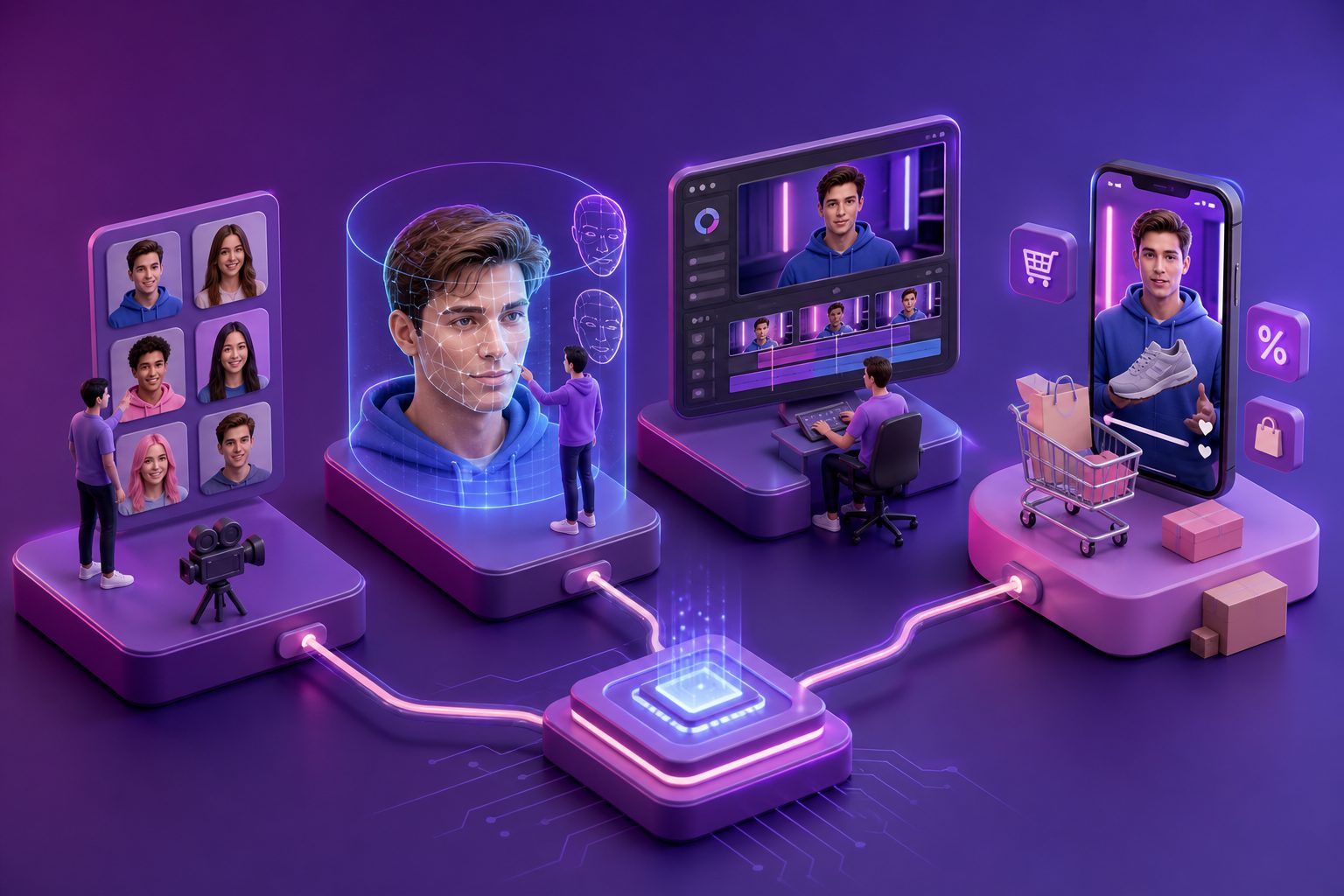
AI face swap for marketing is the use of AI to replace or adapt a presenter’s face in commercial creative while preserving the original video’s motion, framing, timing, and often its sales structure. For ecommerce teams, the practical value is not novelty. It is faster persona testing, localized UGC-style ads, and creative refreshes without reshooting every variation.
The highest-performing use case is usually not “make a funny deepfake.” It is more operational: take a product demo, founder-style pitch, creator testimonial format, or winning paid social hook, then generate controlled variants for different audiences.
That opportunity comes with risk. Face swaps can cross lines around consent, impersonation, testimonials, platform disclosure, and brand safety. This guide explains when the workflow makes sense, when it does not, and how ecommerce marketers can build a repeatable system.
What is AI face swap for marketing?
AI face swap for marketing is a production workflow that changes the visible speaker or actor in an ad while keeping the underlying creative idea intact. It is most useful when the ad’s structure is already strong but the brand needs more presenter, language, demographic, or channel variations.
In a standard video ad, changing the presenter means booking talent, reshooting, editing, subtitling, and exporting again. With AI face swap, the team can reuse the same performance base and create new audience-facing versions.
That does not mean every ad should use it. The method works best when the source footage has clear face visibility, stable lighting, limited occlusion, and a simple commercial message. For ads with complex hand-to-face movement, dramatic shadows, reflective eyewear, or fast cuts, a full AI actor workflow or a new shoot may be safer.
Where does face swap fit in an ecommerce creative system?
Face swap fits between raw production and media testing: it extends a proven concept into more variants without starting from a blank page. Ecommerce teams should treat it as a controlled creative multiplier, not as a replacement for product positioning or offer testing.
A practical ecommerce workflow has five layers:
- Product truth: what the item actually does, looks like, costs, and solves.
- Winning angle: problem, desire, comparison, demo, review, bundle, or promotion.
- Presenter format: founder, creator, expert, shopper, unboxing host, or AI ads actor.
- Localization: face, voice, language, captions, on-screen text, and cultural cues.
- Media iteration: hooks, CTAs, first three seconds, aspect ratio, and offer framing.
AdsTurbo supports this broader production layer with AI Face Swap, Lip Sync, video translation, subtitles, product video generation, AI upscaling, and background replacement. Teams that need persona-led ecommerce ads can also connect face swap with AI ads actors for ecommerce video ads or use replace character in video AI workflows when the goal is broader character substitution.
When should marketers use face swap instead of reshooting?
Use face swap when the creative structure is proven, the product visuals are accurate, and the main variable is the presenter. Reshoot when the product demonstration, claim, legal disclosure, or user experience must be captured from scratch.
A simple decision table helps:
| Scenario | Better option | Why |
|---|---|---|
| Winning UGC hook needs new presenters | Face swap | Keeps timing and edit rhythm while testing persona fit |
| Same video needs localized speaker and captions | Face swap + translation + lip sync | Reduces reshoot cost across markets |
| Product demo is inaccurate or outdated | Reshoot | AI should not repair false product evidence |
| Need a new scene, new setting, or new offer | New generation or production | The structure has changed, not just the face |
| Creator contract does not allow synthetic reuse | Do not swap | Consent and usage rights come first |
| Brand wants a consistent virtual spokesperson | AI actor/persona workflow | More scalable than swapping random faces |
A useful rule: swap identity only after the message is validated. If the hook, offer, and landing page are still weak, a new face will not fix the funnel.
The Consent-to-Creative Matrix for safer campaigns
The Consent-to-Creative Matrix is a four-part checklist for deciding whether a face-swapped ad is safe enough to produce, review, and publish. It scores consent, likeness source, claim type, and disclosure need before creative production begins.
This is the original operating framework we recommend for ecommerce teams:
| Risk area | Low-risk pattern | High-risk pattern | Required control |
|---|---|---|---|
| Consent | Licensed AI actor or written permission | Real person copied from public content | Signed usage rights and revocation terms |
| Likeness source | Brand-owned persona or approved talent | Celebrity, influencer, competitor, employee without approval | Identity clearance |
| Claim type | Scripted product explainer | “I used this and got results” testimonial | Substantiation and clear role disclosure |
| Platform context | Organic demo or standard product ad | Political, regulated, sensitive, or medical-style claims | Policy review before upload |
The most common mistake is confusing “technically possible” with “commercially usable.” A face swap that looks realistic can still be unusable if the source identity is not cleared.
For U.S. advertisers, the FTC’s endorsement guidance matters because viewers may interpret a speaker as giving a real opinion or experience. The FTC’s Endorsement Guides cover endorsements, influencers, reviews, and material connections; the FTC also notes that fake or misleading testimonials can create legal risk. If a synthetic presenter is acting, do not imply they are an actual customer unless the underlying testimonial is real and properly disclosed.
How to build a face swap ad workflow
A good workflow starts with a clean source video, a cleared target persona, and a written variation plan. The goal is to produce testable ad versions while keeping product claims, identity rights, and platform labels under control.
- Choose the source creative. Start with a 6–30 second video that already has a strong hook, clear product moment, and visible face.
- Clear the rights. Confirm that the original performer, target face, voice, and script can be used in ads.
- Define the variable. Test one main change at a time: persona, language, hook, CTA, or offer.
- Generate the face swap. Preserve motion, gaze, lighting, and scene continuity.
- Localize the supporting elements. Add translated voiceover, lip sync, captions, and on-screen text where needed.
- Export channel formats. Prepare 9:16, 1:1, or 16:9 depending on TikTok, Meta, Shorts, or display needs.
- Review before launch. Check facial artifacts, claim accuracy, disclosure labels, and landing page consistency.
AdsTurbo can support this workflow with Face Swap, Lip Sync, AI video subtitles, video translation, AI upscaling, and clip-by-clip editing. Its asynchronous generation tasks can be monitored through status polling or Webhook callbacks, while higher-tier plans support team workflows and custom workflow support (API access itself is available on every plan).
For teams building paid social systems, this workflow pairs naturally with AI TikTok ad generator testing and video-first Facebook ad creative planning.
What source material creates the best results?
The best source material shows a well-lit face, stable head movement, clean audio, and a product moment that does not depend on tiny facial details. Poor source footage increases uncanny results and slows approval.
Use this preflight checklist before generating an AI face swap ad:
- Face is visible for most of the clip.
- Lighting is even across forehead, cheeks, and jawline.
- The performer is not constantly covering the mouth or chin.
- The camera does not shake aggressively.
- The source video is not heavily compressed.
- The product is clearly visible and not distorted.
- The script contains no unsubstantiated “customer result” claim.
- The target persona is licensed, brand-owned, or explicitly approved.
If the source ad is low-resolution but strategically valuable, upscaling may help before or after editing. AdsTurbo provides video resolution enhancement, and this should be used carefully: 4K upscaling for ecommerce video ads works best when the original detail is recoverable, not when the footage is fundamentally unusable.
How should teams measure whether it worked?
Measure face-swapped ads as creative variants, not as isolated AI experiments. The key question is whether the new persona improves paid-media efficiency without increasing rejection risk, negative comments, or brand-trust problems.
A lean test plan uses four groups:
| Test group | Variable | What to learn |
|---|---|---|
| Control | Original creator or presenter | Baseline CTR, CPA, hold rate |
| Persona A | Same script, new face | Audience fit |
| Persona B | Same script, different demographic cue | Market resonance |
| Localized version | New language, captions, lip sync | Regional efficiency |
Track:
- 3-second hold rate
- Thumb-stop rate
- CTR
- Add-to-cart rate
- CPA or CAC
- Comment sentiment
- Ad rejection rate
- Frequency fatigue curve
- Post-click conversion quality
The strongest signal is not always CTR. A face-swapped persona might earn more clicks but attract lower-intent visitors. For ecommerce, connect ad-level metrics to checkout behavior and refund patterns where possible.
A practical benchmark is to stop treating “AI version vs. human version” as the test. The more useful test is which persona-message-market combination produces profitable attention.
What are the platform disclosure rules?
Disclosure rules depend on the platform, the market, and how substantially AI changed the person, voice, or scene. Marketers should review policies before launch because AI labeling rules continue to evolve.
TikTok’s ad tools include disclaimer options for AI-generated, synthetic, or manipulated media. Its help center states that the AI-generated content disclaimer adds a disclosure label to ads that include AI-generated content; see TikTok’s page on ad disclaimers in TikTok Ads Manager.
Meta has also expanded transparency around generative AI in ads. Meta says it labels ads created or significantly edited with its own generative AI advertising tools and has been extending transparency around third-party AI signals through ad information surfaces; see Meta’s update on GenAI transparency for ads products.
For marketers, the safe operating principle is simple: if the ad could make an ordinary viewer believe a real person said, did, or experienced something they did not, disclose and document it.
What should an ecommerce team avoid?
Avoid any use that misrepresents identity, product experience, endorsement, or evidence. Face swapping becomes risky when it makes a synthetic or unauthorized person appear to be a real customer, expert, employee, celebrity, or competitor.
Do not use AI face swap ads to:
- Put a celebrity’s face into a product endorsement.
- Make a customer appear to say something they never said.
- Replace a creator after their contract ends without permission.
- Localize medical, financial, or sensitive claims without review.
- Hide that a testimonial is acted or synthetic.
- Copy a competitor’s creator format so closely that it creates confusion.
- Alter product results, before-and-after visuals, or safety demonstrations.
The issue is not just legal. Viewers can detect mismatched mouth movement, odd expressions, and over-polished AI faces. If the creative feels deceptive, comments can become the campaign’s biggest problem.
A practical example: one product demo into four ad variants
A clean face swap workflow can turn one approved product demo into multiple market-ready ads while keeping the same product proof. The important constraint is that only the presenter layer changes; the product demonstration remains truthful.
Example setup:
- Product: portable garment steamer
- Source video: 18-second UGC demo showing wrinkles removed from a shirt
- Original structure: problem hook, close-up steam shot, before/after fabric, CTA
- Variants: college student, frequent traveler, boutique owner, gift shopper
- Localization: English and Japanese captions, translated voiceover, lip sync
- Exports: 9:16 for TikTok/Reels/Shorts, 1:1 for Meta feed
This approach creates creative diversity without inventing new product claims. The team can test which persona makes the same demonstration feel most relevant.
AdsTurbo’s Product Video workflow supports uploading JPG or PNG product images, with clear photos on solid backgrounds producing the best results. It can also generate product review, product introduction, and product demonstration videos. When face swap is combined with subtitles, translation, and product video creation, ecommerce teams get a repeatable campaign system instead of one-off assets.
How AdsTurbo supports AI face swap ad production
AdsTurbo is an AI video ad generation tool for ecommerce sellers that supports face swap, lip sync, video translation, subtitles, product videos, ad cloning, and post-production controls. It is designed for teams that need many video ad variants, not just a single edited clip.
Relevant capabilities include:
- AI Face Swap for replacing or adapting presenters.
- Lip Sync for matching mouth movement to audio.
- Character Swap for replacing people while preserving motion, lighting, and scene realism.
- Video Translation for localizing uploaded videos or linked videos into 40+ target languages.
- Video Subtitle for automatic transcription, time-synced subtitles, embedded subtitle exports, or separate subtitle files.
- Ad Clone for analyzing a reference ad’s structure, rhythm, early hook, shot logic, and CTA pattern.
- Product Video for generating ecommerce UGC-style short ads from product images.
- AI Upscaling, AI Eraser, Background Replace, and Clip by Clip editing for post-production control.
- API modules for image generation, Persona, AI actors, ad cloning, video generation, and task handling.
AdsTurbo’s video generation API uses Bearer API Key authentication and asynchronous task execution. Generation tasks can be tracked through polling or Webhook callbacks. Its video API includes endpoints for shot analysis, lip sync, watermark removal, translation, super-resolution, face swap, motion control, and subtitles.
Common questions
Is AI face swap legal for advertising?
It can be legal when the advertiser has permission, accurate claims, and appropriate disclosure. Risk rises when a brand uses a real person’s likeness without consent or implies a false endorsement. Always clear likeness rights and review local laws.
Is face swap the same as an AI avatar?
No. Face swap changes the face in existing footage, while an AI avatar or AI actor is usually generated or controlled as a reusable synthetic presenter. Face swap is best for adapting a proven clip; avatars are better for ongoing spokesperson systems.
Do AI face swap ads need disclosure?
Often, yes, especially when realistic AI changes a person, voice, or scene in a way viewers could misunderstand. Platform rules differ, so check TikTok, Meta, Google, YouTube, and local advertising requirements before launch.
Can face swap improve ad performance?
It can improve testing speed and audience matching, but it does not guarantee better performance. The real advantage is faster iteration across personas and markets. Measure conversion quality, not just click-through rate.
What is the safest first campaign to try?
Start with a licensed AI actor or approved internal spokesperson in a simple product demo. Avoid testimonials, celebrity likenesses, sensitive categories, and exaggerated before-and-after claims until your review process is mature.
Key takeaway
AI face swap for marketing is most valuable when it helps ecommerce teams responsibly multiply proven video ads across personas, languages, and platforms. The winning workflow is not “swap every face.” It is consent-first creative testing: clear rights, truthful product evidence, controlled variants, proper disclosure, and performance measurement tied to revenue.
Used this way, face swap becomes a practical production layer in the ecommerce ad stack. It helps teams refresh creative, localize faster, and learn which presenter-market combinations convert without reshooting every version from the ground up.