AI German Dubbing Tool for Video Ads: Localize Ecommerce Creatives

Summarize with
Summary
Learn how an AI German dubbing tool for video ads can localize ecommerce creatives with translated voice, lip sync, captions, and a practical QA workflow. Start with AdsTurbo.
By adsturbo.ai | Published 2026-10-24 | Updated 2026-10-24
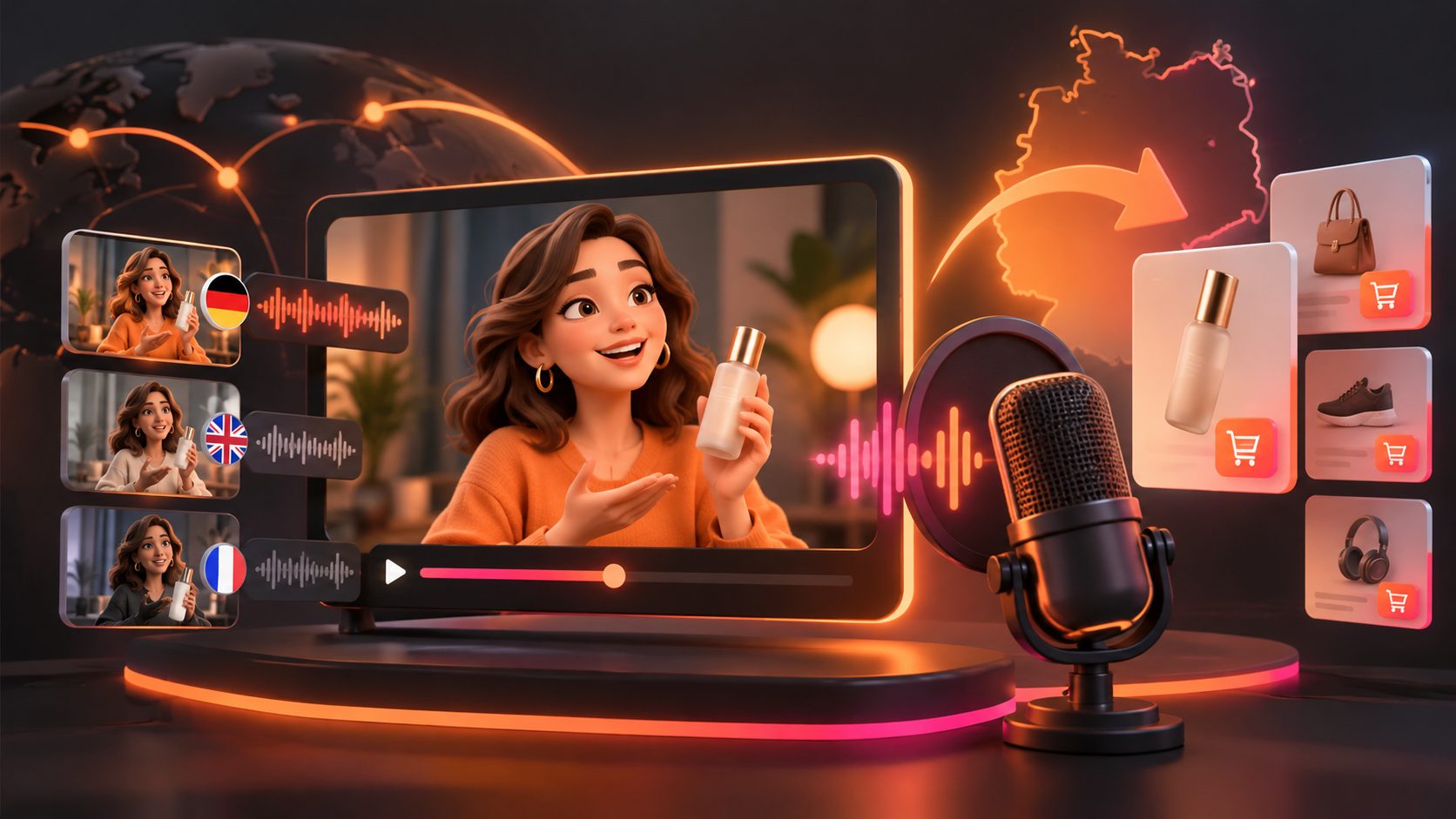
An AI German dubbing tool for video ads converts an English ecommerce video into a German version by translating the spoken script, generating German audio, synchronizing speech timing, and optionally adapting visible mouth movements. For cross-border sellers, this creates a faster path from one proven English creative to localized German ads without arranging a complete reshoot.
What is AI German dubbing for video ads?
AI German dubbing is the process of replacing an original video’s spoken language with German while preserving the ad’s core visuals, offer, pacing, and call to action. A complete localization workflow may include transcription, translation, German voice generation, lip synchronization, subtitle creation, and on-screen text adaptation.
The important distinction is between voiceover and full video localization:
| Approach | Best for | Main limitation |
|---|---|---|
| German voiceover | Product montages, screen recordings, B-roll | The speaker’s mouth still follows English |
| German subtitles | Silent demonstrations or low-budget tests | Viewers must read while watching |
| German dubbing | UGC, reviews, tutorials, explainers | Requires timing and translation QA |
| German dubbing with lip sync | Face-forward hooks and testimonials | More sensitive to facial angles, cuts, and speech timing |
Search results for AI dubbing commonly emphasize translation, voice replacement, subtitles, and lip sync. For advertising, however, the strongest result is not simply a translated file. It is a version where the hook, product promise, proof, offer, and CTA still work naturally in German. (reedapt.com)
Why German localization needs more than direct translation
English and German rarely use the same sentence length, emphasis, or word order. A direct translation can make a 15-second ad run long, force unnatural pauses, or push the CTA into the final frame.
German also has practical copy considerations:
- The subject may appear later in the sentence.
- Compound nouns can create longer text overlays.
- Formal and informal address should match the brand and audience.
- Discounts, shipping claims, guarantees, and product benefits must remain consistent with the landing page.
- A short English hook may need a different German phrasing to preserve urgency.
For this reason, treat the English ad as a creative structure, not a line-by-line script. Keep the original sequence of attention, problem, product demonstration, proof, and CTA, but allow the German wording to change where necessary.
AdsTurbo’s ecommerce video dubbing workflow describes this broader approach: dubbing can be combined with subtitles, lip sync, translated on-screen text, and offer continuity rather than treated as audio replacement alone.
How to dub an English ad into German
A reliable workflow has seven steps.
1. Choose the right source video
Start with a creative that already has a clear purpose. Strong candidates include:
- UGC product reviews
- Founder or creator testimonials
- Product demonstrations
- Unboxing videos
- Before-and-after explanations for permitted, non-restricted products
- Short paid-social ads with a clear CTA
Avoid beginning with a video that has overlapping speakers, heavy background noise, rapid cuts across faces, or important text embedded in the footage.
2. Extract and review the English script
Use video analysis or script extraction to identify:
- The first three seconds
- Main product benefit
- Demonstration sequence
- Social proof or credibility cue
- Discount or promotional detail
- Final CTA
This step prevents a common mistake: translating every spoken word while losing the ad’s conversion logic.
3. Rewrite for natural German delivery
German copy should be concise enough for the original shot length. Prioritize meaning and rhythm over literal wording.
For example, an English line such as “Get smoother-looking skin in minutes” may need a shorter or more cautious German formulation depending on the product category and substantiation. The localized script should sound like an ad written for German-speaking customers, not a translation exercise.
4. Generate the German voice track
Select a voice that matches the source creative’s energy and audience. A calm product demonstration, energetic TikTok hook, and expert explainer should not all use the same delivery style.
Preserve pauses around product reveals and offer statements. If the German sentence is longer, shorten the wording before excessively speeding up the voice.
5. Add lip sync only where it improves trust
Lip sync is most valuable when the viewer is watching a person speak directly to camera. It is less important for product close-ups, screen recordings, voiceover sequences, or scenes where the speaker is not visible.
A useful production rule is:
Face visible and speaking = consider lip sync. Face absent or covered by product footage = prioritize clean audio and captions.
This avoids spending effort on visual mouth adjustment where it will not materially improve the ad.
6. Rebuild subtitles and on-screen text
German captions should be recreated rather than copied from English. Check:
- Line breaks
- Reading speed
- Safe-zone placement
- Discount codes
- Dates and promotional conditions
- Product names
- CTA wording
AdsTurbo Video Subtitle can automatically transcribe speech, create time-synced captions, translate them, and export either embedded subtitles or a separate subtitle file. Its subtitle styling is designed for formats such as TikTok, Instagram Reels, and YouTube Shorts.
For a complete production workflow, combine automatic captions for ecommerce video ads with German dubbing instead of using one language for audio and another for visible text.
7. Export platform-specific versions
Create separate exports for vertical, square, and horizontal placements. Do not assume that cropping a 16:9 master into 9:16 will preserve the speaker, product, and CTA.
AdsTurbo supports video translation, lip sync, subtitles, resolution enhancement, character replacement, motion control, and other post-production controls. Its asynchronous tasks can be tracked through status polling or Webhook completion events, which is useful when a team is generating multiple language variants or integrating localization into an internal pipeline.
An original QA framework for German ad localization
A useful way to review localized ads is the H-M-P-O-C check:
- Hook — Does the first spoken German line create the same reason to keep watching?
- Meaning — Is the product benefit accurate and understandable?
- Pacing — Do the German words fit the original cuts and pauses?
- Offer — Are discount details, codes, dates, and conditions unchanged?
- Credibility — Does the voice, lip movement, caption style, and visual presentation feel consistent?
Score each category from 0 to 2:
- 0: incorrect or unusable
- 1: understandable but needs revision
- 2: ready for a controlled test
A version should normally reach at least 8 out of 10 before paid distribution. This is not a platform benchmark; it is a practical internal gate designed to catch the five failures that ordinary translation checks miss: weak hooks, timing drift, offer errors, awkward German phrasing, and reduced trust.
When should sellers use dubbing, subtitles, or a new German creative?
Use German dubbing when the original video has strong performance signals and the presenter’s delivery is central to the message. Use subtitles when the visual demonstration carries most of the persuasion or when the speaker is rarely visible.
Create a new German-first creative when the offer, cultural reference, humor, product usage, or customer objection is market-specific. Localization is most efficient when it reuses proven creative structure without forcing every cultural detail into the original footage.
AdsTurbo’s AI video translation workflow is also relevant when sellers need translated audio and subtitles across multiple markets. For performance testing, one English master can become several German variants by changing the hook, narrator style, CTA, or product angle rather than producing only one translated version.
Common questions
Is German dubbing better than German subtitles for video ads?
It depends on the creative. Dubbing is usually stronger for presenter-led videos because viewers can listen naturally. Subtitles may be more practical for product demonstrations, silent footage, or fast validation tests.
Does German dubbing always require lip sync?
No. Lip sync is most useful when a visible person is speaking directly to camera. Voiceover ads and product-led sequences can often use a German audio track without modifying the speaker’s mouth.
Can one English ad produce several German variants?
Yes. A seller can vary the German hook, voice style, CTA, subtitle treatment, or offer emphasis while keeping the core product footage. AdsTurbo’s Ad Clone workflow can analyze a reference video’s structure and help generate advertising variations for testing.
What source files work best?
Use a clear video with isolated speech, visible actions, and readable source audio. Short clips with one primary speaker generally make timing and lip-sync review easier than long, multi-speaker edits.
Final takeaway
The best German video localization is not a literal translation. It is a controlled adaptation of the ad’s message, timing, voice, captions, offer, and visual credibility. Start with a proven English creative, rewrite the hook for natural German delivery, apply lip sync only where it adds value, and review every localized version with a structured QA score.
Explore AdsTurbo for AI video localization and ecommerce creative production.