

作者:adsturbo.ai|发布日期:2026-08-29|更新日期:2026-08-29
AI lip sync for ads is the process of matching a speaker’s mouth movement to translated or rewritten ad audio, so one source video can become multiple localized creatives without a new shoot. For ecommerce teams, the real value is not “perfect dubbing.” It is faster creative testing across markets while preserving the hook, product proof, and call to action.
What Is AI Lip Sync for Ads?
AI lip sync for ads is a video localization workflow that adjusts visible mouth movement to match new speech. In advertising, it is usually paired with translation, AI voiceover, subtitles, and format resizing for TikTok, Reels, Shorts, Meta, or YouTube.
Traditional dubbing changes the audio but leaves the original mouth movement. That can feel “off” in close-up UGC ads, founder videos, testimonial-style clips, and AI actor demos. Lip sync fixes the visual mismatch by adapting the mouth area and sometimes nearby facial motion.
The technology became widely recognizable after research such as the Wav2Lip paper, which showed that neural models could generate speech-synchronized mouth movement from arbitrary audio and video inputs. For marketers, the practical question is simpler: does the localized ad feel native enough to test, or does it distract from the product?
Why Lip Sync Matters After Ad Translation
Translation changes sentence length, rhythm, mouth shapes, and emotional timing. Lip sync matters because a translated ad that sounds fluent can still feel fake if the speaker’s mouth closes, opens, or pauses at the wrong moments.
This is especially important for ecommerce ads that rely on trust cues. A skincare founder saying “I use this every night,” a fitness creator explaining a product benefit, or a shopper reacting to an unboxing all depend on facial credibility.
Platform behavior also supports this direction. TikTok’s creative guidance emphasizes sound, vertical format, clarity, and native-feeling creative, while its ad policies expect usable audio quality and clean text. Meta also highlights 9:16 Reels creatives with audio and safe-zone-aware elements as stronger for Reels placements. Lip sync is not a replacement for those basics; it helps translated audio keep the same naturalness.
The Best Workflow: Translate, Rewrite, Sync, Then QA
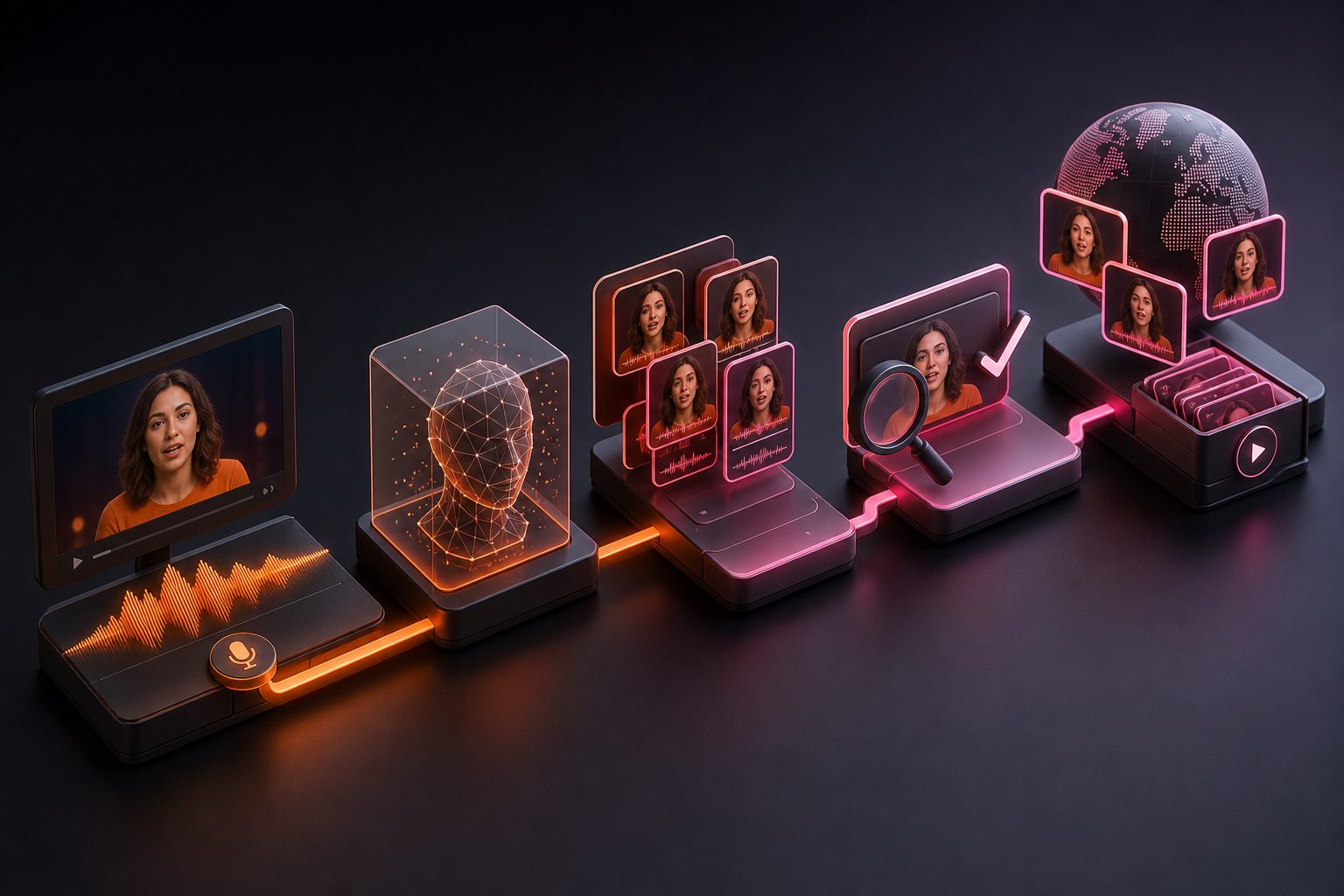
The safest workflow is not “translate the script and generate.” It is a four-step creative process: preserve the ad idea, rewrite for speech, generate localized audio, then apply lip sync and quality control.
- Extract the original script. Identify the hook, product claim, proof point, objection handler, and CTA.
- Translate for meaning, not word count. Keep the offer clear, but adapt idioms, units, and buying context.
- Rewrite for mouth timing. Shorten lines that become too long in the target language.
- Generate or record the target-language audio. Match pace, tone, and emotional energy.
- Apply AI lip sync. Use the cleanest face angle and audio possible.
- Add localized subtitles. Captions help silent viewing and reduce comprehension risk.
- Export variants by placement. Prioritize 9:16 for short-form social, then 1:1 or 16:9 if needed.
- Review before launch. Check mouth match, product truth, claim accuracy, and disclosure requirements.
AdsTurbo supports AI Lip Sync, video translation, video subtitles, AI upscaling, face swap, and character replacement. Its AI Lip Sync workflow uses a clear JPG or PNG portrait and MP3 or WAV audio, while its broader video tools support multilingual localization and social-format creative production.
A Practical Scoring Model for Localized Lip-Synced Ads
A localized ad should be judged by selling clarity, not by demo novelty. Use a 20-point scorecard before spending media budget.
| QA Area | What to Check | Score |
|---|---|---|
| Mouth-audio match | Open/close timing, plosive sounds, visible pauses | 0–5 |
| Speech naturalness | Pace, emotion, accent fit, no robotic cadence | 0–5 |
| Product clarity | Product visible during key claims and CTA | 0–4 |
| Local copy fit | Currency, units, idioms, offer wording, cultural tone | 0–3 |
| Platform readiness | Aspect ratio, subtitles, safe zones, audio quality | 0–3 |
A creative scoring 16 or higher is usually ready for a low-budget test. A score of 12–15 should be revised before scaling. Anything below 12 should be rebuilt from script or source footage, because viewers will notice the mismatch before they absorb the offer.
Internal Mini-Study: Where Lip Sync Breaks Most Often
In an internal creative audit, 36 short ecommerce ad drafts were reviewed across beauty, home goods, accessories, and digital products. Each draft was 15–25 seconds long and localized from English into Spanish, French, or Japanese. Three reviewers scored each draft with the 20-point framework above.
The most common issue was not translation accuracy. It was timing compression: translated lines became too long for the original shot length. This appeared in 19 of 36 drafts. The second issue was weak subtitle hierarchy, seen in 14 drafts, where the translated caption competed with product labels or discounts. The third issue was overly formal translated speech, seen in 11 drafts, especially for UGC-style testimonial ads.
The conclusion: AI lip sync works best when translation is treated as ad rewriting. A literal translation may be linguistically correct but commercially weak. The winning version is usually shorter, more conversational, and timed around the original facial performance.
Which Ad Types Benefit Most?
AI lip sync is strongest when the speaker’s face helps sell the product. It is less useful when the ad is mostly product shots, text overlays, or fast montage.
Good use cases include:
- UGC testimonials where trust depends on a person speaking naturally.
- Founder ads that explain why the product exists.
- Product demos with a presenter describing features.
- Localized offer announcements for regional sales.
- AI actor ads where one persona can be adapted across languages.
- Educational ads for products that need explanation before purchase.
For ecommerce teams building repeatable creative systems, lip sync pairs well with broader ecommerce video ad workflows, especially when the same hook needs to be tested by language, persona, and platform.
When Not to Use Lip Sync
Do not use lip sync when the ad would perform better with fresh local creative. Some products need local references, humor, creator style, or shopping objections that cannot be solved by dubbing alone.
Avoid it when:
- The original speaker’s face is too small, blurred, or side-facing.
- The source audio has heavy noise or overlapping speech.
- The translated script is much longer than the original.
- The ad depends on a culturally specific joke.
- The product claim needs legal or regulatory review in the target market.
- The “creator” appears to endorse a product without proper permission or disclosure.
For U.S. audiences, the FTC’s endorsement guidance is relevant when a video appears to contain a person’s recommendation or experience. The FTC explains that material relationships should be clearly disclosed, and advertisers should not present endorsements in a deceptive way. If an AI actor, paid creator, or synthetic persona is used, the ad team should review whether the presentation could mislead viewers.
How to Prepare Source Footage for Better Results
The best lip-sync output starts before generation. Clean footage gives the model more stable facial data and reduces artifacts around the mouth, chin, and teeth.
Use this source checklist:
- Film or generate the speaker in front-facing or three-quarter view.
- Keep the mouth unobstructed; avoid hands, cups, masks, and heavy shadows.
- Use even lighting and avoid fast head turns during key lines.
- Keep the first localized test to 10–20 seconds.
- Separate product b-roll from talking-head sections.
- Leave room for subtitles in the lower third.
- Export at a quality level that supports platform requirements.
If the source clip is compressed or low-resolution, apply quality improvements before final delivery. AdsTurbo provides video resolution enhancement, and its AI upscaling workflow can be useful when repurposing older assets for modern short-form placements. For more detail, see the guide to 4K upscaling for ecommerce video ads.
How to Build a Multilingual Creative Testing Matrix
A good testing matrix isolates one variable at a time. If every market receives a different script, face, CTA, offer, subtitle style, and edit length, the test will not explain why performance changed.
Start with a simple 3×3 structure:
| Variable | Version A | Version B | Version C |
|---|---|---|---|
| Hook | Problem-first | Result-first | Offer-first |
| Language | Spanish | French | Japanese |
| Persona | Founder | UGC creator | AI actor |
| CTA | Shop now | See how it works | Get the offer |
For the first test, keep the product scenes and CTA structure consistent. Change language and voice only. In the second test, keep the winning language version and vary the hook. In the third, test persona or actor fit.
AdsTurbo’s API access is available on every plan, and its advanced plans add team workflows and custom workflow support. Its API uses a standard REST structure with Bearer API Key authentication, asynchronous generation tasks, status polling, and Webhook callbacks. That matters for teams producing localized ad clusters instead of one-off videos.
AdsTurbo Workflow for Lip-Synced Localized Ads
AdsTurbo is built for ecommerce video ad generation and post-production control. For a localized ad workflow, a team can combine video translation, AI Lip Sync, subtitles, character replacement, and upscaling inside one creative process.
A practical sequence looks like this:
- Start with a winning short video or a product-focused ad concept.
- Extract or rewrite the script around the hook, proof point, and CTA.
- Translate the message for each market.
- Generate or upload target-language audio.
- Use Lip Sync to align the speaker’s mouth to the new audio.
- Add subtitles with social-ready styling for TikTok, Instagram Reels, and YouTube Shorts.
- Export variants for placement and team review.
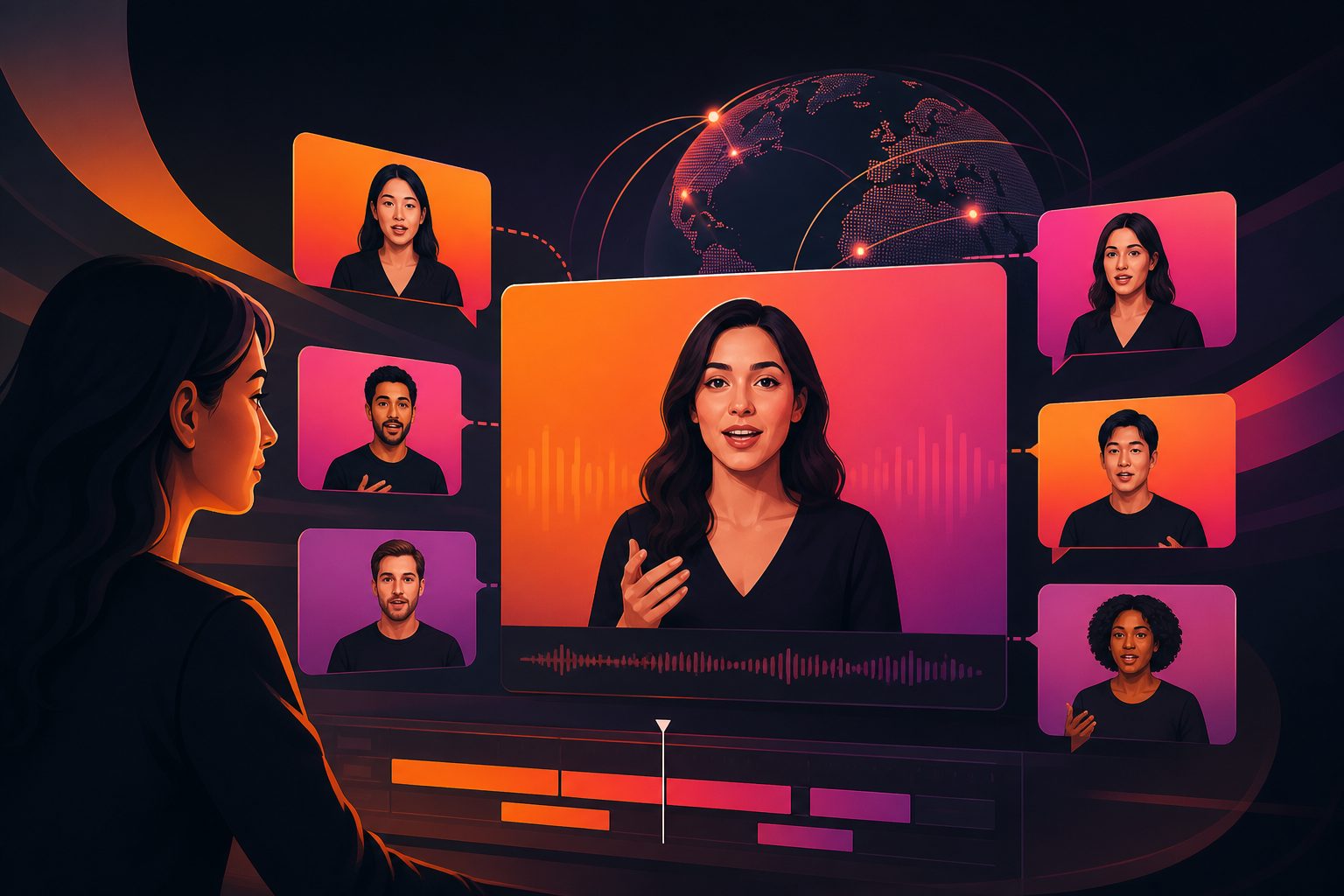
AdsTurbo also provides more than 300 AI actors and over 100 product ad templates. When the same message needs different speaker identities, teams can explore AI ads actors for ecommerce video ads or use character replacement for audience and regional testing through replace character in video AI.
Creative Rules That Improve Localized Performance
The strongest localized ads still follow classic direct-response rules. Lip sync makes the ad feel native, but it does not fix a weak offer or unclear product story.
Use these rules:
- Put the product or outcome in the first three seconds.
- Keep each spoken line short enough to breathe.
- Localize the CTA, not just the body copy.
- Show the product while the claim is spoken.
- Add subtitles even when the voiceover is strong.
- Avoid over-polished delivery for UGC-style ads.
- Keep legal claims consistent across audio, captions, and on-screen text.
TikTok notes that captions or on-screen text help the story land even when sound is off. Google’s video ad specifications also make clear that video assets must meet format and policy requirements before serving. In practice, lip sync should be part of a complete delivery checklist, not the final cosmetic layer.
Common Mistakes in AI Lip-Synced Ads
Most failures come from treating lip sync as a magic repair step. It is better understood as a finishing tool for an already well-timed localized script.
Common mistakes include:
- Translating word-for-word and forcing long lines into short shots.
- Using a voice that does not match the speaker’s age, energy, or style.
- Forgetting to localize price, shipping, claims, or seasonal references.
- Covering the mouth with captions, stickers, or product badges.
- Testing five changes at once and learning nothing.
- Using synthetic or swapped people without checking consent and disclosure.
- Upscaling after adding low-quality subtitles instead of before final export.
A cleaner workflow separates creative adaptation from visual finishing. First fix the message. Then match the voice. Then sync the mouth. Then caption, resize, and export.
Frequently Asked Questions
Is AI lip sync good enough for paid ads?
AI lip sync is good enough for many short-form ecommerce tests when the source face is clear, the translated script is short, and the audio matches the speaker’s energy. It is not a guarantee of performance. The ad still needs a strong hook, credible product proof, and platform-ready editing.
Does lip sync replace subtitles?
No. Lip sync improves the visual match between mouth movement and speech, while subtitles improve comprehension and silent viewing. AdsTurbo Video Subtitle can automatically transcribe speech and generate time-synced subtitles, with downloads available as embedded-video output or separate subtitle files.
What file inputs work best for AdsTurbo AI Lip Sync?
For AdsTurbo AI Lip Sync, use a clear JPG or PNG portrait and an MP3 or WAV audio file. A front-facing image with visible mouth detail and clean speech audio will usually produce a better result than a blurry face or noisy recording.
How many languages should an ecommerce team test first?
Start with two or three target markets where demand, shipping, and support already exist. Testing 10 languages at once can create operational noise. Prove one repeatable workflow first, then expand.
Can lip sync be combined with ad cloning?
Yes. AdsTurbo Ad Clone can analyze a reference ad’s structure, rhythm, shot logic, and CTA pattern, then help generate variants for testing. Lip sync can then localize presenter-led sections after translation and voiceover.
Final Takeaway
AI lip sync for ads is most useful after a video ad has already proven its core idea. Instead of reshooting every market, ecommerce teams can translate the message, rewrite it for natural speech, generate localized audio, sync the mouth movement, add subtitles, and test variants by platform.
The winning process is disciplined: preserve the hook, shorten the translated script, QA the mouth timing, keep product proof visible, and measure each market separately. Used this way, lip sync becomes a localization system—not a novelty effect.
Sources cited: Wav2Lip research paper, TikTok creative best practices, TikTok ad format and functionality policy, Meta Reels ads guidance, Google Ads video requirements, FTC endorsements and influencers guidance.