By adsturbo.ai | Published 2026-10-15 | Updated 2026-10-15
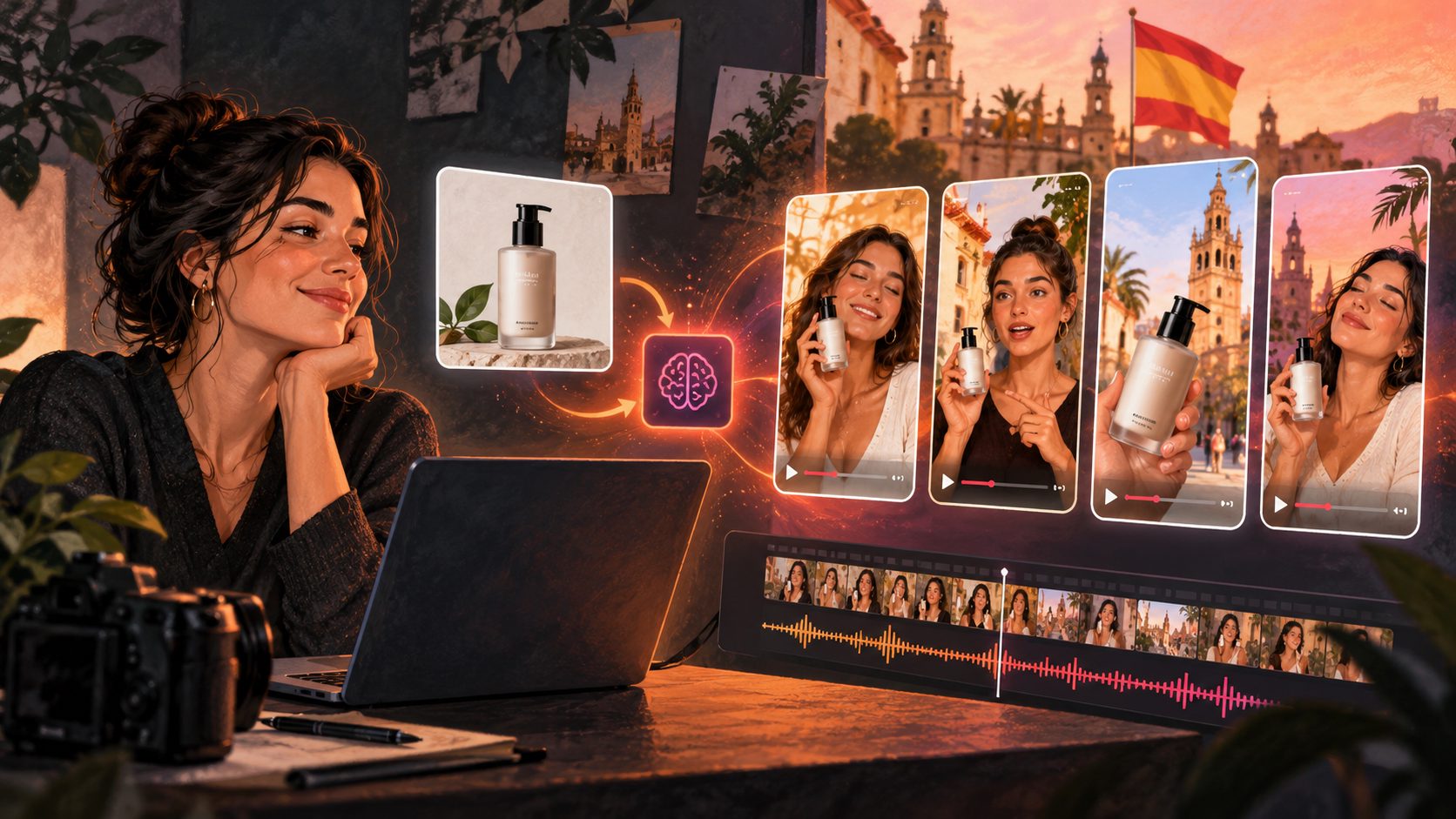
An AI Spanish UGC video ads generator helps ecommerce sellers turn a product image, selling point, and short brief into a Spanish-speaking product video for paid social or organic content. The strongest workflow is not simply translating an English ad. It combines product accuracy, natural Spanish phrasing, believable delivery, readable captions, and a testable creative structure.
What is an AI Spanish UGC video ads generator?
An AI Spanish UGC video ads generator is a tool that creates user-generated-content-style advertising videos with AI presenters, voice, scripts, product visuals, captions, or localized edits.
In practice, sellers usually provide one or more of these inputs:
- A JPG or PNG product image
- Product benefits and promotional details
- A reference video or ad structure
- A target audience or market
- A preferred voice, character, or language
The output is typically a short vertical video designed for platforms such as TikTok, Instagram Reels, Meta Ads, or YouTube Shorts. Many competing tools emphasize URL-to-video generation, AI presenters, automatic scripts, subtitles, and multiple ad variations. (prizmad.com)
The important distinction is that Spanish localization should adapt the selling idea, not only the words. A direct translation may sound formal, use the wrong regional expression, or place the main benefit too late in the video.
Why Spanish UGC ads need more than translation
Spanish-speaking shoppers are not one uniform audience. A creative aimed at Mexico, the United States, Colombia, Argentina, or Spain may need different vocabulary, rhythm, references, and calls to action.
For ecommerce testing, separate the localization problem into four layers:
| Layer | What to localize | Example check |
|---|---|---|
| Message | The promise and reason to believe | Does the benefit make sense in the target market? |
| Language | Vocabulary, grammar, and tone | Does it sound conversational rather than translated? |
| Delivery | Voice, pace, emphasis, and pauses | Does the opening feel natural in the first seconds? |
| Visuals | Captions, prices, offers, and product shots | Are text and product details easy to verify? |
This framework is a practical information gain over the common “choose an avatar, translate the script, and export” workflow. It gives sellers a way to diagnose weak performance: a low hold rate may indicate a weak hook, while good watch time but poor clicks may indicate unclear proof or CTA.
AdsTurbo supports video translation, lip sync, character replacement, subtitles, video analysis, upscaling, and ad cloning. These controls make it possible to reuse a proven creative structure while changing the language, speaker, or product presentation.
How to create a Spanish UGC ad from one product image
1. Start with a clean product input
Use a clear JPG or PNG product image. A product photographed against a solid-color background generally produces the most reliable result because the product outline, color, and category are easier to analyze.
Avoid starting with:
- Blurry screenshots
- Heavy text over the product
- Multiple similar products in one frame
- Reflections that hide the material
- Cropped packaging or missing accessories
AdsTurbo Product Image can analyze a product’s shape, color, and category. It can also generate ecommerce image variations such as banners, lifestyle scenes, close-ups, material details, instruction visuals, and branded images.
2. Write the Spanish brief around one buying moment
Do not ask for a generic “viral ad.” Define the buyer, problem, proof, and action.
A useful brief has this structure:
- Audience: Who is likely to buy?
- Situation: When do they realize they need the product?
- Main benefit: What changes after using it?
- Proof: What can the viewer see or understand quickly?
- Offer: Is there a discount, bundle, or deadline?
- CTA: What should the viewer do next?
For example:
Create a 20-second Spanish UGC-style ad for a compact kitchen organizer. Open with the frustration of a crowded drawer, show the product solving the problem, highlight its compact design, and end with a direct purchase CTA.
This is more useful than translating a finished English script because the system can preserve the intended persuasion sequence.
3. Use a five-part UGC structure
A practical Spanish UGC video can follow this sequence:
- Pattern interrupt: “Si tu cajón siempre termina así…”
- Problem: Show the mess or inconvenience.
- Product reveal: Introduce the product visually.
- Proof: Demonstrate one specific feature.
- CTA: Tell the viewer what to do next.
Keep the first sentence focused on the shopper’s situation. A product name alone is rarely a strong opening. The first few seconds should communicate either a problem, a surprising result, or a useful promise.
AdsTurbo Ad Clone can analyze a reference video and help reconstruct its structure, pacing, shot logic, and CTA pattern. Its API can analyze reference clips up to 12 seconds and generate ad variations in parallel, which is useful when the goal is to study a winning opening rather than copy the original footage.
For a deeper proof-led approach, see this guide to turning product demonstrations into short video ads.
How to localize Spanish voice and captions
Spanish voiceover quality depends on more than correct pronunciation. Check whether the delivery matches the category and audience.
Use these practical rules:
- Prefer short sentences over literal translations.
- Avoid mixing formal “usted” language with casual “tú” language.
- Keep product names and technical terms consistent.
- Make the CTA specific: shop, learn more, claim the offer, or view the product.
- Review numbers, currency, measurements, and discount wording separately.
- Use captions that match the spoken message without covering the product.
AdsTurbo Video Subtitle can automatically transcribe speech, generate time-synchronized captions, and export either a video with embedded subtitles or a separate subtitle file. Its caption layouts are designed for formats used by TikTok, Instagram Reels, and YouTube Shorts.
For cross-market campaigns, use a multilingual subtitle synchronization workflow to check timing, line breaks, and readability before publishing.
A testing matrix for Spanish ecommerce creatives
The goal is not to make one “perfect” Spanish ad. The goal is to isolate which creative variable influences the result.
Use a controlled matrix:
| Variable | Version A | Version B |
|---|---|---|
| Hook | Problem-led | Benefit-led |
| Presenter | Friendly peer | Expert demonstrator |
| Proof | Product demo | Before-and-after visual |
| Offer | Discount | Free shipping or bundle |
| CTA | Shop now | See how it works |
Change one major variable at a time when possible. If the hook, presenter, offer, and product angle all change together, the result becomes difficult to interpret.
A useful internal scorecard is:
- Hook clarity: Can the problem be understood without sound?
- Product fidelity: Does the product retain its real shape and color?
- Language naturalness: Would a native speaker say it this way?
- Proof density: Is there at least one visible reason to believe?
- CTA visibility: Can viewers identify the next action?
Score each item from 1 to 5 before launch. This is an original quality-control layer, not a platform performance guarantee, but it helps prevent avoidable localization errors.
When to use an AI Spanish UGC workflow
An AI workflow is especially useful when a seller needs several versions of the same product ad:
- Different Spanish hooks for creative testing
- Multiple presenters or audience personas
- Spanish voice and subtitle versions of an existing ad
- Product demos built from a single product image
- Regional campaigns with different offers or CTAs
- Short-form variations for TikTok, Meta, and Shorts
AdsTurbo also supports product video creation from JPG or PNG product images, with optional selling points and promotional information. Its broader workflow includes product image generation, background replacement, event posters, AI upscaling, subtitles, character swap, motion control, and video translation.
For sellers who need consistent production across a catalog, the platform provides API access, asynchronous task processing, status polling, Webhook completion events, and composable API modules for image generation, personas, AI actors, ad cloning, video generation, and task handling.
Create a localized ecommerce video workflow with AdsTurbo.
Common questions
Is a Spanish UGC ad the same as a translated English ad?
No. Translation changes the language; localization adapts the message, tone, vocabulary, offer, captions, and delivery for a specific audience.
Can one product image be used to create a Spanish video ad?
Yes. A clear JPG or PNG product image can serve as the core visual input for product-focused video generation. More product angles, benefits, or reference footage can improve creative variety.
Should Spanish captions match the voice word for word?
They should communicate the same meaning and stay synchronized, but captions may need shorter lines to remain readable on mobile screens.
How many versions should an ecommerce seller create?
Start with a small testing matrix, such as two hooks, two presenters, and two proof angles. This creates variation without making performance analysis unnecessarily difficult.
Can an existing English ad be adapted for Spanish audiences?
Yes. A reference ad can provide the structure, pacing, and CTA logic. The Spanish version should use original localized copy and verify product claims, visuals, and captions before publication.