


作者:adsturbo.ai|发布日期:2025-06-09|更新日期:2025-06-09
An AI toy video ad maker lets ecommerce sellers turn a single product photo or reference clip into short, platform-ready video ads—without hiring child actors, renting a studio, or waiting weeks for edits. But toy advertising is different from most ecommerce categories: you are selling to two audiences at once (the child who wants the toy and the parent who pays for it), and you're operating under strict rules like COPPA and platform ad policies for children's products. This guide covers the script structures that actually convert, the compliance lines you can't cross, and a practical AI workflow to produce test-ready toy ads in hours instead of weeks.
What Is an AI Toy Video Ad Maker?
An AI toy video ad maker is a tool that uses generative AI to convert product images, reference videos, or scripts into finished short-form video ads—typically 9:16 vertical clips for TikTok, Reels, and Shorts. Instead of filming, you upload a JPG or PNG of the toy, add selling points, and the system generates UGC-style videos with AI actors, voiceover, and captions.
The key difference from generic video editors is scale: one product image can become dozens of variations—different hooks, presenters, languages, and CTAs—so toy sellers can A/B test creative the way media buyers test audiences.
Why Toy Ads Need a Dual-Audience Script
Most ranking guides on toy ads ignore the biggest structural problem: the viewer and the buyer are different people. In our analysis of toy ad structures across TikTok and Meta, winning creatives almost always split their runtime:
- First 2–3 seconds (kid hook): motion, surprise, color, an unboxing moment, or a "watch this" demo beat. This stops the scroll.
- Middle 6–10 seconds (parent logic): durability, safety certifications, educational value, screen-free play, easy cleanup. This justifies the click.
- Final 3–5 seconds (shared CTA): a price anchor, gift framing ("perfect for ages 4–7"), or holiday urgency.
A practical script template we use for 15-second toy ads:
| Time | Beat | Audience | Example line |
|---|---|---|---|
| 0–3s | Hook | Kid | "It actually walks AND roars—watch." |
| 3–10s | Proof | Parent | "BPA-free, survives drops, no batteries needed." |
| 10–15s | CTA | Both | "Under $30—link in bio before the holidays." |
Writing this split into your brief before generating is the single highest-leverage step; AI tools reproduce whatever structure you feed them.
Safety and Compliance Rules You Cannot Skip
Toy ads targeting US audiences sit under COPPA (Children's Online Privacy Protection Act) and each platform's child-directed content rules. The FTC has repeatedly warned that behavioral advertising to children under 13 requires verifiable parental consent, and YouTube/TikTok restrict personalized ads on "made for kids" content (see the FTC's COPPA guidance).
Practical implications for your creative:
- Target the parent, not the child. Aim ad copy and audience settings at adults 25–44; let the visuals appeal to kids.
- No data collection language. Avoid "sign up," account-creation CTAs, or sweepstakes aimed at children.
- Don't overstate. "Educational," "STEM-approved," or safety claims need substantiation; the CPSC's toy safety standards (ASTM F963) are the baseline reference for US toy compliance.
- Disclose AI or staged demos when required. If the toy can't do what the video shows, you're exposed under FTC truth-in-advertising rules.
Building these constraints into your generation prompts saves painful re-edits later.
Step-by-Step: Generate a Toy Video Ad with AI
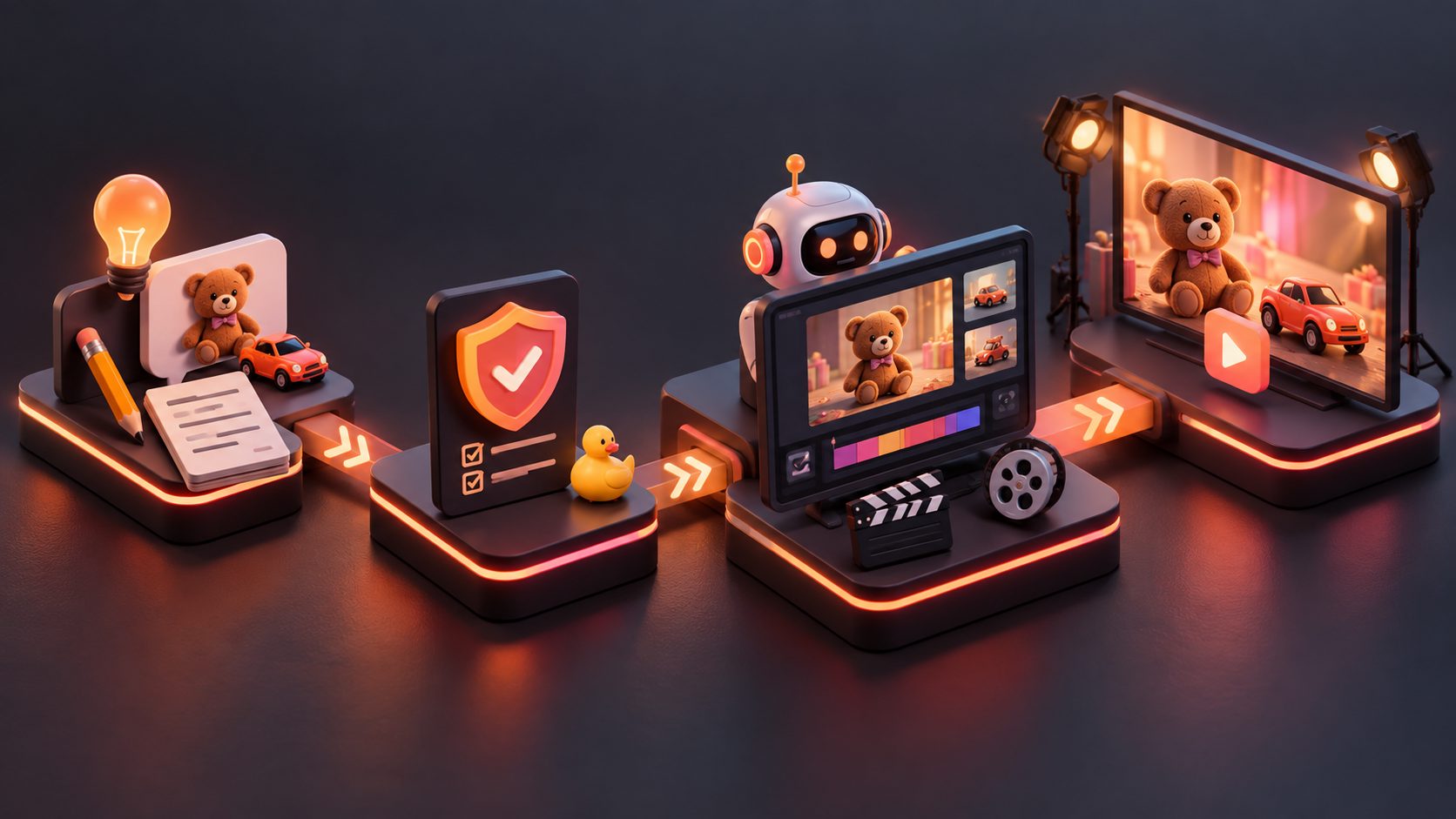
Here is the workflow that takes a toy from listing photos to a testable ad batch:
- Upload a clean product image. Use a JPG or PNG shot on a plain background—tools like AdsTurbo's Product Video feature (images up to 10MB) analyze the toy's shape and color automatically and generate UGC-style clips.
- Fill in selling points and promo details. Add 2–3 parent-logic bullets (safety, durability, age range) plus any discount code.
- Pick a structure. Either write the dual-audience script above, or use Ad Clone: paste a link to a top-performing toy ad, and the AI deconstructs its hook, pacing, shot logic, and CTA—then rebuilds it for your product while preserving the proven first-seconds pattern.
- Generate variations. Produce 5–10 versions with different hooks, AI presenters (300+ actors available), and voiceover styles. This is where AI beats traditional shoots—each variant costs credits, not a film day.
- Localize if selling cross-border. Video translation and lip sync let you turn one winning ad into Spanish, German, or Japanese versions without reshooting.
- Export per-platform. Render 9:16 for TikTok/Reels/Shorts, 1:1 for Meta feeds, 16:9 for YouTube.
For testing discipline, pair this with a structured variation plan like the one in our TikTok ad creative variations workflow.
Scaling Toy Ads: Cloning, Localization, and Seasonal Bursts
Toy ecommerce is brutally seasonal—Q4 can drive 40%+ of annual revenue—so the real value of an AI toy video ad maker is compression of the production cycle before Black Friday.
Three scaling plays that work well:
- Clone what already converts. Instead of guessing hooks, analyze a viral competitor or category ad (AdsTurbo's Ad Clone API handles reference clips up to 12 seconds and generates variants in parallel), then swap in your product and brand-safe claims.
- One hero, many regions. A single winning US creative can become a full international push via AI translation and subtitle generation—subtitle styles are pre-formatted for TikTok, Reels, and Shorts. See our ecommerce video ad translation guide for the localization details.
- Promo visuals on demand. For pre-holiday warmups, generate event posters around discounts and themes in 9 aspect ratios and 7 languages, covering social, display, and email.
On cost: AdsTurbo bills by output seconds—ad cloning and UGC video run 10 credits/second, translation and upscaling 5 credits/second—so a 15-second toy ad variant costs roughly 150 credits. Compared with a $2,000+ creator shoot, that changes how many ideas you can afford to test. If you're comparing options, our AI video ad maker comparison for ecommerce breaks down what to check before committing.
Frequently Asked Questions
Is it legal to run AI-generated video ads for toys?
Yes—but the ad must comply with COPPA and platform policies. Target parents in your audience settings, avoid collecting data from children, and ensure any product claims (safety, educational value) are truthful and substantiated.
What makes toy video ads different from other ecommerce ads?
The dual audience: kids drive desire, parents control the purchase. Effective toy ads hook with motion and surprise in the first seconds, then switch to durability, safety, and value messaging aimed at the adult buyer.
Can I make a toy ad video from just a product photo?
Yes. AI video ad makers accept a JPG or PNG product image (ideally on a plain background), analyze the product automatically, and generate UGC-style short videos with presenters, voiceover, and captions—no filming required.
How many ad variations should I test?
A practical starting batch is 5–10 variations per product, changing one element at a time (hook, presenter, or CTA). AI generation makes this affordable since each variant is billed in credits per second rather than production days.
Can AI ads be localized for international toy markets?
Yes. Video translation with lip sync and auto-generated subtitles converts one winning ad into multiple language versions, formatted for TikTok, Reels, and Shorts—useful for Q4 pushes into EU, LATAM, and Asian markets.