


Author: adsturbo.ai|Published: September 7, 2026|Updated: September 7, 2026
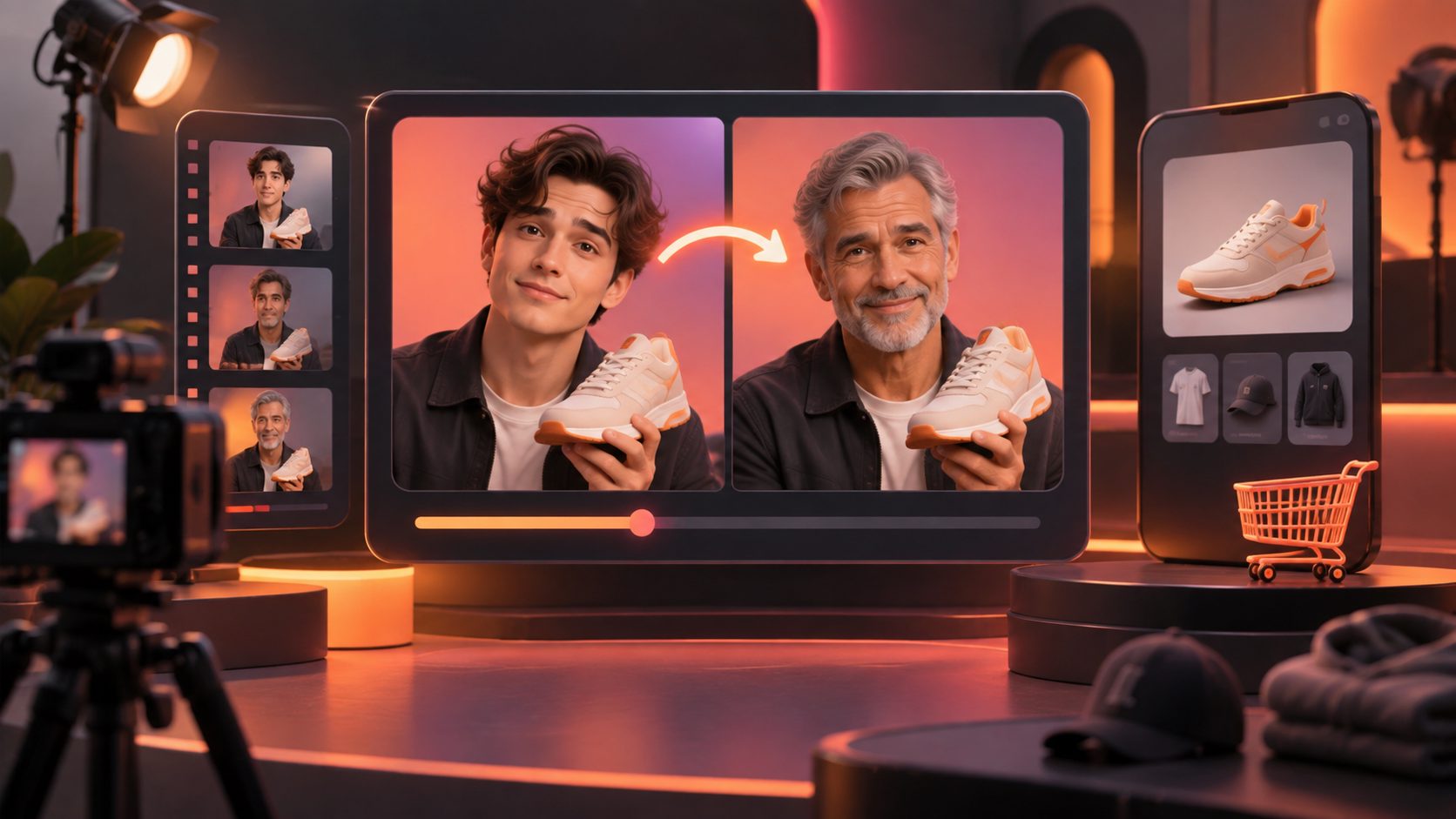
An AI video face swap tool replaces a person’s face in existing footage while preserving much of the original motion, expression, lighting, and scene. For ecommerce sellers, its strongest use is not impersonation—it is authorized UGC localization, where one approved production concept becomes several audience-specific ad variants without repeated shoots.
The opportunity comes with a clear constraint: a technically convincing swap can still create legal, platform, or customer-trust problems. Sellers therefore need a workflow that connects consent, production quality, disclosure, and controlled creative testing.
What Is an AI Video Face Swap Tool?
An AI video face swap tool analyzes a target video frame by frame, tracks facial position and expression, and maps an authorized reference identity onto the original performer. Unlike a photo face swap, video processing must maintain identity consistency as the person speaks, turns, blinks, or moves through changing light.
Face replacement is also narrower than a full character swap:
| Method | What changes | Best ecommerce use |
|---|---|---|
| Face swap | Facial identity | Testing approved spokesperson identities |
| Character swap | Face and broader character appearance | Adapting an actor or persona while retaining motion |
| Lip sync | Mouth movement | Matching translated or replacement audio |
| Dubbing | Spoken language or voice track | Localizing a proven ad for another market |
| Full regeneration | Most visual elements | Creating a substantially different concept |
AdsTurbo offers AI face swapping alongside lip sync, character replacement, video translation, subtitles, and resolution enhancement. Sellers can combine these controls when a localized ad requires more than a new face.
When Should Ecommerce Sellers Use Face Replacement?
Face replacement works best when the creative structure already performs its job and the audience-facing identity is the variable being tested. The product demonstration, camera movement, pacing, opening hook, and call to action can remain stable while the seller changes the presenter.
Practical applications include:
- Localizing an authorized UGC concept for different geographic markets
- Testing presenter demographics without reshooting the entire scene
- Replacing a temporary actor after usage rights expire, provided the new version is separately authorized
- Producing product-focused variants for distinct customer segments
- Adapting a creator-approved concept when the contract explicitly permits synthetic editing
It is less suitable when hair, body shape, clothing, or physical interaction must change. In those cases, video character swap for ecommerce ads may fit the production requirement better.
Do not use face replacement to fabricate a celebrity endorsement, imitate a customer, or make a real person appear to endorse claims they never approved.
How Do You Use Face Swap Responsibly in UGC Ads?
A compliant workflow begins with documented permission, not generation. Obtain authorization from both the original performer and the person whose likeness will appear in the output, then define where, how long, and in which markets the resulting advertisement may run.
Use this five-step process:
- Document likeness rights. Specify synthetic editing, paid media channels, countries, campaign duration, and whether derivatives are permitted.
- Choose controlled source footage. Favor clear facial visibility, moderate head movement, stable lighting, and limited obstruction.
- Generate a short test segment. Review two to four seconds before processing the complete ad.
- Inspect every scene. Check identity consistency, mouth edges, teeth, reflections, hands near the face, and transitions.
- Apply required disclosures. Review local law and each advertising platform’s current synthetic-media rules before publishing.
The FTC states that endorsements must be honest and not misleading, while material relationships should be disclosed clearly and conspicuously. (ftc.gov) TikTok Ads Manager identifies disclaimers as mandatory for significantly AI-generated, synthetic, or manipulated media. (ads.tiktok.com)
What Makes a Face-Swapped Ad Look Credible?
A believable result depends more on input compatibility than aggressive post-processing. The best reference image has a sharp, unobstructed face, neutral lighting, and an angle reasonably close to the presenter’s dominant position in the video.
Before export, review the ad at normal speed and frame by frame:
- Facial geometry: Watch the jawline, ears, forehead, and side profile.
- Occlusion: Inspect frames where hair, glasses, products, or hands cross the face.
- Lighting continuity: Reject sudden changes in skin brightness or color temperature.
- Expression stability: Check smiles, closed eyes, fast speech, and extreme head turns.
- Audio alignment: Use lip sync when localized speech no longer matches the mouth.
- Export quality: Upscale only after identity and motion problems are resolved.
AdsTurbo supports face swap, lip sync, clip-by-clip editing, subtitles, translation, and video upscaling. A related AI lip-sync workflow for multilingual ads explains how mouth movement can be aligned with replacement audio without reshooting.
How Should You Structure a Multi-Market Creative Test?
The strongest test changes one strategic variable at a time. If the face, language, hook, offer, subtitles, and CTA all change together, performance data cannot reveal which modification influenced the result.
A useful original framework is the CLEAR test matrix:
| Dimension | Question |
|---|---|
| C — Consent | Is every depicted identity authorized for this market and channel? |
| L — Localization | Are language, currency, cultural references, and captions appropriate? |
| E — Equivalence | Are non-test variables consistent across variants? |
| A — Authenticity | Does the presenter-product interaction remain believable? |
| R — Response | Which metric will decide whether the variant advances? |
For an initial 12-ad test, use three presenter variants across two markets and two hooks. Keep the offer, product demonstration, runtime, CTA, landing page, and media-buying conditions as consistent as possible.
Judge early creative performance using hold rate and completion behavior, then use click-through and conversion metrics to evaluate commercial relevance. This approach complements a broader ecommerce ad variation testing workflow.
What Compliance Checks Are Required Before Publishing?
Before launch, verify identity permission, claim accuracy, disclosure requirements, and platform policy. A consent form alone does not make a misleading advertisement acceptable, and an AI label does not cure an unauthorized use of someone’s likeness.
Use a final publication gate:
- The original footage is owned or properly licensed.
- Every person’s likeness and voice are authorized for synthetic modification.
- Product claims remain truthful and substantiated.
- Testimonials reflect genuine approved opinions rather than invented experiences.
- Required paid-relationship and AI-media labels are visible.
- The creative does not imply celebrity, expert, or customer approval that never occurred.
- Source files, approvals, contracts, and final exports are retained.
Google Ads prohibits manipulating media to deceive, defraud, or mislead users. (support.google.com) The U.S. Copyright Office has also identified unauthorized digital replicas as a significant policy concern, reinforcing why sellers should treat likeness rights as a formal production asset. (copyright.gov)
For international campaigns, pair authorized identity adaptation with a structured video ad translation and dubbing workflow.
Frequently Asked Questions
Can I face-swap a creator after purchasing their UGC video?
Only when your agreement authorizes that use. Ordinary video usage rights do not automatically grant permission to alter identity, create synthetic derivatives, or continue using a performer’s body and voice with another face.
Should an AI-edited ecommerce ad include a disclosure?
Requirements vary by platform, location, and the significance of the edit. Disclose whenever required and consider a clear label when the modification could materially affect how viewers interpret the presenter or endorsement.
Is face swap the same as replacing the whole actor?
No. Face swap primarily changes facial identity. Character replacement is more appropriate when the desired change includes the person’s broader appearance while retaining source motion, lighting, and scene composition.
Can face swapping localize the spoken language?
Face replacement alone does not translate speech. Combine it with video translation, dubbing, lip sync, and time-synchronized subtitles when adapting an advertisement for another language.
What source footage produces the best results?
Use short, high-quality clips with clear facial detail, stable lighting, limited motion blur, and minimal obstruction. Test difficult frames—including side profiles and hand-to-face gestures—before generating the complete video.