By adsturbo.ai | Published 2026-10-17 | Updated 2026-10-17
For Amazon and eBay auto-parts sellers, an automotive fitment video ad ecommerce workflow should do more than display a product. It should show where the part goes, how it installs, which vehicle details matter, and what the buyer should verify before ordering. That combination can reduce uncertainty, improve product-page clarity, and support more qualified purchases.
Amazon’s automotive experience uses fitment information to help shoppers check whether a vehicle-specific product matches their vehicle. eBay likewise uses vehicle details and item compatibility data to confirm fitment for eligible parts. Video cannot replace accurate catalog data, but it can make that information easier to understand and remember. Amazon’s automotive fitment documentation and eBay’s Guaranteed Fit guidance show why structured compatibility data remains the foundation.
What is an automotive fitment video ad?
An automotive fitment video ad is a short product video that connects a part to a specific vehicle use case. It combines the product, installation context, compatibility cues, and a clear next step instead of relying on a generic product beauty shot.
A strong video answers four buyer questions quickly:
- What is the part?
- Where does it fit?
- What does installation look like?
- What should I confirm before purchasing?
This is particularly valuable for floor mats, trim pieces, lighting, mounts, filters, organizers, brackets, covers, and other parts where a visually wrong shape or mounting point can lead to a return.
The key distinction is that the video should demonstrate fitment evidence, not invent compatibility. It should never imply that a part fits every trim, engine, body style, or model year unless the seller’s verified catalog data supports that claim.
Why installation proof matters more than a polished product montage
Most automotive product pages already show the part from several angles. Fewer show the moment that creates buyer confidence: the part aligning with the vehicle and reaching its final seated position.
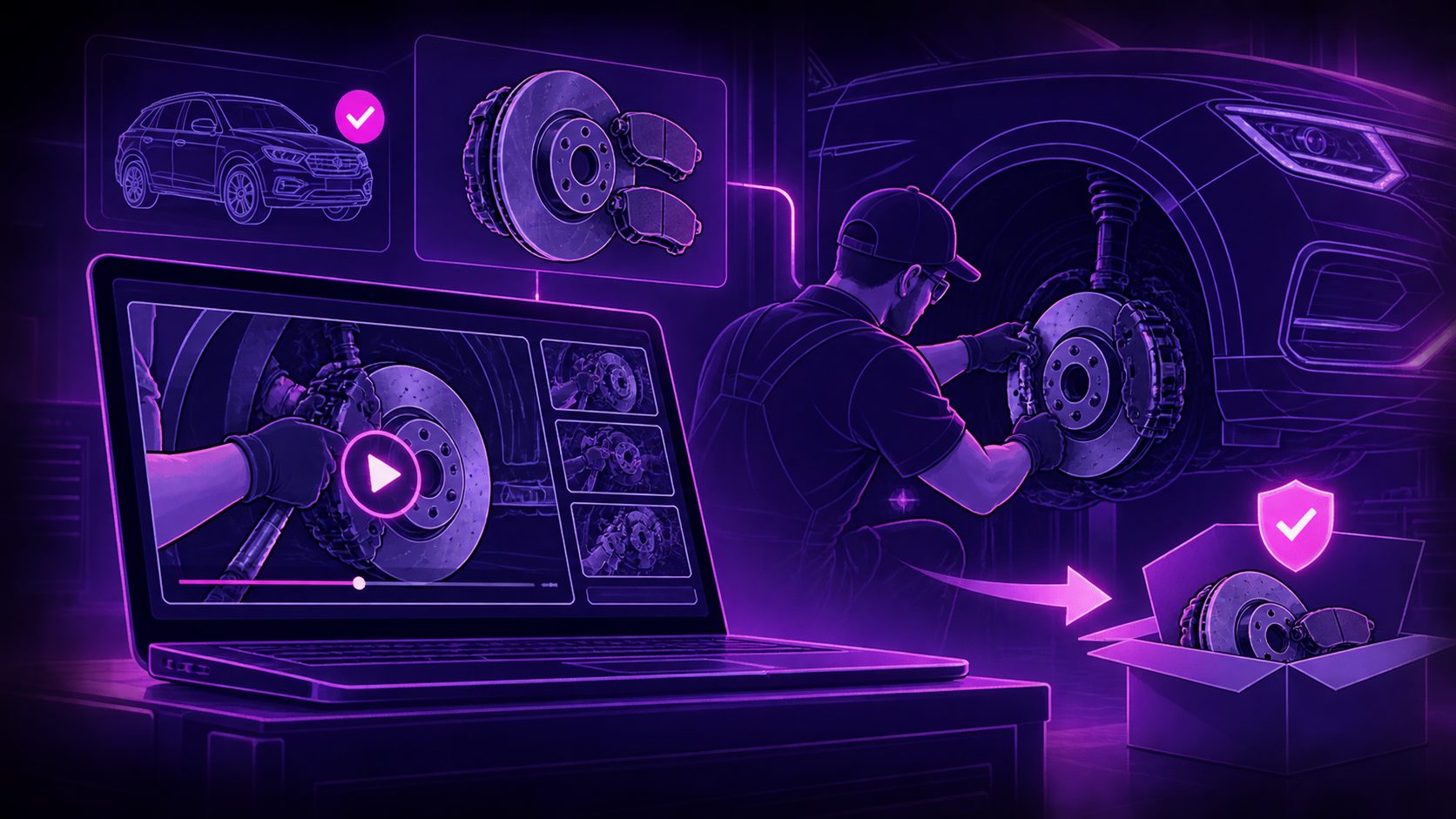
A useful installation sequence has three layers:
- Context: Show the relevant area of the vehicle, such as the door frame, dashboard, wheel well, cargo floor, or seat rail.
- Action: Demonstrate the real motion—clip, slide, twist, clamp, bolt, lay, or plug.
- Confirmation: Show the installed result, including edges, clearance, connection points, and visible gaps.
This structure is more persuasive than a fast montage because it addresses the practical fear behind many fitment questions: “Will this actually work on my vehicle, or will I have to return it?”
A fitment video should also show limitations when they matter. For example, a seller may need to state that a product fits a specific body style but not a different trim, or that an adapter is required for certain model years. Clear exclusions can prevent low-quality orders better than vague claims such as “universal fit.”
The Fitment Proof Matrix: a practical framework for auto-parts sellers
A useful way to plan each video is to score the creative against four proof types. This framework is designed for catalog-scale production, where one seller may need dozens or hundreds of SKU-specific videos.
| Proof type | What to show | Buyer concern answered |
|---|---|---|
| Identity proof | Product name, shape, connector, part number, or distinctive feature | “Is this the correct part?” |
| Vehicle proof | Year, make, model, trim, or relevant vehicle area | “Does this belong on my vehicle?” |
| Installation proof | Hands-on placement, fastening, or connection | “Can I install it correctly?” |
| Result proof | Final fit, clearance, finish, or operation | “What will it look like when installed?” |
For a 15-second video, use a simple allocation:
- 0–3 seconds: Identify the problem and vehicle context.
- 3–9 seconds: Show the installation action.
- 9–12 seconds: Show the final fit from a useful angle.
- 12–15 seconds: Display the verification instruction and call to action.
This is not a substitute for an installation manual. It is a decision-support layer for shoppers who need visual confirmation before opening the technical specifications.
How to create fitment videos for Amazon and eBay
1. Start with verified fitment data
Before producing creative, organize each SKU by:
- Year range
- Make and model
- Trim or body style
- Engine or drivetrain, when relevant
- OEM number or manufacturer part number
- Included hardware
- Exclusions and exceptions
Use the same terminology in the video, title, images, and compatibility table. eBay states that buyers of eligible Car & Truck parts may need full vehicle information, including year, make, model, trim, and engine, for fitment confirmation. (ebay.com)
2. Choose the correct demonstration angle
The best camera angle depends on the product:
- Interior accessories: Use a door-open or cabin view to show alignment and coverage.
- Exterior trim: Show the original mounting surface and the finished edge.
- Lighting products: Show the connector, orientation, and operating result.
- Engine-bay components: Use a stable close-up with labels for connection points.
- Clamps and mounts: Show the contact surface and how the product stays secure.
Avoid angles that make a part appear to fit simply because the vehicle is shown in the background. The part must be visibly connected to the relevant area.
3. Add text only where it reduces confusion
Use short overlays such as:
- “Fits 2018–2022 [model]”
- “Front passenger side”
- “Clip-on installation”
- “Check trim before ordering”
- “Hardware included”
Do not overload the video with a long compatibility table. Put detailed fitment information on the product page, then use the video to emphasize the most important verification point.
4. Produce platform-ready variations
The same core footage can support multiple outputs:
- 9:16: TikTok, Reels, Shorts, and mobile-first social placements
- 1:1: Product feeds and square marketplace placements
- 16:9: YouTube, desktop pages, and broader display use
AdsTurbo supports product video creation from JPG or PNG product images, as well as clip-by-clip editing, subtitles, background replacement, and video upscaling. Its Event Poster workflow can also create promotional assets in multiple aspect ratios for campaigns that combine fitment education with discounts or seasonal offers.
For a broader production system, the Amazon and e-commerce video ads guide explains how product videos can be adapted across marketplace and paid-media contexts.
A 15-second script template for a vehicle-specific part
Hook:
“Replacing the driver-side mirror cover on a 2020–2023 Ford Explorer?”
Demonstration:
“Align the clips with the factory mounting points, press firmly along the edge, and check that the cover sits flush.”
Proof:
“Here is the installed result from the front and side.”
Verification CTA:
“Confirm your year, model, trim, and side before ordering.”
The script works because it combines a vehicle reference, an installation action, a visible result, and a verification instruction. It avoids unsupported claims such as “fits all vehicles” or “installs in seconds” unless the seller can substantiate them.
AdsTurbo’s product video workflow can help turn product imagery and selling points into short-form creative concepts. For existing reference ads, the competitor video ad script teardown tool can be used to study hook structure, pacing, and CTA placement without copying another seller’s claims.
How to measure whether the video is helping
Do not judge a fitment video only by views. Track the metrics closest to buyer uncertainty:
- Product-page video plays
- Average watch time
- Click-through rate from ad to listing
- “Does not fit” return reasons
- Buyer questions about compatibility
- Conversion rate by vehicle segment
- Return rate for SKUs with and without fitment video
A practical test is to select 10–20 comparable SKUs and create two versions: a standard product video and a fitment-proof video. Keep price, title, images, and ad targeting stable. Compare performance over the same test window, then review return reasons rather than relying on conversion rate alone.
This measurement design is more useful than claiming a universal conversion lift. Automotive fitment varies by category, catalog quality, traffic source, and the accuracy of the underlying compatibility data.
Common questions
Can a video replace Amazon or eBay fitment data?
No. Video explains the product visually, but marketplace fitment systems and compatibility tables remain essential for structured matching. Use the video as reinforcement, not as the only source of truth.
Should every auto part have an installation video?
Not necessarily. Prioritize parts with high fitment uncertainty, frequent buyer questions, visible installation steps, or expensive return shipping. Simple consumables may need a compatibility graphic rather than a full installation demonstration.
What if a product fits several vehicle models?
Create a modular video structure. Keep the installation sequence consistent, then change the opening text, vehicle context, and compatibility overlay for each model group. This is safer than using one vague “multi-fit” video.
Are subtitles useful for automotive product ads?
Yes. Many shoppers watch short-form ads without sound, and subtitles make technical instructions easier to follow. AdsTurbo Video Subtitle can transcribe speech, generate synchronized captions, translate them, and export either a captioned video or a separate subtitle file.
How can sellers scale fitment videos across a large catalog?
Use structured SKU data, reusable scene templates, and batch production. AdsTurbo supports product-image-based video generation, asynchronous task processing, API access on higher-level plans, and composable API modules for image generation, personas, AI actors, ad cloning, video generation, and task handling.
Final takeaway
The most effective automotive fitment video ad ecommerce strategy is not a generic car montage. It is a short visual proof system: identify the part, anchor it to the right vehicle, demonstrate the real installation motion, show the final result, and remind the shopper what to verify.
That approach supports better marketplace listings, clearer paid ads, and more informed purchasing decisions. To turn product images and fitment details into testable video variations, explore AdsTurbo.