

By adsturbo.ai | Published 2026-09-26 | Updated 2026-09-26
A b2b factory tour video for buyers should do more than show a clean production floor. It should help an overseas procurement team verify capability, understand quality control, and decide what to ask next—before booking a factory visit or requesting a quotation.
The strongest factory videos combine real workshop footage with close-up product evidence, inspection moments, packaging flow, and clear buyer-oriented explanations. They are less like corporate commercials and more like a structured remote audit.
What is a factory tour video for B2B buyers?
A factory tour video is a visual supplier-verification asset that shows how a product moves through production, inspection, packing, and dispatch. For B2B buyers, its purpose is not simply brand awareness; it is to reduce uncertainty around manufacturing capability and operational reliability.
High-performing examples commonly show equipment, assembly, quality checks, warehouse handling, and product ranges. (allwellsports.com) A useful video also connects each scene to a buyer question:
- Can this supplier make the product consistently?
- Does the facility have the right equipment?
- Are quality checks performed before packing?
- Can the supplier support my product category or order type?
- What evidence should I request after watching?
A factory walkthrough cannot replace samples, contracts, compliance documents, or an independent inspection. It can, however, make the sourcing conversation more concrete and help qualified buyers move forward faster.
Why generic factory tours fail to build buyer confidence
A generic walkthrough often begins at the factory entrance, pans across machinery, and ends with a logo animation. It may look professional, but it forces buyers to interpret the footage themselves.
The main weakness is missing evidence linkage. Showing a machine does not prove that it produces the buyer’s product. Showing workers does not explain the inspection standard. Showing cartons does not establish how finished goods are checked before shipment.
A better video pairs every visual with a business implication:
| Footage | Buyer question answered |
|---|---|
| Raw material or component handling | What enters the production process? |
| Machine operation | Is the facility equipped for this product? |
| Assembly detail | How is the product built and handled? |
| Inspection or testing | Where are defects identified? |
| Packing and labeling | How is shipment readiness controlled? |
| Finished product close-up | What does the final output look like? |
The footage should also preserve some operational realism. Buyer-focused factory content is generally more credible when it shows actual people, machinery, and process context instead of relying only on polished claims. (mrkcal.com)
The six-shot trust chain for a buyer-ready factory video
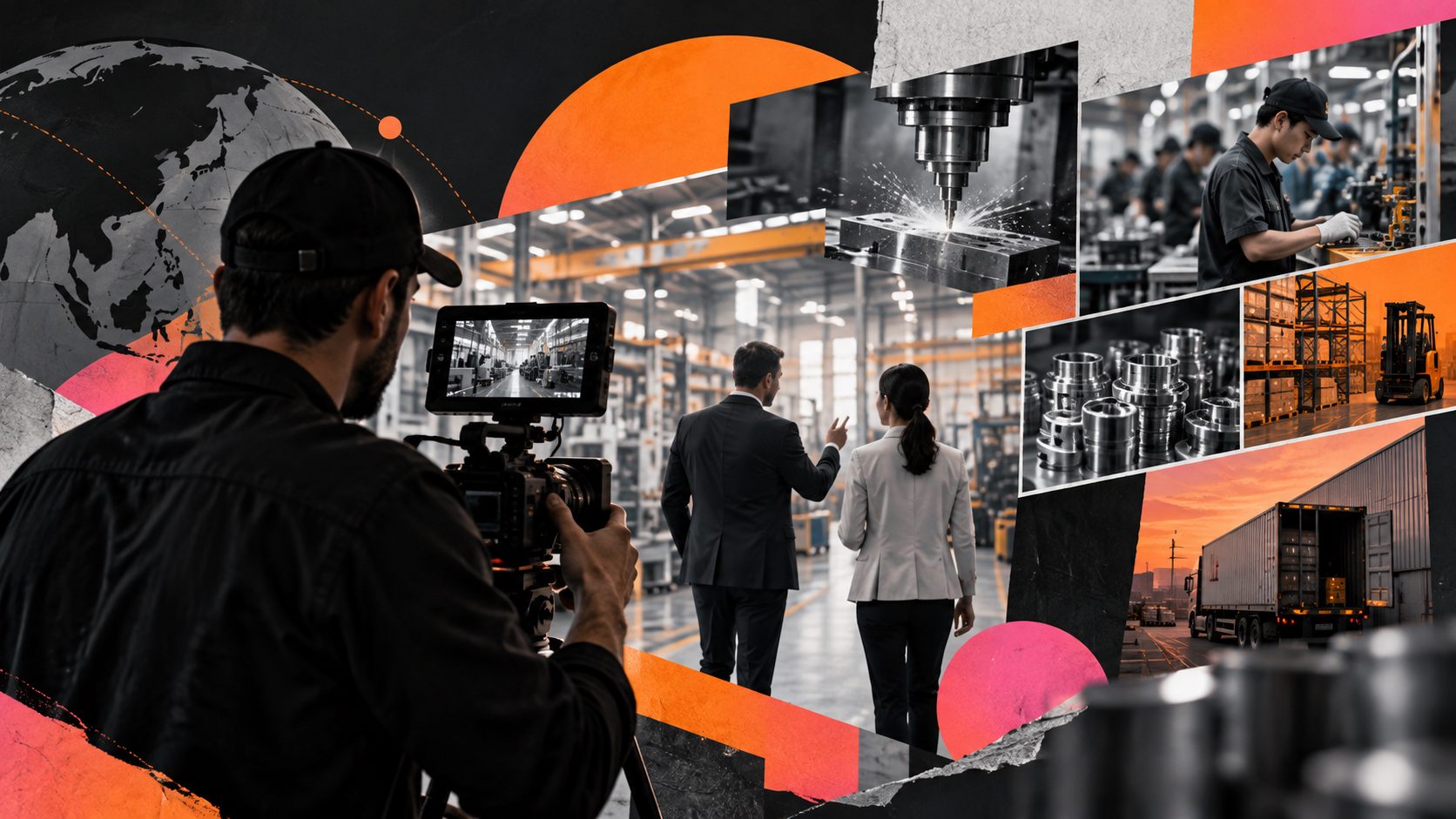
The following framework is designed for a short video of approximately 45–90 seconds. Each shot has a specific role in the buyer’s evaluation process.
1. Establish the facility and product scope
Open with the factory exterior, entrance, production area, or a clear interior wide shot. Add a short text overlay identifying the facility’s product category and manufacturing role, such as OEM, ODM, assembly, or component production.
Avoid unsupported superlatives such as “world-class” or “number one.” Let the facility, equipment, and products provide the initial evidence.
2. Show the process, not just the premises
Move quickly from the wide shot to active production. Capture material preparation, machine operation, assembly, or finishing work.
The key is sequence. Buyers should be able to understand what happens before and after the moment shown. If the process is complex, use short clip-by-clip edits rather than one continuous camera movement.
3. Make quality control visible
Quality assurance is often the most important missing section in factory videos. Show operators checking dimensions, appearance, function, fit, or packaging—provided the footage accurately represents the supplier’s real process.
Do not add invented inspection numbers or certification claims. Instead, use precise labels such as “surface inspection,” “assembly check,” or “pre-shipment review” when those actions are genuinely visible.
This section transforms the video from a facility showcase into a supplier-evaluation tool.
4. Connect the factory to the actual product
Insert product images or close-up shots between process clips. Buyers need to see the relationship between the machinery and the finished SKU.
If the original footage is incomplete, AdsTurbo Product Image can work from a JPG or PNG product photo. Clear product photos on a plain-color background generally provide the best starting material. Product visuals can be generated in formats suited to Amazon, Shopify, TikTok Shop, and Instagram, including nine output aspect ratios.
For a broader content workflow, a wholesale product catalog to video workflow can help turn multiple SKUs into buyer-facing product explainers rather than leaving the factory tour disconnected from the catalog.
5. Show packing, warehouse, or dispatch readiness
Packaging footage answers practical questions that production shots cannot. Show cartons, labeling, pallet organization, finished-goods handling, or the movement from inspection to storage.
Do not imply shipment volume or capacity unless the video can substantiate it. A small, clear sequence of organized handling is more useful than a dramatic warehouse shot with no explanation.
6. End with a buyer-specific next step
The final frame should tell the viewer what information to send or request. Examples include:
- Product specification and target market
- Estimated order quantity
- Customization requirements
- Required testing or compliance documents
- Sample and quotation request
A buyer CTA is stronger than “Contact us today” because it defines the next commercial action.
How to create the video from limited factory footage
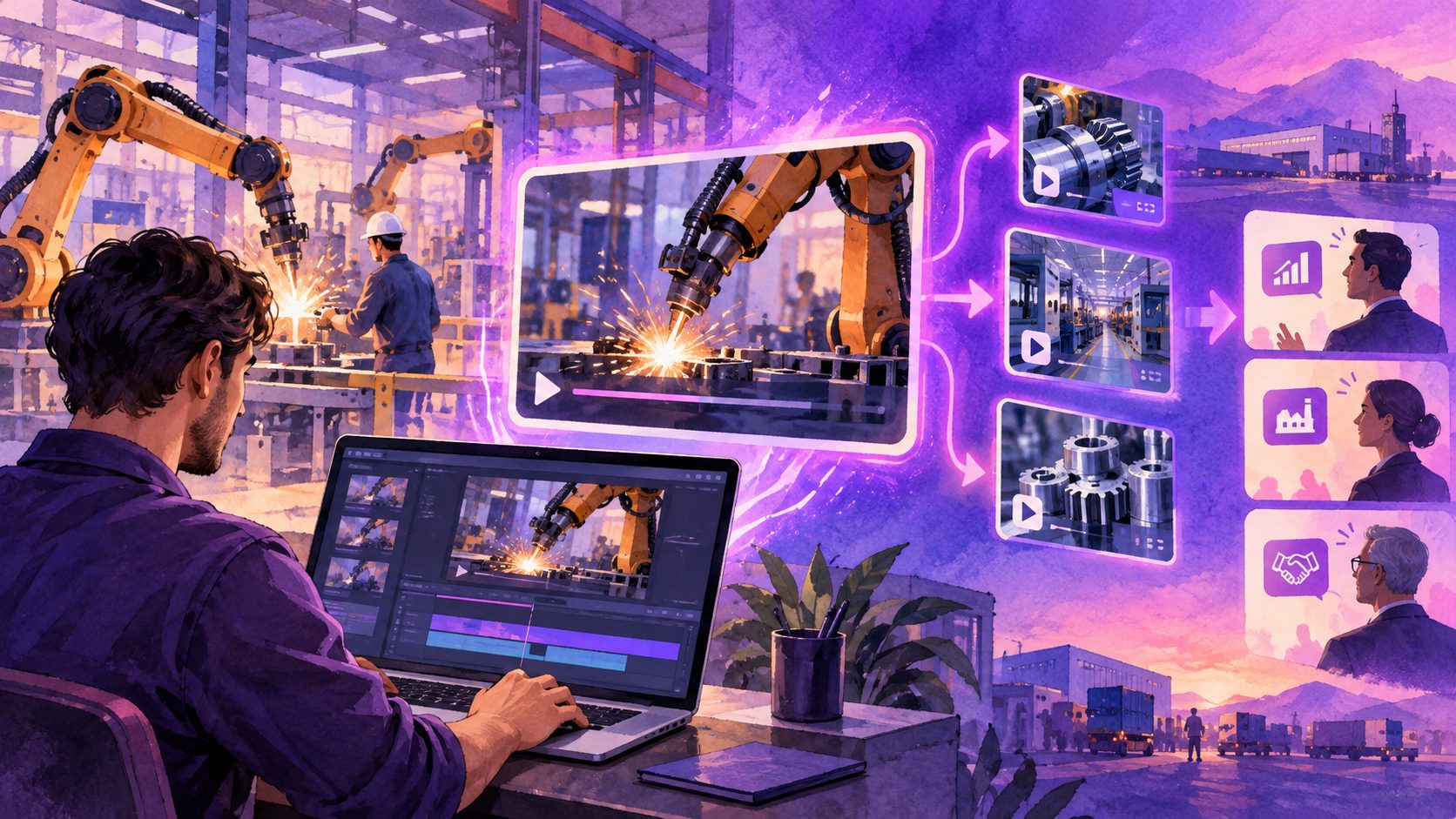
Many suppliers do not have a professionally filmed tour. They may only have phone clips, inspection photos, product images, or an older corporate video. That does not automatically prevent a useful buyer video.
Use this production order:
- Collect evidence: exterior, production, inspection, product, packing, and warehouse clips.
- Sort by buyer question: capability, process, quality, product fit, and shipment readiness.
- Trim each clip: remove dead time and keep only moments that communicate an action.
- Add product visuals: use clear JPG or PNG images to identify the finished item.
- Add captions: label what is happening without making claims the footage cannot prove.
- Create language versions: translate subtitles or voice tracks for target markets.
- Export platform variants: prepare a landscape version for sales pages and a vertical cut for social discovery.
AdsTurbo supports clip-by-clip editing, product video generation, video subtitles, translation, background replacement, and AI upscaling. Its Video Subtitle workflow can transcribe speech, create time-synced captions, and export either a subtitled video or a separate subtitle file. For cross-border sourcing, ecommerce video translation and localization can help adapt the same factory evidence for different buyer regions.
If the source footage is soft or heavily compressed, use a before-and-after review rather than assuming enhancement will fix every problem. Upscaling can improve legibility, but it cannot recreate missing inspection detail or prove an undocumented process. AdsTurbo’s AI video upscaling workflow is most useful when the underlying footage already contains meaningful visual evidence.
A practical buyer-video checklist
Before publishing, verify the following:
- The facility shown is the facility connected to the quotation.
- The product in the video matches the product being offered.
- Inspection footage is authentic and not presented as a universal standard if it is only an example.
- Sensitive customer names, labels, documents, and confidential production details are hidden.
- Text overlays use measurable, supportable language.
- The first ten seconds explain what the buyer is about to see.
- Subtitles remain readable on mobile screens.
- The final CTA requests useful buyer information.
- The video has both a sales-page version and a short social version.
A useful editorial test is simple: Can a procurement manager write three informed follow-up questions after watching the video? If not, the video is probably showing activity without communicating evidence.
Common questions about factory tour videos
Should a factory tour video be polished or documentary-style?
It should be technically clear but operationally credible. Good audio, stable framing, readable captions, and clean editing matter. Excessive staging, stock footage, or unsupported claims can make the video feel less trustworthy.
How long should a B2B factory tour video be?
A focused overview often works well at 45–90 seconds. A longer version can support sales conversations, supplier pages, or trade-show follow-up. The right length depends on how many buyer questions the video must answer, not on a fixed duration.
Can product images replace missing factory footage?
Product images can clarify the output, but they cannot replace process evidence. Use them to connect production scenes to the actual SKU, not to imply that a photographed product was filmed inside the facility.
Should the video include prices and minimum order quantities?
Only when those details are stable and intentionally published. Otherwise, use the video to explain the production capability and direct buyers to request current commercial terms.
Can one factory tour serve multiple countries?
Yes, if the visual evidence remains the same while subtitles, voiceover, CTA language, and product emphasis are localized. AdsTurbo supports multilingual video translation and subtitle workflows for adapting a core factory asset to different markets.
Final takeaway
A buyer-ready factory tour is not a moving company brochure. It is a compact evidence chain: facility, process, inspection, product, packing, and next step.
When every shot answers a sourcing question, even modest footage can support serious B2B conversations. Combine real workshop clips with accurate product imagery, readable subtitles, and localized versions, then use the same evidence across sales pages, email follow-ups, and short-form discovery content.