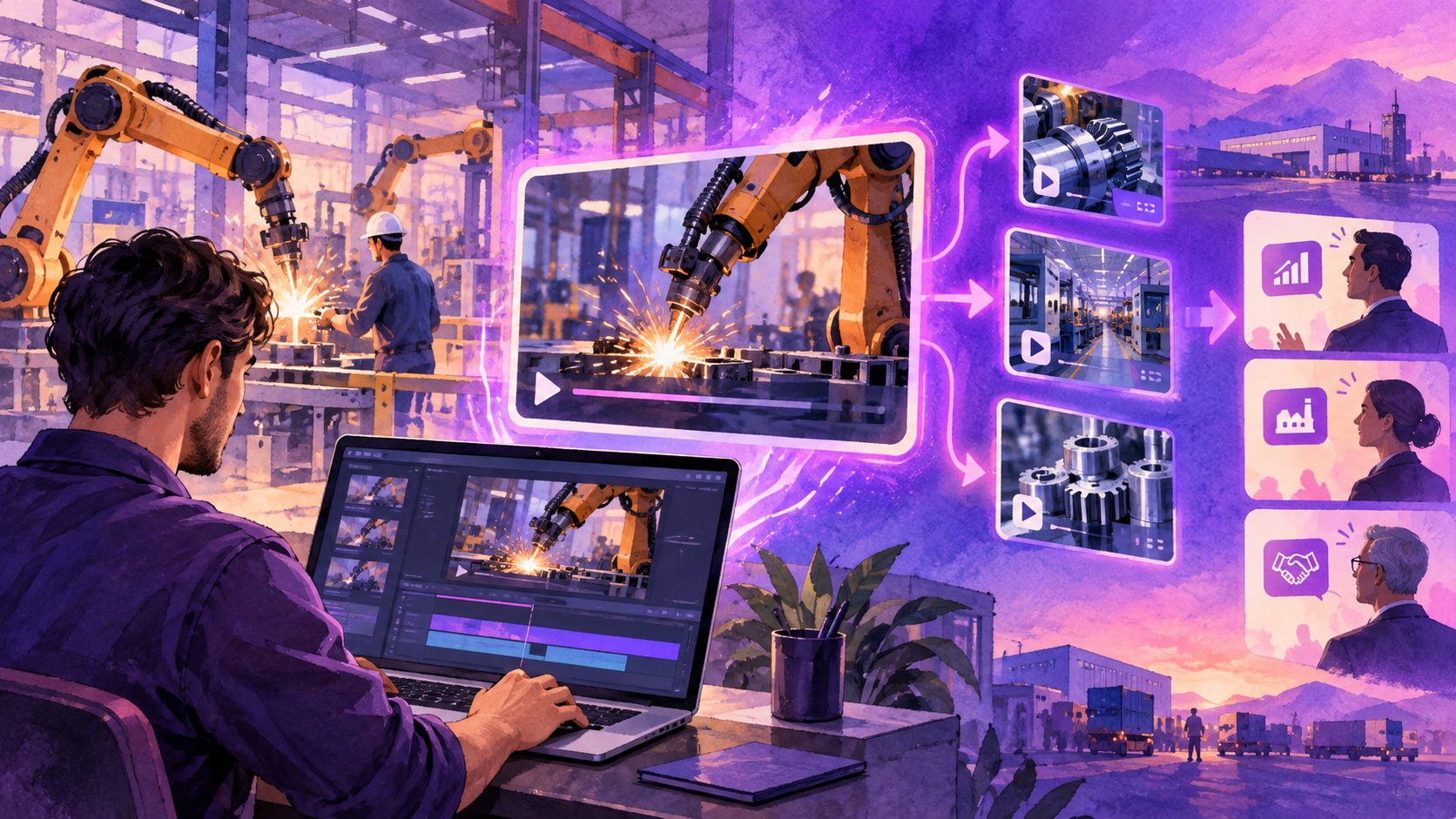
B2B Sample Lead Time and Air Freight Tracking Video: A Practical Guide


Summarize with
Summary
Learn how to turn B2B sample lead times and air freight tracking milestones into clear video ads that build buyer confidence. Plan your workflow with AdsTurbo.
By adsturbo.ai | Published 2026-11-04 | Updated 2026-11-04
A B2B sample lead time and air freight tracking video turns an abstract promise—“fast delivery”—into a visible sequence buyers can understand. For exporters, manufacturers, and cross-border suppliers, the strongest version connects sample approval, production, pickup, airport handling, customs, and final delivery in one concise story.
What is a B2B sample lead time and air freight tracking video?
A B2B sample lead time and air freight tracking video is a short visual explanation of how long a sample order takes and what happens during international transportation. It combines a production timeline with shipment milestones, rather than showing only a warehouse, aircraft, or tracking number.
The goal is not to promise an exact arrival date without evidence. The goal is to show which events influence delivery, what has been completed, and what the buyer should expect next.
A useful video usually covers:
- Sample request and specification confirmation
- Prototype or sample production
- Quality check and packing
- Factory pickup
- Export documentation and airport acceptance
- Security screening and flight departure
- Import customs clearance
- Local delivery and proof of delivery
International air cargo typically involves quotation, booking, cargo preparation, pickup, airport acceptance, security screening, export procedures, flight transport, import clearance, and final delivery. The exact steps depend on the route, cargo, and booked service. (icontainers.com)
Why should suppliers visualize sample lead time?
B2B buyers often evaluate more than product quality. They also assess whether a supplier can communicate clearly, manage deadlines, and reduce uncertainty before a larger purchase order.
A written lead-time statement can be misunderstood because it may combine several different clocks:
| Timeline component | What the buyer needs to know |
|---|---|
| Sample production | When specifications are confirmed and work begins |
| Internal review | Whether revisions or approval are required |
| Dispatch preparation | When packing and documents are completed |
| Air freight | Which transportation milestones are visible |
| Customs and delivery | What happens after landing |
| Exceptions | What may change the expected schedule |
This distinction matters because sample production time is not the same as transit time. A supplier that separates the two appears more credible than one that gives a single vague number.
Air freight can be fast, but airport handling, customs, documentation, and local delivery still affect the door-to-door result. For example, an IATA logistics illustration separates pickup, consolidation, terminal customs, air transport, and inland legs instead of treating the entire route as one movement. (iata.org)
What should the video timeline include?
The most persuasive structure is an event-based timeline. Each scene should answer one buyer question: What happened, what is happening now, and what happens next?
1. Start with the commercial promise
Open with a specific, verifiable message such as:
“From approved sample to international dispatch: a step-by-step view of our fulfillment process.”
Avoid unsupported claims such as “guaranteed delivery” or “fastest supplier.” Use the actual sample schedule, service level, or milestone data available to your sales team.
2. Show sample production separately
Use a short sequence for:
- Requirement confirmation
- Material or component preparation
- Sample assembly
- Inspection and approval
- Packing for dispatch
This section is especially important for custom products. A buyer needs to see when the lead time starts. If the clock begins after artwork approval, payment, or specification confirmation, show that condition on screen.
3. Convert tracking data into simple milestones
Do not place a dense tracking dashboard on screen for the entire video. Translate operational events into buyer-friendly labels:
- Picked up from factory
- Export documents submitted
- Accepted at origin airport
- Departed origin
- Arrived at destination
- Customs processing
- Out for delivery
- Delivered
A logistics video should explain status meaning, not merely display status codes. Tracking visibility is increasingly important in air freight because shippers want early warnings when a planned process changes. (igaircargo.ch)
4. End with the next action
The final scene should tell the viewer what to do:
- Request a sample quotation
- Confirm product specifications
- Ask for a shipping estimate
- Submit a purchase order
- Contact the supplier for the next milestone
For B2B audiences, a clear CTA is usually more effective than a generic “Learn more.”
How to turn operational data into a video script
A practical script can follow a five-column planning model:
| Scene | On-screen visual | Voiceover idea | Data required | Buyer question answered |
|---|---|---|---|---|
| 1 | Product and order summary | “Your sample journey starts after approval.” | Product name, approval condition | When does the clock start? |
| 2 | Factory or production visual | “The sample enters production and inspection.” | Production stage | What is happening now? |
| 3 | Package and airway bill | “The shipment is packed and prepared for export.” | Dispatch date, tracking reference | Has it left the factory? |
| 4 | Animated route map | “The shipment moves through origin handling and air transport.” | Origin, destination, milestone labels | Where is it? |
| 5 | Delivery confirmation | “The sample reaches the receiving location for review.” | Delivery event, next step | What should I do next? |
This framework is an original operational distinction: separate “elapsed time,” “remaining process,” and “exception risk.” Many logistics videos show only elapsed time. A stronger B2B video also marks whether the next step depends on buyer approval, customs processing, or carrier movement.
How to produce the video efficiently
Start with a clean product image, a route or process diagram, and verified milestone text. A supplier does not need a large film crew to create the first version.
A practical production workflow is:
- Collect the product image, sample timeline, route, and tracking events.
- Remove ambiguous internal codes and replace them with plain-language labels.
- Choose one format for the main use case: 16:9 for sales presentations, 1:1 for LinkedIn or catalog pages, or 9:16 for short-form social content.
- Use a visual hierarchy: product first, timeline second, status third, CTA last.
- Add subtitles so the video works without sound.
- Create separate versions for different routes, products, or buyer regions.
- Review every date, status, location, and promise before publishing.
AdsTurbo supports product video generation from JPG or PNG product images, as well as video subtitles, translation, AI upscaling, background replacement, and clip-by-clip editing. Its subtitle tool can generate synchronized captions and export either a captioned video or a separate subtitle file. That makes one approved logistics script easier to adapt for sales teams and regional campaigns.
For related production ideas, see this guide to turning product screenshots into testable video ads and this CAD-to-video ecommerce workflow.
How can suppliers avoid misleading delivery claims?
A trustworthy logistics video distinguishes between planned lead time and guaranteed delivery.
Use language such as:
- “Typical sample production sequence”
- “Estimated transit window”
- “Milestones may vary by route and customs”
- “Tracking updates depend on carrier and handling partners”
- “Final delivery timing is subject to clearance and local transport”
Avoid showing a fixed arrival date unless the underlying service genuinely supports that commitment. Also avoid implying that an aircraft journey represents the full door-to-door timeline. Pickup, export handling, destination clearance, and local delivery may all sit outside the flight itself.
The best video is transparent about uncertainty without making the process sound uncontrolled.
Common questions
What is the ideal length for this type of video?
For a sales follow-up or product page, aim for roughly 30–60 seconds. Use a longer version when explaining a complex sample approval process or multiple shipping routes.
Should the video show a real tracking number?
Only if the shipment data can be shared safely. Otherwise, use a demonstration reference or generalized milestone labels. Never expose confidential customer, supplier, or commercial information.
Can the same video support multiple markets?
Yes. Keep the core timeline consistent, then create localized versions with translated voiceover, subtitles, currencies, date formats, and destination-specific terms. AdsTurbo supports video translation and subtitle localization for this type of adaptation.
What if the sample lead time changes?
Update the affected scene instead of rebuilding the entire concept. A modular, clip-by-clip structure makes it easier to replace one timeline segment, route label, or CTA.
Can the workflow be automated?
AdsTurbo tasks run asynchronously and support status polling or Webhook callbacks for completion events. Its API includes modules for image generation, Persona, AI actors, ad cloning, video generation, and task processing. Higher-tier plans support team workflows, API access, and custom workflows.
Final takeaway
A B2B sample lead time and air freight tracking video should do more than make shipping look fast. It should make the process understandable, checkable, and commercially useful.
Show when the lead-time clock begins. Separate production from transportation. Translate tracking events into plain language. Mark uncertainty honestly. Then connect the final delivery milestone to a clear sales action.
For suppliers building repeatable product and logistics creative, explore AdsTurbo to combine product visuals, subtitles, localization, and reusable video workflows.