


By adsturbo.ai | Published 2026-09-22 | Updated 2026-09-22
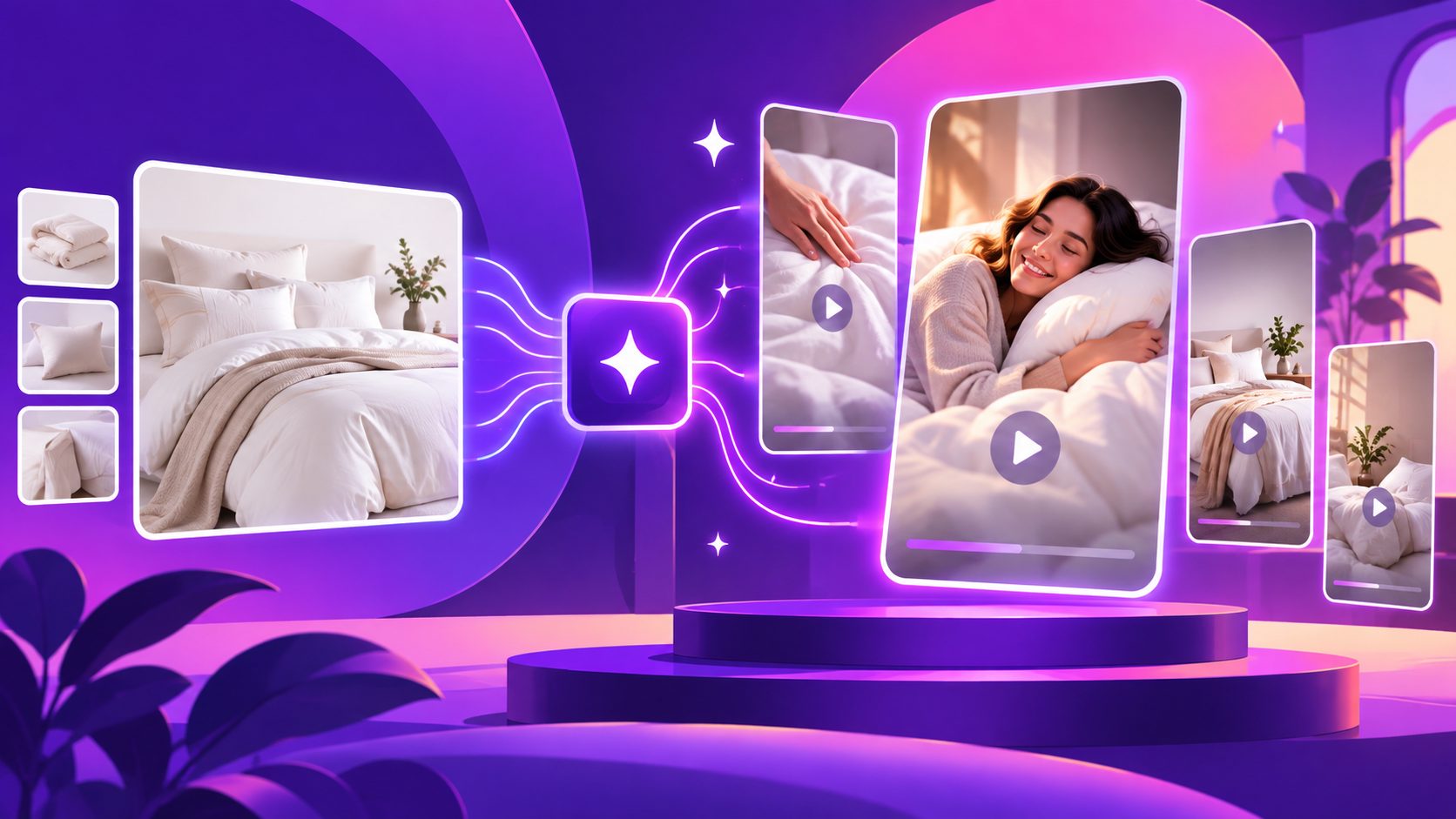
A bedding video ads generator ai workflow can turn a single JPG or PNG product image into a short-form creative designed for TikTok, Instagram Reels, YouTube Shorts, Shopify, or paid social. The strongest bedding ads do more than rotate a flat-lay image: they make shoppers notice drape, softness, breathability, texture, and the visual change a new bedding set creates in a room.
For DTC bedding brands, the challenge is not simply producing a video. It is translating tactile product benefits into visual proof without making claims the image cannot support.
What is an AI bedding video ad generator?
An AI bedding video ad generator is a workflow that transforms product assets and selling points into short marketing videos without requiring a traditional photo shoot. Typical inputs include a product image, product name, key benefits, promotion, reference video, or optional script.
Most ecommerce video tools follow a simple pattern: upload a product asset, choose a creative style and aspect ratio, then generate a short video for testing. Current product-video platforms commonly support product showcases, UGC-style formats, lifestyle scenes, and vertical social outputs. (highreach.ai)
For bedding, however, a generic product showcase is rarely enough. A good creative should answer visual questions such as:
- Does the fabric fall naturally over the mattress?
- Does the set look breathable rather than heavy?
- Can shoppers see the weave, sheen, quilting, or surface texture?
- Does the product look suitable for a real bedroom?
- Is the difference between the “before” and “after” immediately clear?
That is why bedding creatives benefit from a product-first workflow rather than a purely cinematic one.
Which bedding benefits should the video demonstrate?
The best bedding ads map each selling point to a visible action. This prevents the video from becoming a sequence of attractive bedroom shots with no product evidence.
| Bedding benefit | Visual proof to request | Suitable creative angle |
|---|---|---|
| Soft appearance | Close-up of fabric folds, pillow compression, or hand movement | “The first thing you notice when you get into bed” |
| Draping quality | Duvet or sheet falling over the mattress edge | “See how it lays instead of bunching” |
| Breathability | Light, airy bedroom styling and relaxed summer use | “A cooler-looking setup for warm nights” |
| Smooth texture | Controlled macro detail and slow camera movement | “A cleaner, more polished bedroom finish” |
| Easy styling | Before-and-after bed makeover | “Refresh the room in seconds” |
| Color or pattern | Natural daylight, neutral surroundings, and detail shots | “A simple way to update the space” |
Avoid turning a visual impression into an unsupported performance claim. For example, a light-colored, loosely styled bed can communicate an airy feel, but it does not prove a specific temperature rating or clinical benefit.
The Fabric Proof Ladder: a better framework for bedding ads
A useful original framework for bedding creative is the Fabric Proof Ladder. Each level adds a different type of buyer confidence, moving from recognition to sensory imagination.
1. Recognition
Show the complete product clearly within the first seconds. Use the original color, pattern, and silhouette. This is where a clean product image matters most.
2. Behavior
Show what the bedding does when handled: unfolding, spreading, smoothing, folding, or being placed on the bed. Movement gives the shopper a reason to look at the fabric rather than only the room.
3. Texture
Use a closer shot to communicate surface detail. The goal is not to invent fibers or weave patterns, but to make the existing product appearance easier to inspect.
4. Outcome
Finish with the styled bed, the offer, and a direct next step. This connects the tactile impression to the shopping decision.
This ladder is more practical than asking for a generic “luxury bedding video” because every shot has a job. It also creates a repeatable structure for testing different hooks without changing the core product evidence.
How to create a bedding UGC ad from a product photo
Follow this five-step production workflow.
-
Prepare the source image.
Upload a clear JPG or PNG product image. A product photo on a plain or solid-color background generally gives the Product Image workflow the clearest visual reference. If the item is a sheet set, duvet cover, comforter, or pillowcase, make sure the main color and pattern are visible. -
Choose one primary buyer promise.
Do not combine “cooling,” “hotel-like,” “wrinkle-resistant,” “hypoallergenic,” and “luxury” in one short clip unless each claim can be supported. Start with one angle, such as softer-looking texture, easier room styling, or a more inviting bed. -
Build a three-beat storyboard.
Use a simple structure: problem or visual contrast, product behavior, then finished bedroom and CTA. A 12–20 second version can often be planned as three to five shots. -
Add captions and platform framing.
Captions should carry the message even when sound is off. AdsTurbo Video Subtitle can automatically transcribe speech, create time-synced captions, and export either a video with embedded subtitles or a separate subtitle file. Its subtitle layouts are designed for short-form environments such as TikTok, Instagram Reels, and YouTube Shorts. -
Export multiple versions for testing.
Change one variable at a time: opening line, room style, presenter, offer, or close-up sequence. This creates a more useful testing set than producing several videos with unrelated changes.
For a broader photo-to-video workflow, see this guide to turning product photos into video ads.
Three bedding ad concepts worth testing
The “bare bed to finished room” reveal
Start with an unmade or minimally styled bed. Show the bedding being placed, smoothed, or arranged, then reveal the finished room. This is effective when the product’s strongest value is visual transformation.
Hook example: “The fastest way to make the bedroom feel finished.”
The “close-up texture” review
Use a creator-style voiceover or captions while alternating between the full product and detail shots. Focus on what shoppers can observe: surface appearance, fall, color, and styling.
Hook example: “Before you buy bedding online, look at how it falls.”
The “one set, three bedroom moods” variation
Create three versions using different room treatments: minimal neutral, warm and layered, or bright and seasonal. Keep the bedding consistent while changing the environment and opening hook.
This approach is useful for testing different customer segments without replacing the product asset.
AdsTurbo can also support AI camera movement for product videos, helping you plan slower detail shots, room reveals, and product-led motion instead of relying on a static slideshow.
How to test bedding video creatives without wasting budget
A practical test matrix should separate creative angle from production variation.
| Test variable | Version A | Version B |
|---|---|---|
| Opening | Before-and-after reveal | Close-up texture |
| Voice | Calm product explanation | Direct UGC recommendation |
| Visual setting | Bright bedroom | Warm evening bedroom |
| CTA | Shop the set | See the available colors |
| Text emphasis | Soft-looking finish | Room transformation |
Run the first test with the same offer and landing page. Otherwise, it becomes difficult to tell whether performance changed because of the video or the promotion.
For DTC teams, a useful operating rhythm is to create one core product story, then produce several controlled variations. AdsTurbo supports product video generation, ad cloning, character replacement, motion control, translation, upscaling, and subtitles. Its asynchronous generation model also supports status polling or Webhook callbacks, which can help teams connect creative production to a larger workflow.
For performance measurement, compare thumb-stop rate, three-second view rate, average watch time, click-through rate, and conversion rate. A video with a strong opening but weak product-page conversion may need a clearer offer or more accurate expectation-setting rather than another visual effect.
Common mistakes in AI bedding ads
Making the bedroom more prominent than the product
A beautiful room can attract attention while leaving shoppers unsure what is being sold. Keep the bedding visible in the first frame or make the transition to the product unmistakable.
Showing impossible fabric behavior
Overly dramatic waves, floating sheets, or inconsistent patterns reduce trust. Use restrained movement and preserve the product’s actual color, shape, and design.
Using vague sensory language
Words such as “soft,” “cool,” or “silky” should be connected to observable details or verified product specifications. Do not let captions promise what the source material cannot establish.
Ignoring mobile readability
Small captions, low contrast, and long sentences disappear on vertical screens. Keep each caption short, high contrast, and timed to the shot it explains.
Frequently asked questions
Can I create a bedding ad from one product photo?
Yes. A single clear JPG or PNG product image can serve as the starting asset for a product video workflow. Additional product information, selling points, or a reference video can improve the creative direction.
What is the best format for bedding social ads?
Vertical 9:16 is usually the most practical starting format for TikTok, Instagram Reels, and YouTube Shorts. Create square or landscape versions when the same campaign also needs feed placements, product pages, or display environments.
Should a bedding ad use an AI presenter?
An AI presenter can help explain features or deliver a review-style script, but it should not replace product evidence. Pair the presenter with close-ups, bed styling, and clear product shots.
How can I localize bedding ads for different markets?
Use translated voiceover and subtitles while keeping the product visuals consistent. AdsTurbo supports video translation, subtitle generation, and multiple creative workflows for producing localized variants.
What should the final CTA say?
Use a CTA that matches the landing page, such as “Shop the set,” “See the color options,” or “View the full bedding collection.” Avoid a generic CTA if the video highlights a specific promotion or product bundle.