Earbuds Call Noise Cancellation Wind Noise Comparison Video Ad

Summarize with
Summary
Learn how to produce an earbuds call noise cancellation wind noise comparison video ad with clear audio proof, visual waveforms, and platform-ready ad variations.
By adsturbo.ai | Published 2026-10-31 | Updated 2026-10-31
An earbuds call noise cancellation wind noise comparison video ad should prove one specific buying benefit: whether the listener can understand the speaker when wind and background noise are present. The strongest creative does not rely on a generic “noise-canceling” claim. It shows the same sentence, the same environment, and the same visual or audio evidence before and after processing.
What makes wind-noise call testing different from ANC testing?
Wind-noise call testing measures what the person on the other end hears, while ANC testing usually measures what the earbud wearer hears. These are related but different experiences.
Active noise cancellation can make music or nearby traffic quieter for the wearer. Call noise reduction must also protect the microphone signal, preserve speech intelligibility, and avoid cutting off syllables. Independent testing sources commonly separate microphone performance from listening performance, using quiet rooms, loud environments, reverberant spaces, and simulated or real wind conditions. (rtings.com)
For ecommerce advertising, this distinction creates a useful opening:
- Listener-side proof: “Can I hear my caller?”
- Caller-side proof: “Can the other person hear me?”
- Wind-resistance proof: “Does speech remain understandable outdoors?”
- Consistency proof: “Does the result hold across multiple conditions?”
A comparison ad should prioritize the caller-side result. That is the benefit most shoppers cannot judge from a product photograph or a conventional music demo.
How should the comparison video be structured?
A clear comparison video can be built around a 30–45 second proof sequence. Each section should answer one question and use the same voice line so viewers can compare the result without guessing.
Recommended storyboard
-
Hook: 0–3 seconds
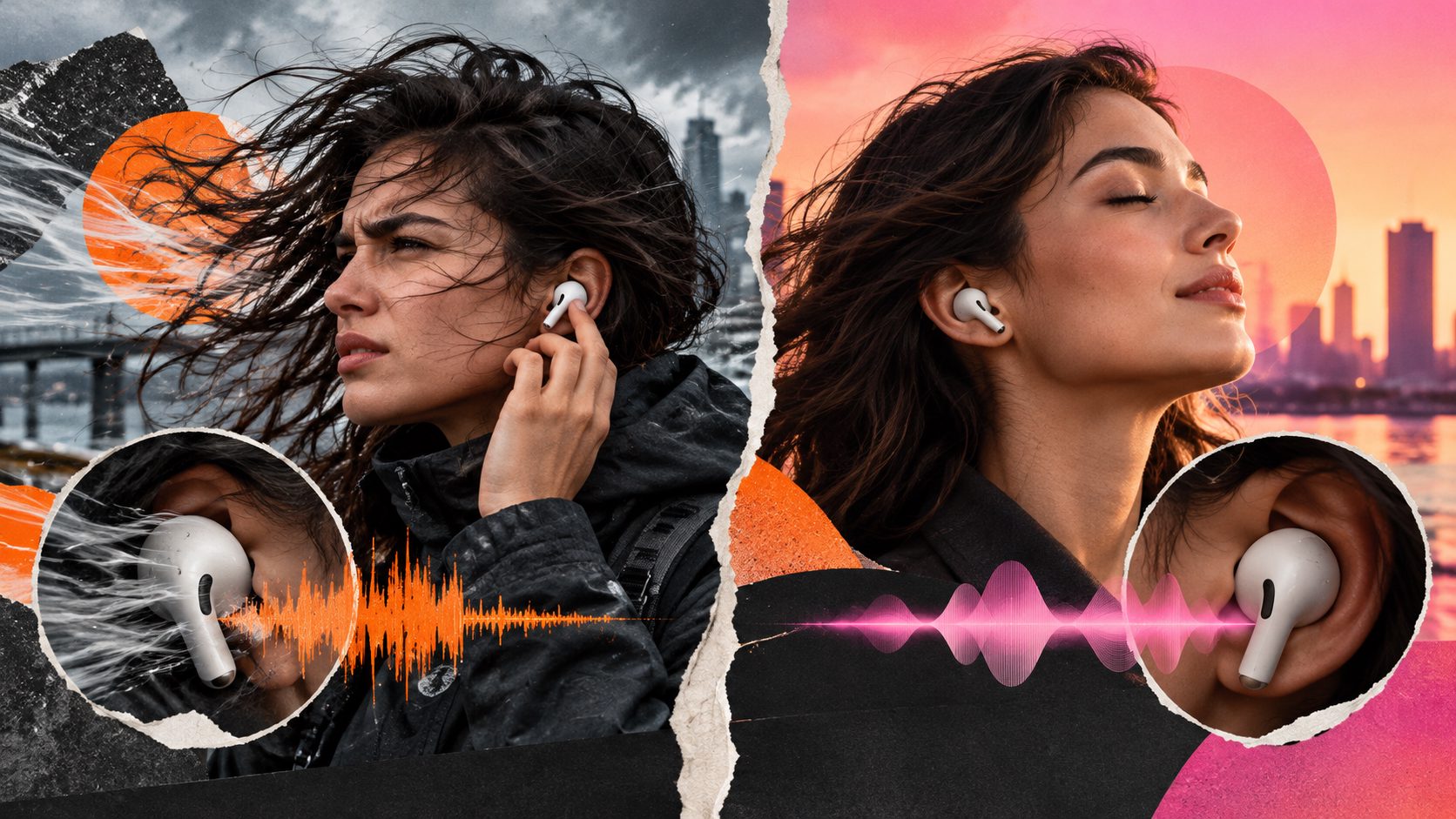
Show a person outdoors with visible wind movement. Add a direct question such as: “Can they still hear you in the wind?” -
Test setup: 3–7 seconds
Display the two earbuds or two test modes side by side. Keep the camera angle, speaker distance, and voice line consistent. -
Quiet baseline: 7–13 seconds
Play the same sentence in a quiet room. This establishes how the speaker sounds before environmental stress is introduced. -
Light wind: 13–20 seconds
Add airflow from one direction. Show the original recording and the comparison recording in alternating cuts. -
Strong wind or street noise: 20–30 seconds
Use a controlled outdoor take or a repeatable fan setup. Avoid switching microphones, speakers, or distances between takes. -
Audio verdict: 30–38 seconds
Highlight the words that remain understandable. Use a waveform, caption, or short transcript rather than a vague “better sound” label. -
CTA: 38–45 seconds
End with the product, a concise benefit, and the intended action: “Compare call clarity before you buy.”
This structure is more persuasive than opening with specifications because it makes the viewer hear the claimed advantage before asking for a click.
Which audio visualizations help shoppers understand the result?
Audio visualizations should clarify speech, not decorate the screen. The most useful approach is a three-layer comparison: raw audio, speech transcript, and a simple signal display.
| Visualization | What it communicates | Best use |
|---|---|---|
| Waveform | Changes in overall amplitude | Showing sudden wind bursts |
| Spectrogram | Frequency distribution over time | Demonstrating low-frequency rumble or high-frequency hiss |
| Live captions | Whether words remain intelligible | Showing practical call clarity |
| Speaker labels | Which recording is playing | Preventing left/right confusion |
| A/B meter | Relative speech-to-noise contrast | Creating a fast visual verdict |
Do not imply that a larger waveform automatically means better call quality. Wind can produce a large waveform while making speech harder to understand. A better editorial cue is to highlight the speech band, show synchronized captions, and let the viewer compare the same phrase.
A useful original framework is the W.I.N.D. proof model:
- W — Words: Are the key words understandable?
- I — Identity: Is the same speaker and sentence used?
- N — Noise exposure: Is the wind condition visible and repeatable?
- D — Decision: Can the viewer tell which result is preferable?
This framework turns an audio test into a visual shopping argument.
What should the test method include?
A credible earbuds microphone comparison needs repeatable conditions. Record at least three takes per condition and use one fixed sentence, such as a short product-support message. Keep the following variables consistent:
- Speaker-to-camera distance
- Earbud position and fit
- Phone or recording device
- Wind direction
- Approximate wind intensity
- Background location
- Voice volume and speaking pace
- Editing level applied to each sample
The important comparison is not necessarily a laboratory decibel score. It is whether a viewer can identify the sentence without replaying it several times.
For a stronger ad, label the conditions honestly: “quiet room,” “light outdoor wind,” or “street background.” Avoid presenting a fan indoors as identical to natural wind. The airflow pattern, reflections, and microphone exposure can differ significantly.
Reviewers and testing labs also warn that loud environments can trigger aggressive noise gates, causing parts of a voice to become quieter or less intelligible. (rtings.com) That is why a good ad should include both the raw sample and the edited comparison, rather than presenting only a polished voiceover.
How can ecommerce sellers turn one test into multiple ads?
One controlled comparison can produce a full creative test set. Start with the same master footage, then create variants around different buyer concerns:
- Outdoor caller angle: “Take calls while walking.”
- Travel angle: “Stay understandable near traffic.”
- Work angle: “Make clearer calls away from your desk.”
- Proof angle: “Hear the same sentence in quiet and wind.”
- Feature angle: “Voice-focused noise reduction for calls.”
Use different opening hooks while preserving the evidence section. This isolates the effect of the hook, caption, or CTA instead of changing the entire video at once.
AdsTurbo can support this production workflow with product video generation, Ad Clone, video subtitles, video translation, AI upscaling, background replacement, and clip-by-clip editing. Its Ad Clone workflow can analyze a reference video of up to 12 seconds and generate advertising variations while preserving the reference structure, pacing, shot logic, and CTA pattern. For a practical proof-led workflow, see the guide on turning product photos into video ads.
For cross-border campaigns, subtitles and voice localization should be treated as separate tests. Keep the demonstration unchanged, then vary the language, on-screen claim, and opening line. AdsTurbo Video Subtitle can automatically transcribe speech, create synchronized captions, and export either a subtitled video or a separate subtitle file.
How should the final ad be adapted for TikTok, Reels, and Shorts?
Short-form platforms reward immediate context. Put the test condition in the first frame instead of hiding it behind a long introduction.
Recommended formatting:
- 9:16: Use a stacked comparison with large captions.
- 1:1: Place the product and test condition at the top, with the transcript below.
- 16:9: Use side-by-side footage and larger waveform space.
- Keep captions inside safe areas.
- Use one claim per scene.
- Make the audio comparison loud enough for mobile playback without clipping.
- Add a written verdict for viewers watching without sound.
AdsTurbo Event Poster can also create supporting campaign visuals from JPG or PNG logos, product images, or brand assets. It supports nine aspect ratios and multilingual poster copy, which is useful for matching the comparison video with launch, retargeting, or promotional creative.
For a broader proof-first approach to ecommerce demonstrations, the waterproof demonstration video ad guide shows how to organize visible test conditions, comparison moments, and trust-building claims.
Common questions about earbuds wind-noise comparison ads
Is ANC the same as call noise cancellation?
No. ANC mainly affects what the wearer hears. Call noise cancellation focuses on how clearly the microphone captures and transmits the speaker’s voice to another person.
Should the ad show decibel measurements?
Only if the measurement method is consistent and understandable. For most ecommerce ads, synchronized speech samples and clear condition labels are more persuasive than unexplained numbers.
How many conditions should one video include?
Three conditions are usually enough for a short ad: quiet baseline, light wind, and stronger wind or street noise. More conditions can be used in a longer product page video.
Can AI create the full comparison ad?
AI can help generate product scenes, captions, localized versions, and creative variations. The actual performance claim should still come from authentic, consistently recorded test material.
What is the strongest CTA?
Use a CTA connected to the evidence: “Hear the difference,” “Compare call clarity,” or “See the outdoor call test.” Link the ad to a product page that explains the test setup.
Final checklist
Before publishing, confirm that the video:
- Uses the same sentence in every comparison.
- Identifies each test condition.
- Separates wearer-side ANC from caller-side microphone quality.
- Shows captions or another intelligibility cue.
- Avoids unsupported absolute claims such as “zero wind noise.”
- Includes versions for the intended platform ratio.
- Keeps the product visible without covering the proof.
- Creates at least two hook variants for testing.
A successful earbuds call noise cancellation wind noise comparison video ad makes the benefit audible, visible, and repeatable. That combination gives shoppers a reason to trust the demonstration instead of relying on a generic noise-cancellation label.