Garden Resin Shed Video Ad: Show Assembly, Weather Protection, and Storage

Summarize with
Summary
Learn how to create a garden resin shed video ad that demonstrates assembly, rain protection, and real storage use. Get a practical script and production framework.
By adsturbo.ai | Published 2026-11-14 | Updated 2026-11-14
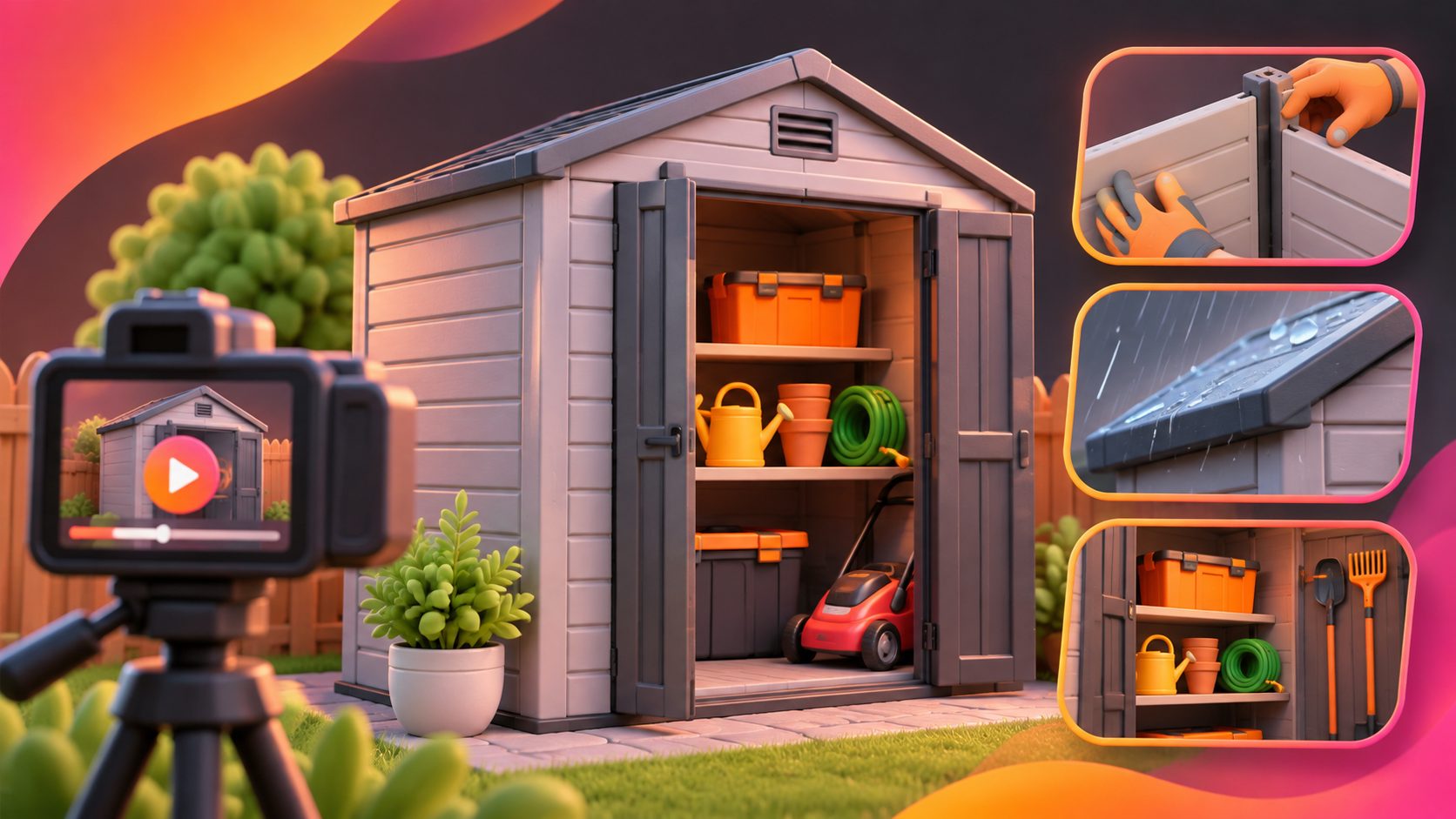
A garden resin shed video ad should do more than show an attractive shed in a backyard. It should answer the buyer’s practical questions quickly: How difficult is assembly? What can it store? How does it handle rain? Can one person access the doors and organize equipment easily?
The strongest creative approach is a short visual story that moves from empty outdoor space to a usable, organized storage zone. This guide explains the structure, shots, script, and testing framework for ecommerce sellers promoting resin garden sheds.
What should a garden resin shed video ad prove?
A garden resin shed video ad is a short product-focused video designed to demonstrate how a resin outdoor shed solves a real storage problem. The best version combines installation clarity, weather-related reassurance, and visible storage capacity instead of relying on generic lifestyle footage.
Search results for resin shed content commonly emphasize step-by-step assembly, base preparation, roof installation, door alignment, weather resistance, and storage for tools, bikes, lawn equipment, and patio supplies. Assembly tutorials often break the process into recognizable stages such as the floor, wall panels, roof, and doors. (youtube.com)
Your ad should therefore make three claims visible:
- It can be assembled with a clear process.
- It helps protect outdoor belongings from changing weather.
- It creates a more organized backyard or patio.
Avoid making unsupported claims about exact assembly time, wind resistance, waterproof ratings, or product lifespan unless those details are verified for the specific model.
Which product benefits deserve screen time?
A resin shed has several possible selling points, but a 15- to 30-second ad cannot explain everything. Prioritize benefits that viewers can understand without technical knowledge.
| Buyer concern | Visual proof to show | Suggested message |
|---|---|---|
| Assembly seems difficult | Panels, fasteners, roof, and doors appearing in sequence | “A clearer way to build your outdoor storage.” |
| Rain may damage stored items | Closed roof, door seal, raised base, and dry interior | “Keep garden essentials covered and organized.” |
| The yard feels cluttered | Before-and-after comparison | “Turn scattered equipment into one storage zone.” |
| Large items may not fit | Mower, bins, tools, or bikes entering the shed | “Make room for the gear you use every season.” |
| The shed may look bulky | Wide shot integrated into the garden | “Practical storage without losing the clean backyard look.” |
The important distinction is between feature listing and visual proof. “Weather-resistant resin construction” is a claim. A closed shed with garden tools stored off the wet ground is a scene that helps the viewer understand the benefit.
How should the video be structured?
A practical structure is problem → proof → use case → action. This sequence works particularly well for TikTok, Instagram Reels, YouTube Shorts, and product detail pages because the viewer sees the outcome before deciding whether to keep watching.
1. Hook: show the storage problem
Start with a cluttered patio, scattered tools, or a mower blocking a walkway. Keep the shot simple and recognizable.
On-screen text:
“Still storing garden gear outside?”
This opening is stronger than beginning with a slow exterior beauty shot because it frames the product as a solution.
2. Reveal the shed
Cut to the shed in a clean backyard setting. Use a slow push-in or a quick before-and-after transition.
Voiceover:
“Create one dedicated place for tools, equipment, and seasonal outdoor essentials.”
3. Demonstrate assembly
Use fast, clear clips of the base, wall panels, roof, and doors. Do not show every screw. Instead, show the major milestones in the order a buyer expects to see them.
A useful edit pattern is:
- Lay out the parts.
- Assemble the base.
- Connect the wall panels.
- Secure the roof.
- Adjust the doors.
- Show the finished exterior.
Existing assembly videos and instruction materials commonly use this sequence because it matches the viewer’s mental model of a shed build. (youtube.com)
4. Show weather-related reassurance carefully
Rain protection should be demonstrated through relevant visuals rather than exaggerated promises. Film water beading or running away from the roof only when the product has been tested for that demonstration and the footage accurately represents the product.
Show:
- The roofline during rain or after rainfall.
- The closed doors.
- Items stored inside.
- A raised or properly prepared base, if included in the product design.
- A dry, organized interior.
Use wording such as “designed to help keep outdoor items covered” unless the manufacturer provides a more specific tested claim.
5. Prove the storage use case
The most persuasive section is often the interior transformation. Place items inside one at a time: a lawn mower, long-handled tools, planters, folding chairs, bicycles, or pool accessories.
The viewer should understand what fits, where it goes, and how access works. A simple overhead shot or labeled close-up can communicate more than a long narration.
What is a 20-second script for a resin shed ad?
Here is a compact script that can be adapted for a product page or vertical paid ad:
0–3 seconds — Problem
Visual: Tools, bins, and equipment scattered across the yard.
Text: “Your garden gear needs a home.”
3–7 seconds — Product reveal
Visual: Clean exterior shot of the resin shed.
Voiceover: “Bring outdoor storage together in one practical space.”
7–12 seconds — Assembly
Visual: Base, wall, roof, and door clips cut to the beat.
Text: “Build it. Organize it. Use the space better.”
12–16 seconds — Weather protection
Visual: Closed doors, roof detail, and protected items inside.
Voiceover: “Keep everyday equipment covered and ready to use.”
16–20 seconds — Storage and CTA
Visual: Mower, tools, and patio items arranged inside.
Text: “Clear the clutter. Upgrade your backyard storage.”
CTA: “See the full shed setup.”
For ecommerce sellers, create a second version with a stronger product-detail angle. Replace the emotional opening with dimensions, door access, floor information, or included accessories—but only when those facts are confirmed for the exact listing.
How can sellers create several ad variations efficiently?
The most useful testing variable is not always the opening line. For garden sheds, test the buyer situation:
- Small-yard version: focus on reclaiming patio or side-yard space.
- Lawn-care version: focus on mower and tool access.
- Weather version: focus on covered outdoor storage.
- Assembly version: focus on the build sequence.
- Seasonal version: focus on storing winter, patio, or gardening equipment.
Use the same core footage while changing the first three seconds, captions, voiceover, and final call to action. This creates meaningful creative variation without producing five completely different videos.
You can also repurpose a longer product demonstration into short clips with captions. For planning the message and pacing, this practical framework for demo videos offers a useful example of how to turn product operation into a concise visual sequence.
How should the footage be prepared?
Before generating or editing the ad, collect assets that make the product believable:
- Exterior photos from front, side, and three-quarter angles.
- Close-ups of the roof, doors, handles, floor, and ventilation.
- Assembly footage or approved diagrams.
- Interior images with realistic storage examples.
- Brand logo and product colors.
- Verified dimensions and product specifications.
- Any approved rain, durability, or warranty language.
Shoot vertical footage first for 9:16 placements, then capture a few wider shots for product pages and 16:9 placements. Keep captions large enough to read on a phone, and make the core story understandable without sound.
If the original footage is soft, compressed, or recorded in poor lighting, an AI video enhancer can help prepare clearer footage for close-ups and platform exports. Enhancement should improve presentation, not create details that were absent from the original product.
Common questions about resin shed video ads
Should the ad focus on assembly or storage?
Lead with the buyer’s problem, then use assembly as reassurance. Storage is usually the stronger emotional benefit, while assembly footage reduces uncertainty about the purchase.
How long should the video be?
Create a 15- to 30-second primary version. If the product has a more complex installation process, produce a longer demonstration separately for the product page rather than placing every detail in the paid ad.
What should the first shot show?
Show the problem the shed solves: clutter, exposed tools, blocked walkways, or seasonal equipment without a clear storage place. A visible problem gives the product reveal a reason to exist.
How can a seller advertise weather protection responsibly?
Show the construction and use case, but match every statement to verified product information. Avoid absolute claims such as “completely waterproof” or “storm-proof” unless the product documentation supports them.
Can one product shoot create multiple ads?
Yes. Recut the same footage for small-yard storage, lawn equipment organization, assembly confidence, and seasonal storage. Change the hook and proof sequence so each version targets a different buyer concern.