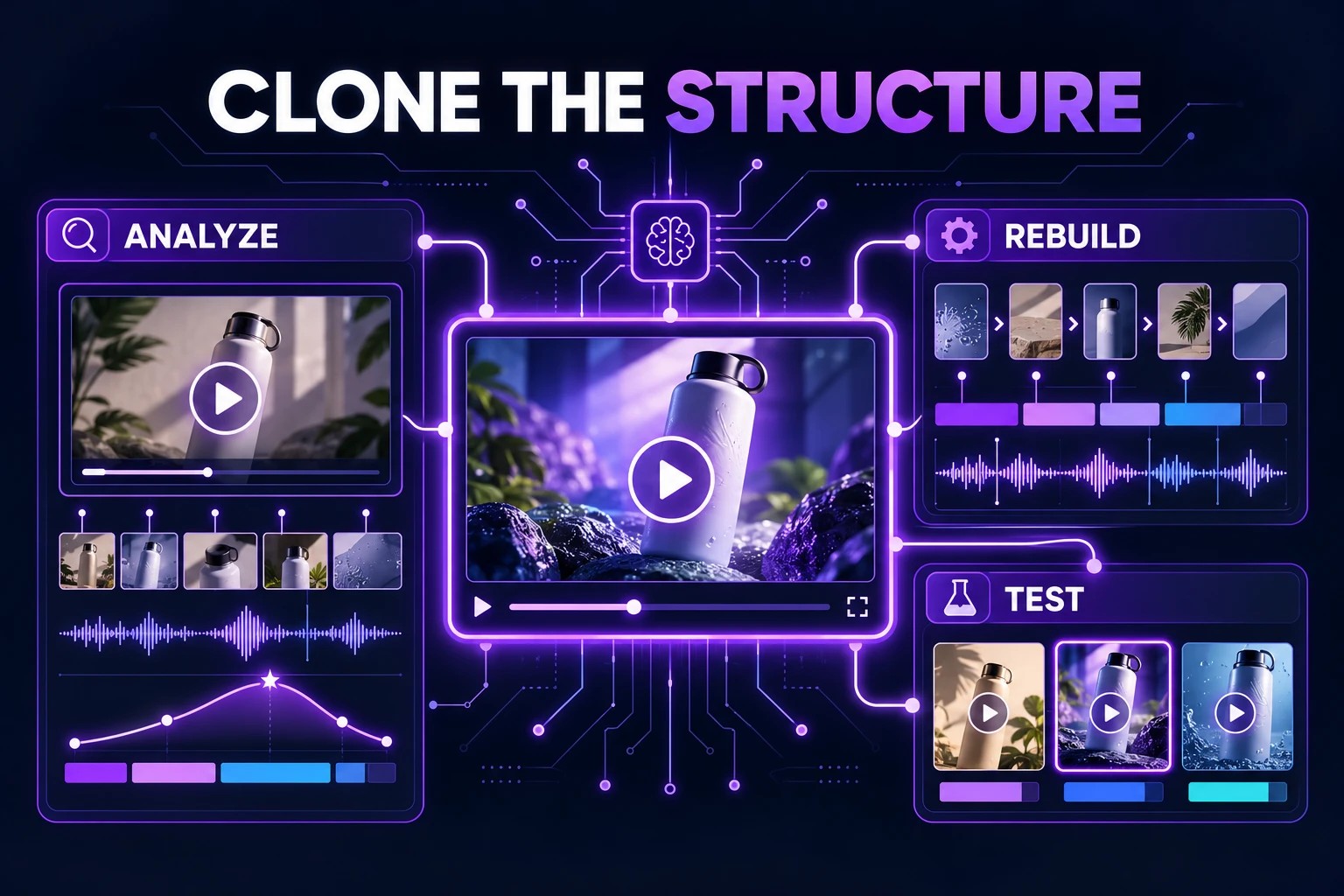
How to Analyze a Video Ad Shot by Shot

Summarize with
Summary
Learn how to analyze a video ad shot by shot with a teardown table, a worked ecommerce example, and a framework for turning observations into tests. Build your brief.
By adsturbo.ai | Published 2026-11-16 | Updated 2026-11-16
Learning how to analyze a video ad shot by shot means separating what appears on screen from what you think it accomplishes. Log each shot’s timing, visuals, words, camera angle, and purpose. Then turn those observations into a specific creative hypothesis—not a claim that a competitor’s ad must be profitable.
This guide introduces an Observation → Interpretation → Test framework, a reusable teardown template, and an illustrative ecommerce example.
What is a shot-by-shot video ad breakdown?
A shot-by-shot video ad breakdown is a time-coded record of an ad’s visual sequence, audio, messaging, and persuasive structure. Its purpose is to explain how the ad builds its argument, rather than merely transcribe the script. Each row should document something visible or audible before assigning an intended function.
For this worksheet, define a shot as a continuous visual segment between edits. Track an overlay change separately when it changes the message without changing the underlying shot.
Use these labels consistently:
- Shot: A distinct visual segment.
- Beat: A change in the argument, such as problem to demonstration.
- Structure: The sequence of beats across the whole ad.
Several shots can serve one beat. One continuous shot can contain several beats.
As a broader review lens, Google’s ABCD framework identifies Attention, Branding, Connection, and Direction as principles of effective video advertising. Use those categories to ask questions, not to force every ad into identical timestamps. (support.google.com)
How do you build the teardown table?
Build one row per shot, with separate fields for evidence and interpretation. Record start and end times, describe the picture literally, and keep spoken words separate from on-screen text. This makes the breakdown useful to an editor who has not watched the original.
- Choose permitted material. Use your own footage or material you are authorized to access and analyze. Analysis does not grant reuse rights.
- Watch uninterrupted. Summarize the promise, intended audience, and requested action.
- Mark boundaries. Scrub through the video and verify each cut.
- Log picture and sound. Include dialogue, overlays, music changes, and sound effects.
- Assign purpose last. Label the intended hook, demonstration, objection handling, or CTA.
| Field | What to record |
|---|---|
| Time | Start, end, and duration |
| Visual | Subject, action, product visibility, background |
| Words | Speech and screen text in separate entries |
| Camera | Shot size, angle, movement |
| Purpose | Intended contribution to the argument |
| Confidence | Verified observation or uncertain interpretation |
How should you analyze the first three seconds?
Treat the first three seconds as a close-reading window, not a universal performance threshold. Inspect the opening frame, the first meaningful action, and the relationship between picture and words. Ask whether the viewer can identify the situation and understand why the next moment might matter.
Run three passes:
- Muted: What product, problem, or outcome is understandable from the picture and text?
- Audio only: What does the opening line promise?
- Combined: Do the channels reinforce each other or introduce competing ideas?
Record an opening as “hand pulls a tangled charging cable from a bag,” rather than “powerful hook.” The first is evidence; the second needs explanation.
Google’s creative guidance recommends tight framing and clear audio for attention, alongside intentional, relevant calls to action. Those are useful review questions, not proof that a particular opening will convert. (support.google.com)
How can an AI video analyzer help?
Use AI to draft the inventory, then review it against the source. Keep factual extraction—timestamps, visible actions, spoken words—separate from judgments about persuasion. An AI-generated description should remain a working report until you have checked the details that affect your creative decision.
In adsturbo.ai, the AI video analyzer accepts an MP4 upload or a supported video link and produces a clip-by-clip report covering shots, timing, visual notes, scripts, camera angles, and ad structure.
For a video analysis AI workflow, check:
- Whether boundaries match the actual edits.
- Whether speech and overlays are recorded separately.
- Whether product details are described accurately.
- Whether inferred intent is labeled as interpretation.
If you search for “analyze video AI,” prioritize this inspectable output over an unexplained creative score.
Review original footage first. If your own source needs resolution improvement for production, an AI video enhancer can support that separate step; enhancement is not evidence of authentic product detail.
What does a worked ecommerce teardown look like?
Consider this illustrative 15-second cable-organizer ad. It is a constructed teaching example, not a tested campaign. The table shows how to separate description from persuasion without inventing performance results.
| Time | Visual and camera | Speech / screen text | Intended purpose |
|---|---|---|---|
| 0–2s | Top-down close-up; tangled cable catches in bag | Speech: “Still digging for this?” | Establish problem |
| 2–5s | Eye-level medium shot; organizer opens | Text: “A place for every cable” | Introduce solution |
| 5–9s | Overhead close-up; cables placed in compartments | Speech: “Separate. Zip. Pack.” | Demonstrate use |
| 9–12s | Close-up; hand removes one cable | Text: “Find the one you need” | Show payoff |
| 12–15s | Static product and brand frame | Text: “Choose your organizer” | Request action |
This example contains five shots, averaging 3 seconds each: 15 divided by 5. That calculation describes pacing; it does not establish ideal pacing.
The key interpretation is that the demonstration begins at second five. A useful hypothesis is to show the organized result earlier—not simply add more cuts.
How do you turn observations into a brief and test?
Use Observation → Interpretation → Test to preserve the reasoning behind every edit. The observation must be verifiable, the interpretation must remain provisional, and the test must specify what changes. This prevents a teardown from becoming a collection of preferences disguised as findings.
For the organizer example:
- Observation: The organized interior first appears at second two.
- Interpretation: A result-first opening might communicate the benefit sooner.
- Test: Replace only the opening with the organized interior, keeping the body and CTA unchanged.
Then write a compact creative brief:
| Brief field | Example |
|---|---|
| Audience | Travelers carrying multiple charging cables |
| Single promise | Keep cables separated and accessible |
| Required proof | Continuous view of selecting one cable |
| Opening variants | Problem-first versus result-first |
| Fixed elements | Body, offer, landing page, CTA |
| Decision rule | Compare against the campaign’s primary outcome |
Choose the success metric and testing conditions before launch. Use short video ad variants to organize distinct hypotheses and a product-benefit script workflow to translate each into original copy.
Frequently asked questions
How many ads should you analyze?
Start with one complete teardown. Add others to investigate a specific question, such as how different brands demonstrate the same benefit. Avoid treating repetition across a small sample as proof of effectiveness.
Can you identify a winning ad from its structure?
Structure alone is insufficient evidence. Label your output a creative hypothesis unless campaign results support a stronger conclusion. A persuasive-looking sequence is not a verified business outcome.
Should you recreate a competitor’s sequence?
Extract the principle, not the assets or distinctive expression. “Demonstrate the benefit before explaining it” is a useful brief direction. Copying another brand’s footage, wording, or testimonial is not the same exercise.
What should the final deliverable contain?
Deliver the time-coded table, a short structural summary, uncertainties requiring review, and one prioritized test. A useful breakdown ends with an actionable decision—not an unsupported score.