Short Video Ad Variants for Ecommerce Products: A Five-Story Matrix


Summarize with
Summary
Build short video ad variants for ecommerce products with five distinct story angles, a reusable shot list, and a controlled testing plan. Start with one product.
By adsturbo.ai | Published 2026-11-16 | Updated 2026-11-16
Short video ad variants for ecommerce products should tell different stories, not merely swap captions on the same footage. A seller with one product can build five testable ads by changing the reason a shopper should care: a problem, a demonstration, a detail, a routine, or a buying objection. The matrix below turns those angles into scripts while keeping the offer and product facts consistent.
What makes an ad variant meaningfully different?
A meaningful variant changes the argument of the ad. A new font or soundtrack may change its appearance, but a problem-first opening and a demonstration-first opening give shoppers different reasons to keep watching. TikTok’s small-business storytelling guidance likewise starts with one product and explores different ways to present it. (tiktok.com)
This distinction matters when reviewing results. If one edit changes the opening, price, presenter, and landing page, a better outcome cannot be attributed to any single choice. Begin with five concept variants to discover which story merits attention. Then make narrower versions of the promising concept to test its hook, proof shot, or CTA. The first round explores; the second isolates.
How can one product support five distinct stories?
Start with a concrete example: a compact, adjustable laptop stand. Assume its product page confirms the adjustment mechanism and shows how it folds. Do not add claims about posture, dimensions, or durability unless the seller can substantiate them.
The matrix is an original planning framework, not a report of five ads run or measured. Each row changes the opening question and sequence while drawing from the same verified product assets.
| Story angle | Opening shot or line | Middle sequence | What the seller learns |
|---|---|---|---|
| Problem → solution | A cluttered desk makes space for a laptop. | Place the stand, then show the new setup. | Does the desk problem attract the intended shopper? |
| Show it working | A hand adjusts the stand immediately. | Show adjustment and folding in clear, continuous shots. | Is seeing the mechanism more persuasive than hearing a pitch? |
| Detail-led | Close-up of the stand’s adjustment points. | Move from construction details to the full product in use. | Do product details prompt further interest? |
| Routine-led | “From work setup to packed bag.” | Show setup, use, folding, and packing. | Does the use occasion make the product easier to imagine owning? |
| Objection-led | “Will it fit into my daily setup?” | Show the stand beside the seller’s actual laptop and bag. | Is a practical buying question holding shoppers back? |
These are story hypotheses, not promises that one angle will win. A detail-led ad, for example, needs legible close-ups; an objection-led ad needs footage that genuinely answers the question. If the available images cannot support an angle, replace it rather than manufacturing evidence.
Which assets should you prepare before editing?
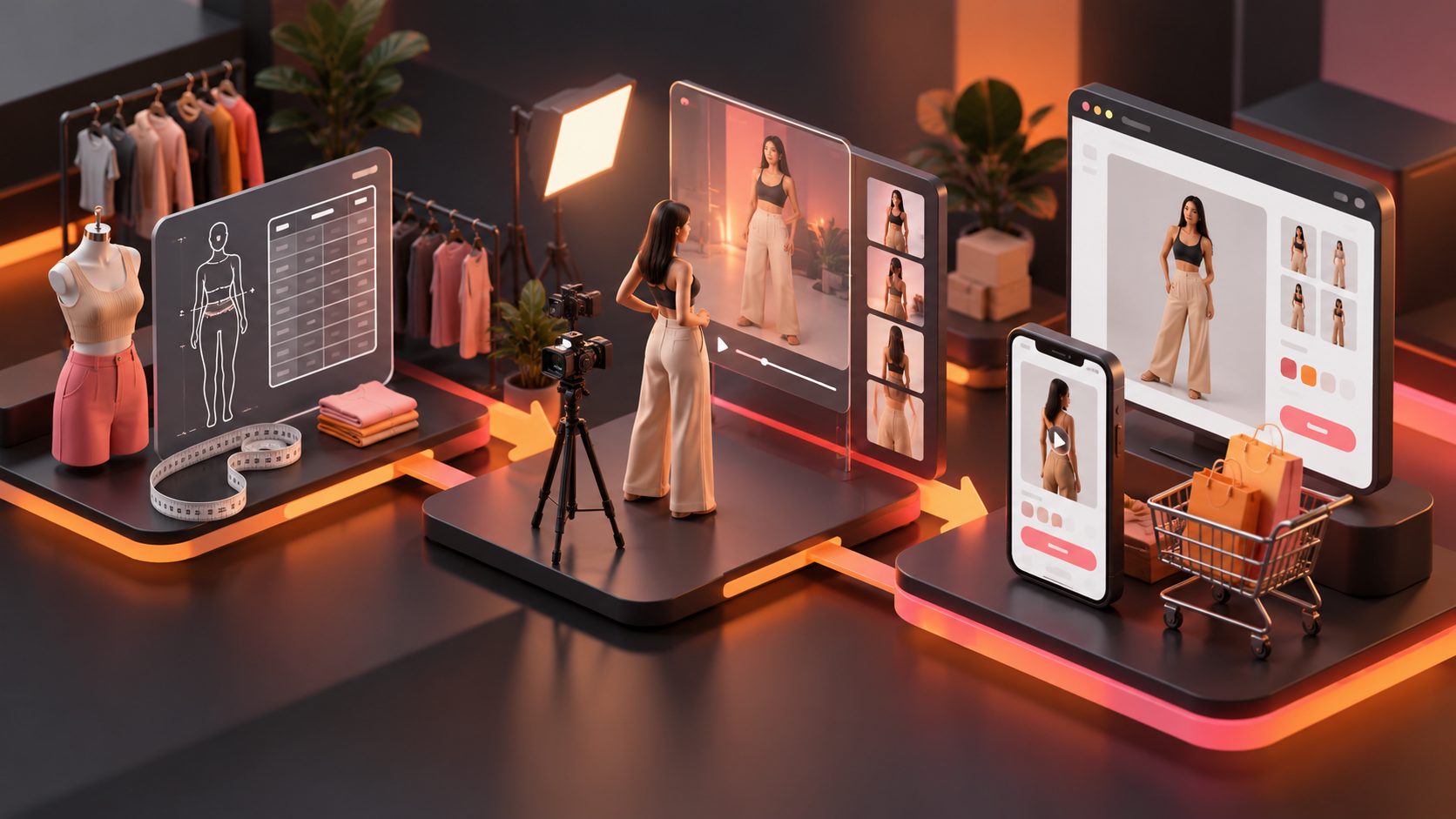
Prepare one small asset kit that can support all five stories: a clear product image, a full-view shot, close-ups of relevant details, and footage of the product being used. Add a verified fact sheet containing the product name, supported claims, offer terms, and the destination page. This keeps the scripts varied without letting product facts drift.
For the laptop stand, label clips by what they show: adjust, fold, desk-setup, and bag-pack. A close-up can serve the detail story and the demonstration story, but the surrounding sequence should change. If footage is missing, plan a short pickup shot rather than letting an image imply an action it cannot prove. The same principle applies when building product-photo-to-video ads: the source image must clearly represent the item being sold.
How do you turn the matrix into five short scripts?
Write the claim and action first; add polish later. Give each concept one opening, two or three supporting beats, and one clear next step. For a proposed 15-second edit, the timing below is an editing template—not a platform requirement or a proven optimal length.
- Seconds 0–3: Open with the story’s question. Show the desk problem, the adjustment action, a product detail, a routine moment, or an objection.
- Seconds 3–11: Supply visual evidence. Demonstrate only what the source material actually shows. Keep on-screen text tied to the visible action.
- Seconds 11–15: Resolve and direct. Show the full product and use a consistent CTA, such as “See the product details.”
Keep the same product, factual claims, offer, CTA, and destination across the first batch. Change the narrative order and supporting footage. AdsTurbo’s Product Video workflow can use a JPG or PNG product image to generate a short UGC-style product ad; its Ad Clone workflow can analyze a reference ad’s structure to create new brand variants. Treat either output as a draft to check against the fact sheet, not as proof of a product claim.
For a larger production batch, the camera-free product video workflow covers asset preparation and repeatable editing. If older source footage looks soft, an AI video enhancer can help prepare it for review; check the resulting image for inaccurate product details before publishing.
How should you test and interpret the variants?
Run the five stories as an exploratory test, then isolate one variable in the next round. Before launch, choose a primary business outcome—such as purchases or qualified product-page visits—and record the budget, audience, placement, offer, and destination used for each ad. Avoid declaring a winner from a handful of interactions.
Review results in two layers. First, ask whether viewers stayed long enough to encounter the product. Then ask whether that attention led to the chosen business outcome. A striking opening that attracts views but not relevant shoppers is not necessarily the strongest ad. Log the story angle alongside each file so the learning survives a round of exports; a video ad asset naming system can keep those records readable.
If the demonstration story looks promising, preserve its main sequence and test two openings against it. If an objection-led story draws attention but its question remains unresolved, improve the evidence shot before changing the CTA. Do not treat a creative result as a universal rule: the useful finding is which question your shoppers responded to under the conditions you tested.
Frequently asked questions
Are five different hooks enough to make five variants?
Not for this first matrix. Five hooks on the same body test openings; five story angles test different reasons to consider the product. Both are useful, but label them separately so the results answer the question you intended to ask.
Should every version use the same CTA?
Yes, during the initial story-angle comparison. Holding the CTA and destination steady makes differences easier to interpret. Test alternative CTAs after you have identified a story worth refining.
Can I make these ads from one product photo?
A photo can start a draft, but some stories require visual proof. A demonstration or objection-led ad is stronger when it includes real footage of the relevant action or fit. Choose angles your assets can support honestly.
What if none of the five performs well?
Check the basics before producing more variations: whether the product appears clearly, the opening reaches the intended shopper, the claims match the listing, and the destination answers the ad’s promise. Then revise one weakness at a time.